Eucommia Bark
- Chinese
- 杜仲
- Pinyin
- Du Zhong
- Latin
- Cortex Eucommiae
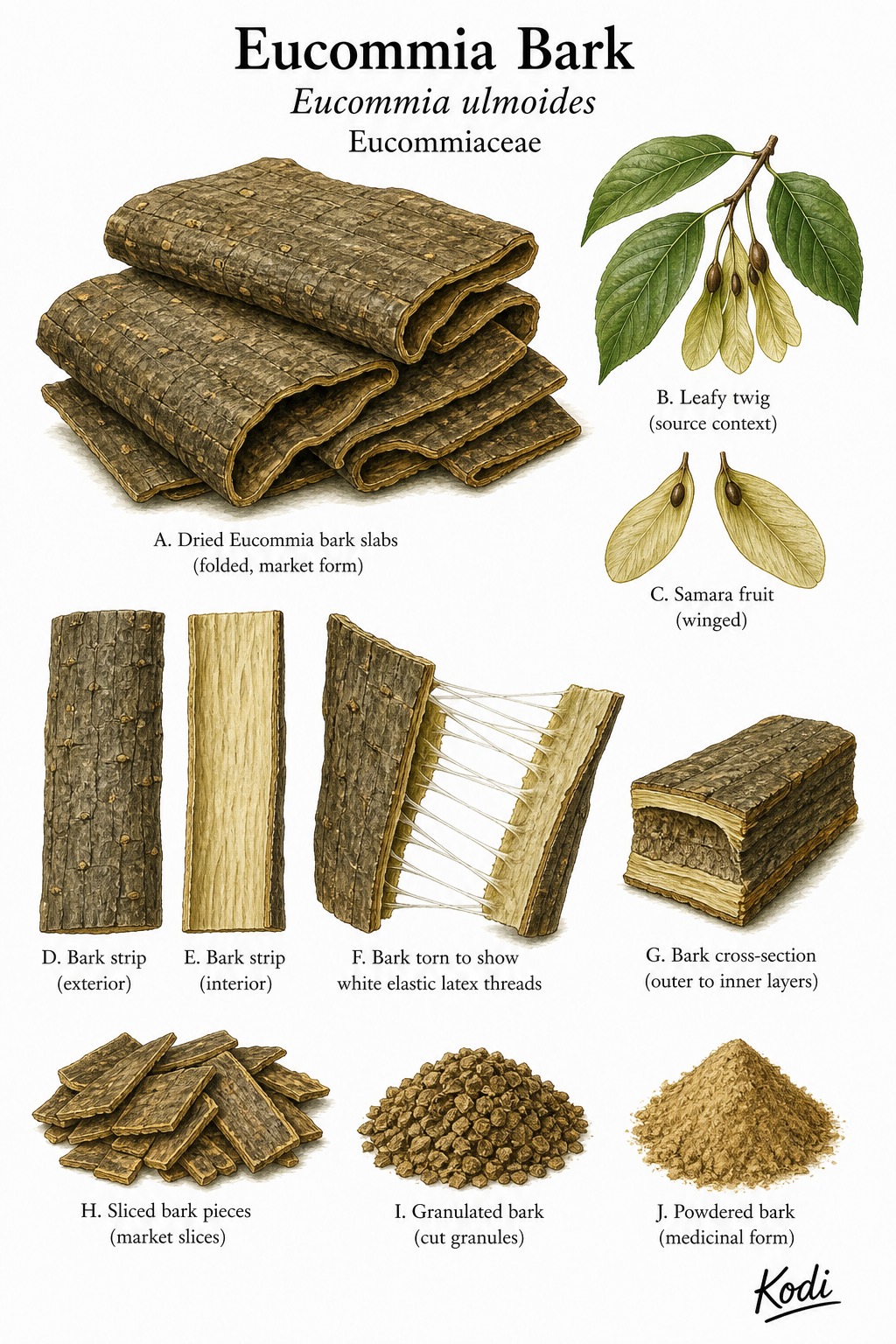
Known in TCM as Du Zhong (杜仲), this sweet and slightly acrid, warm herb enters the Kidney and Liver. Traditionally, it tonifies the Liver and Kidney and strengthens tendons, bones, and the low back - Du Zhong is one of the classic herbs for lumbar soreness, weak knees, and fatigue rooted in deficiency, most often applied for low back pain, threatened miscarriage, and hypertension. Modern research has identified Lignans among its active constituents.
Part used: Bark
Also Known As
Latin: Cortex Eucommiae | Pinyin: Du Zhong | Chinese: 杜仲
TCM Properties
- Taste
- sweet, slightly acrid
- Temperature
- warm
- Channels
- Kidney, Liver
Traditional Use
Primary Actions
- Tonifies the Liver and Kidney and strengthens tendons, bones, and the low back - Du Zhong is one of the classic herbs for lumbar soreness, weak knees, and fatigue rooted in deficiency.
- Calms the fetus and steadies pregnancy - traditional use includes threatened miscarriage with back pain, restless fetus, and weak constitutional support.
- Gently supports yang and structural resilience - unlike harsher hot tonics, Du Zhong is valued for being steady, nourishing, and relatively moderate.
Secondary Actions
- Du Zhong is a foundational Kidney-Liver tonic in orthopedic and fertility practice because it addresses both weakness and instability.
- Its role is often restorative rather than immediately analgesic, so it is usually combined with moving or damp-dispelling herbs when pain is pronounced.
Classic Formulas
- Du Huo Ji Sheng Tang - classic chronic bi formula that relies on Du Zhong to strengthen the underlying Liver-Kidney deficiency.
- Shou Tai Wan - fetus-calming formula in which Du Zhong supports pregnancy when the lower back is weak and the fetus is insecure.
- Kidney-deficiency formulas for soreness and weakness often pair Du Zhong with Xu Duan, Gou Ji, or Sang Ji Sheng.
Classical References
- Traditional herbology consistently presents Du Zhong as a sweet warm bark that enters the Liver and Kidney to strengthen the back, knees, and fetus.
- Its combination of tonifying and fetus-calming actions makes it unusually versatile compared with many other Kidney tonics.
- Classical texts value it for weakness and instability, not for acute excess pain patterns by themselves.
Modern Research
Active Compounds
- Lignans - the most discussed Eucommia bioactive class in musculoskeletal and vascular research
- Geniposidic acid and related iridoids - major marker compounds in Eucommia bark
- Chlorogenic acid and related phenolic acids - contributors to antioxidant and metabolic studies
- Flavonoids and polysaccharide-associated fractions - supportive components in broader pharmacologic investigation
Studied Effects
- A 2019 review highlighted Du Zhong's longstanding use in musculoskeletal weakness, blood-pressure support, and anti-inflammatory applications while summarizing growing laboratory evidence (PMID 30857406).
- A clinical study of standardized Eucommia bark extract showed a good short-term safety profile in mild hypertension and suggested possible cardiovascular relevance, though stronger trials are still needed (PMID 22214253).
- A 2024 review emphasized that bark remains the core medicinal part of Eucommia ulmoides even as research expands into leaves, flowers, and seeds (PMID 38545153).
PubMed References
- Ethnobotany, Phytochemistry and Pharmacological Properties of Eucommia ulmoides: A Review (2019)
- A clinical trial testing the safety and efficacy of a standardized Eucommia ulmoides Oliver bark extract to treat hypertension (2011)
- Biological properties and potential application of extracts and compounds from different medicinal parts (bark, leaf, staminate flower, and seed) of Eucommia ulmoides: A review (2024)
Safety & Interactions
Contraindications
- Use only with professional guidance when threatened miscarriage, back pain, or bleeding may reflect an emergency rather than a simple deficiency pattern
Cautions
- Du Zhong is generally gentle, but therapeutic use in pregnancy should still involve clinician oversight.
- Patients taking antihypertensive medicines should monitor for additive effects if using concentrated extracts.
- MSK page not found - drug interaction data not available from Memorial Sloan Kettering integrative medicine database
Drug Interactions
- Antihypertensive medications - theoretical additive effect
Conditions
- Low Back Pain Traditional ★★★★☆ JSON
- Threatened Miscarriage Traditional ★★★★☆ JSON
- Hypertension Research ★★☆☆☆ JSON
- Frequent Urination Traditional ★★☆☆☆ JSON
Frequently Asked Questions
What is Eucommia Bark used for?
Eucommia Bark is traditionally used to Tonifies the Liver and Kidney and strengthens tendons, bones, and the low back - Du Zhong is one of the classic herbs for lumbar soreness, weak knees, and fatigue rooted in deficiency., Calms the fetus and steadies pregnancy - traditional use includes threatened miscarriage with back pain, restless fetus, and weak constitutional support., Gently supports yang and structural resilience - unlike harsher hot tonics, Du Zhong is valued for being steady, nourishing, and relatively moderate.. Research has investigated its effects on: A 2019 review highlighted Du Zhong's longstanding use in musculoskeletal weakness, blood-pressure support, and anti-inflammatory applications while summarizing growing laboratory evidence (PMID 30857406).; A clinical study of standardized Eucommia bark extract showed a good short-term safety profile in mild hypertension and suggested possible cardiovascular relevance, though stronger trials are still needed (PMID 22214253)..
What are other names for Eucommia Bark?
Eucommia Bark is also known as Eucommia. In TCM: 杜仲 (Du Zhong); Cortex Eucommiae.
Is Eucommia Bark safe during pregnancy?
The safety of Eucommia Bark during pregnancy has not been established. Consult a qualified healthcare provider before use.
What are the contraindications for Eucommia Bark?
Eucommia Bark should not be used in: Use only with professional guidance when threatened miscarriage, back pain, or bleeding may reflect an emergency rather than a simple deficiency pattern. Consult a qualified practitioner before use.
Does Eucommia Bark interact with any medications?
Eucommia Bark may interact with: Antihypertensive medications - theoretical additive effect. Always inform your healthcare provider of any herbal supplements you are taking.