Placenta Powder
- Chinese
- 胎盘粉
- Pinyin
- Tai Pan Fen
- Latin
- Pulvis Embryo
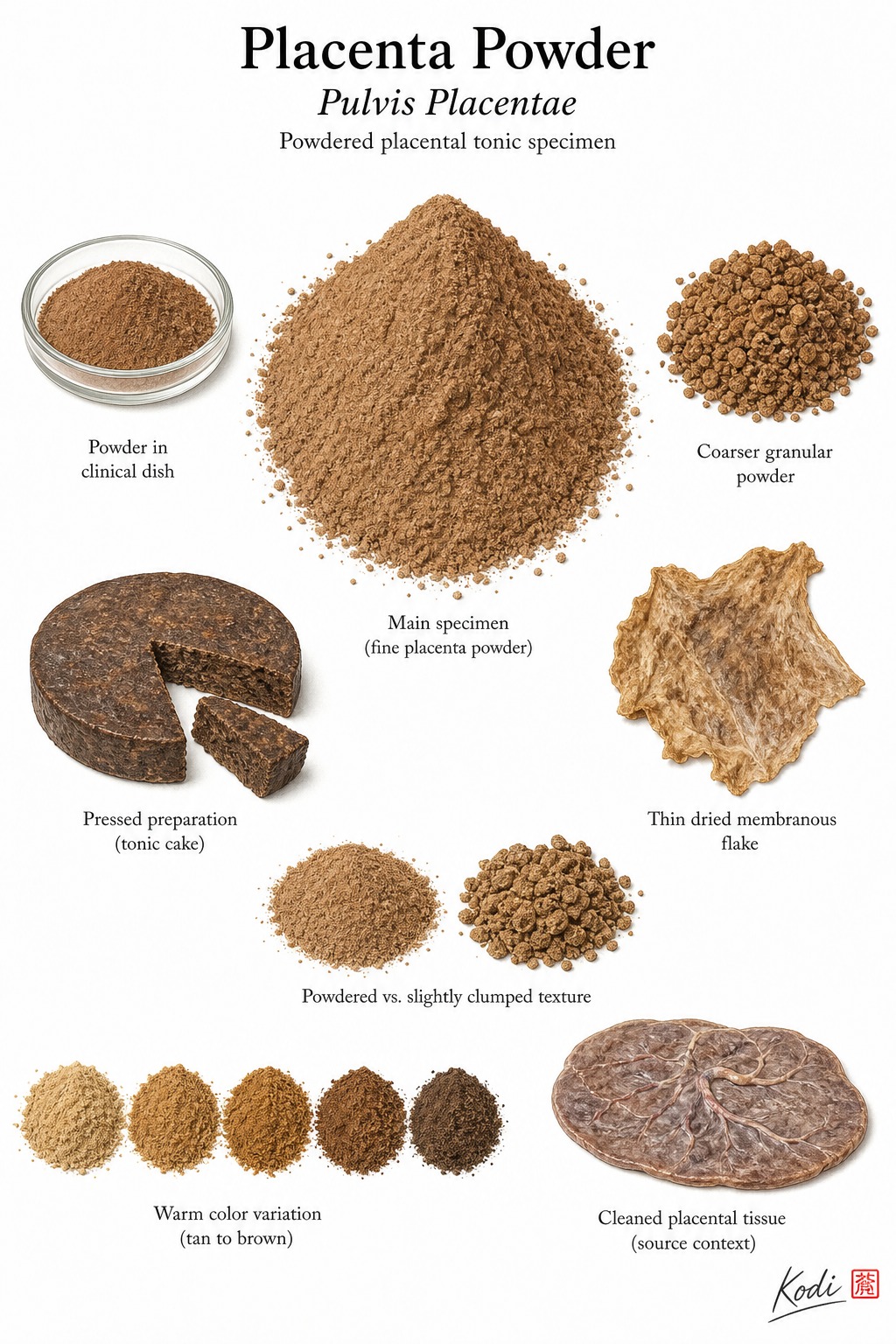
Known in TCM as Tai Pan Fen (胎盘粉), this sweet and salty, warm herb enters the Lung, Kidney, and Liver. Traditionally, it tonifies essence, qi, and blood - Tai Pan Fen appears to refer to a powdered tissue tonic used for profound deficiency patterns marked by fatigue, wasting, weak constitution, and reproductive depletion, most often applied for fatigue, infertility, and asthma. Modern research has identified Protein among its active constituents.
Part used: Powder
TCM Properties
- Taste
- sweet, salty
- Temperature
- warm
- Channels
- Lung, Kidney, Liver
Traditional Use
Primary Actions
- Tonifies essence, qi, and blood - Tai Pan Fen appears to refer to a powdered tissue tonic used for profound deficiency patterns marked by fatigue, wasting, weak constitution, and reproductive depletion.
- Supports chronic deficiency-type cough and wheezing - by analogy with Zi He Che style placenta medicinals, it is used historically for long-standing weakness of the Lung and Kidney with asthma or consumptive cough.
- Assists fertility and recovery after deep depletion - traditional use centers on weakness rather than acute disease, especially when infertility, impotence, or constitutional exhaustion reflect a deficient root.
Secondary Actions
- This is not a standard high-frequency modern herbal product, and the catalog entry most likely refers to powdered processed placenta material closely related to Zi He Che rather than to a distinct mainstream single-herb monograph.
- Because it is a human- or animal-tissue style substance rather than an ordinary dried plant, sourcing, legality, ethics, and pathogen control are central concerns.
Classic Formulas
- No major canonical formula is widely indexed under Tai Pan Fen as a separate classical crude herb, which supports the interpretation that this is a dosage-form or trade-style entry rather than an independent mainstream monograph.
- Its clinical logic parallels placenta-based tonic strategies used for deep deficiency, chronic cough, infertility, and post-illness collapse.
- Traditional pairings by analogy include Lung-Kidney tonics and blood-jing restoratives rather than exterior-releasing or heat-clearing formulas.
Classical References
- IMPORT NOTE: despite the awkward English label, Tai Pan Fen most plausibly denotes placenta powder rather than a stand-alone fetal crude drug in common modern TCM usage.
- Historical placenta-based medicinals are grouped among blood-and-flesh substances used to tonify what is profoundly depleted, not to treat ordinary self-limited symptoms.
- Because the identity is nonstandard and quality control is critical, this entry is framed conservatively.
Modern Research
Active Compounds
- Protein and peptide fractions - the broad nutrient and signaling component most often cited in placenta-derived products
- Lipids, nucleic acids, and polysaccharide fractions - frequently described in placenta-powder commercial literature
- Hormone- and growth-factor-like biologic material - one reason regulatory and safety concerns are substantial
- Mineral and amino acid content - part of the traditional rationale for tonic use, though not proof of clinical efficacy
Studied Effects
- Direct indexed research on Tai Pan Fen as a standardized classical medicinal powder is sparse, and most modern commercial claims rely on extrapolation from broader placenta-derived products rather than robust clinical trials.
- Because placenta-based preparations differ enormously by species, screening, processing, and legality, composition cannot be assumed consistent across products.
- The modern evidence base is too thin and heterogeneous to support strong disease-specific claims for self-use.
Safety & Interactions
Contraindications
- Unverified human- or animal-tissue sources
- Heat, fire, or damp-heat excess patterns rather than deep deficiency
- Pregnancy or fertility treatment without direct clinician supervision
- Any situation in which infection-control or regulatory provenance cannot be confirmed
Cautions
- Placenta-derived materials carry ethical, legal, sourcing, infectious, and contamination concerns that do not apply to ordinary dried botanical herbs.
- Commercial placenta powders vary widely by species and processing, and some marketed products are supplements rather than traditional medicinal materials.
- This is not appropriate for unsupervised self-treatment.
Conditions
- Fatigue Traditional ★★★☆☆ JSON
- Infertility Traditional ★★★☆☆ JSON
- Asthma Traditional ★★☆☆☆ JSON
- Tuberculosis Traditional ★★☆☆☆ JSON
Frequently Asked Questions
What is Placenta Powder used for?
Placenta Powder is traditionally used to Tonifies essence, qi, and blood - Tai Pan Fen appears to refer to a powdered tissue tonic used for profound deficiency patterns marked by fatigue, wasting, weak constitution, and reproductive depletion., Supports chronic deficiency-type cough and wheezing - by analogy with Zi He Che style placenta medicinals, it is used historically for long-standing weakness of the Lung and Kidney with asthma or consumptive cough., Assists fertility and recovery after deep depletion - traditional use centers on weakness rather than acute disease, especially when infertility, impotence, or constitutional exhaustion reflect a deficient root.. Research has investigated its effects on: Direct indexed research on Tai Pan Fen as a standardized classical medicinal powder is sparse, and most modern commercial claims rely on extrapolation from broader placenta-derived products rather than robust clinical trials.; Because placenta-based preparations differ enormously by species, screening, processing, and legality, composition cannot be assumed consistent across products..
Is Placenta Powder safe during pregnancy?
The safety of Placenta Powder during pregnancy has not been established. Consult a qualified healthcare provider before use.
What are the contraindications for Placenta Powder?
Placenta Powder should not be used in: Unverified human- or animal-tissue sources; Heat, fire, or damp-heat excess patterns rather than deep deficiency; Pregnancy or fertility treatment without direct clinician supervision; Any situation in which infection-control or regulatory provenance cannot be confirmed. Consult a qualified practitioner before use.