Figwort Root
- Chinese
- 玄参
- Pinyin
- Xuan Shen
- Latin
- Radix Scrophulariae
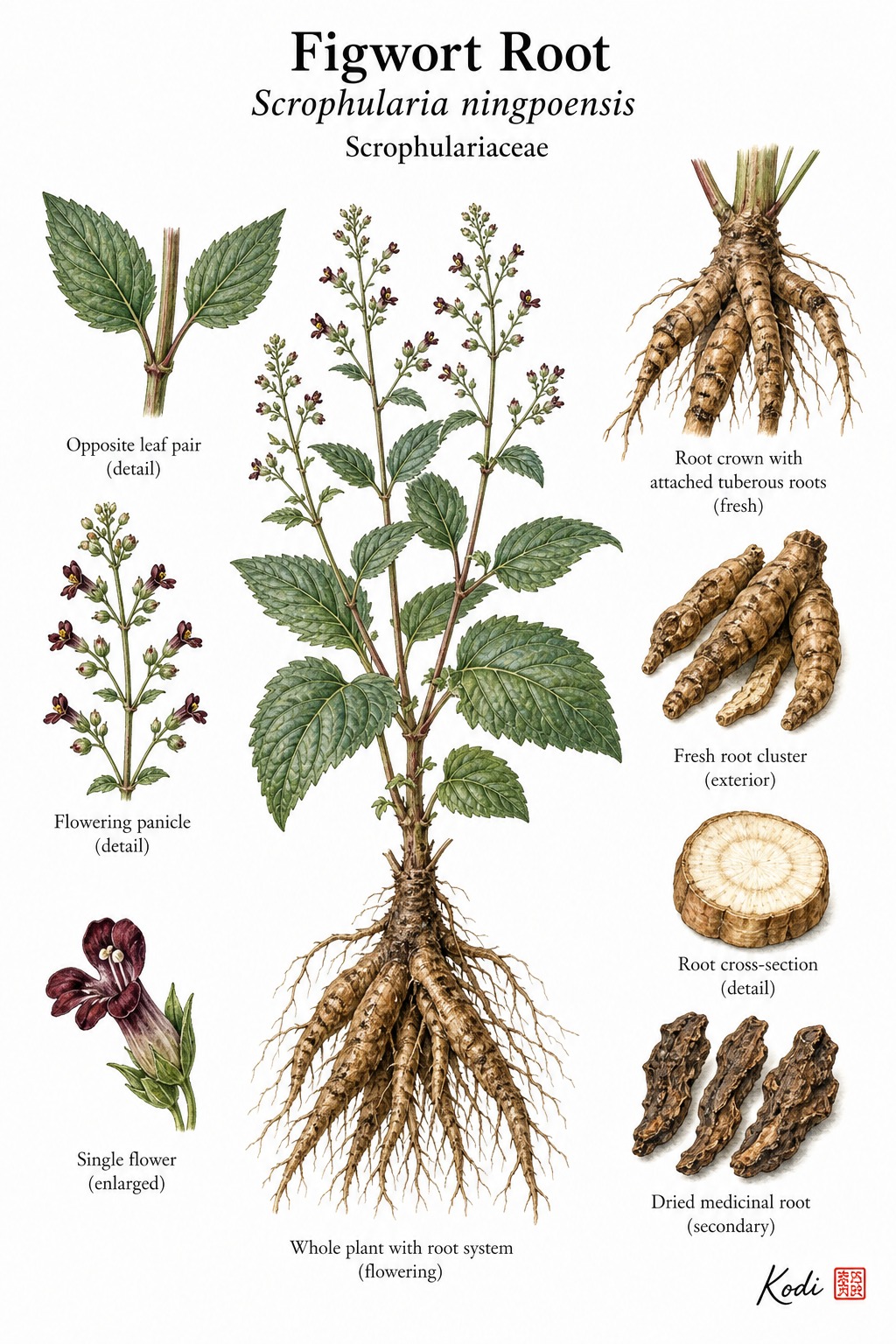
Known in TCM as Xuan Shen (玄参), this salty and sweet and bitter, cold herb enters the Kidney, Lung, and Stomach. Traditionally, it clears heat and cools the blood - Xuan Shen is a major herb for severe heat with sore throat, fever, toxicity, or blood-level heat that dries fluids and agitates the system, most often applied for sore throat, scrofula, and thyroid nodule. Modern research has identified Iridoid among its active constituents.
Part used: Root
Also Known As
Latin: Radix Scrophulariae | Pinyin: Xuan Shen | Chinese: 玄参
TCM Properties
- Taste
- salty, sweet, bitter
- Temperature
- cold
- Channels
- Kidney, Lung, Stomach
Traditional Use
Primary Actions
- Clears heat and cools the blood - Xuan Shen is a major herb for severe heat with sore throat, fever, toxicity, or blood-level heat that dries fluids and agitates the system.
- Nourishes yin and generates fluids - unlike purely draining cold herbs, it replenishes depleted fluids while clearing heat, making it important in warm-disease, dryness, and post-febrile depletion patterns.
- Softens hardness and dissipates nodules - it is classically used for scrofula, swollen glands, thyroid-region masses, and hard heat-toxin accumulations.
Secondary Actions
- Xuan Shen is one of the better examples of a cold herb that both clears excess and enriches what has been scorched by heat.
- Its salty-softening quality distinguishes it from many other yin-nourishing herbs and explains its repeated use in nodules and throat swellings.
Classic Formulas
- Qing Ying Tang - warm-disease formula where Xuan Shen nourishes yin while clearing nutritive-level heat.
- Zeng Ye Tang - classic constipation-from-dryness formula pairing Xuan Shen with Sheng Di Huang and Mai Men Dong.
- Xiao Luo Wan - hallmark nodule and scrofula formula combining Xuan Shen with Mu Li and Zhe Bei Mu.
Classical References
- Traditional herbology describes Xuan Shen as salty, sweet, bitter, and cold, entering the Kidney, Lung, and Stomach to clear heat, cool blood, nourish yin, and soften hardness.
- Its classical throat reputation is strong enough that it appears repeatedly in formulas for painful swelling, loss of voice, and toxic heat in the upper burner.
- The herb is also famous for the admonition against combining it with Li Lu in older incompatibility traditions.
Modern Research
Active Compounds
- Iridoid glycosides such as harpagide and harpagoside-related compounds - key Scrophularia markers
- Phenylpropanoid glycosides - major anti-inflammatory and antioxidant constituents
- Polysaccharides - studied for immunomodulatory and anti-inflammatory effects
- Phenolic acids and flavonoids - supportive compounds in broader Scrophularia pharmacology
Studied Effects
- A 2021 review summarized the pharmacology, phytochemistry, and traditional uses of Scrophularia ningpoensis, supporting Xuan Shen's importance in anti-inflammatory, immunologic, and heat-clearing research (PMID 33338592).
- Polysaccharides from Scrophularia ningpoensis showed antioxidant and anti-inflammatory activity in experimental work, providing a plausible modern correlate for the herb's yin-protecting and toxin-clearing reputation (PMID 33381217).
- A 2021 metabonomics and network-pharmacology study explored the effects of Radix Scrophulariae on hyperthyroidism, which is relevant to its traditional use for thyroid-region swelling and nodules (PMID 34650432).
PubMed References
- Pharmacology, phytochemistry, and traditional uses of Scrophularia ningpoensis Hemsl (2021)
- Polysaccharides of Scrophularia ningpoensis Hemsl.: Extraction, Antioxidant, and Anti-Inflammatory Evaluation (2020)
- Effects of Radix Scrophulariae on Hyperthyroidism Assessed by Metabonomics and Network Pharmacology (2021)
Safety & Interactions
Contraindications
- Spleen-Stomach deficiency cold with loose stools
- Chronic diarrhea without clear heat or dryness
- Use in formulas that intentionally avoid the traditional incompatibility with Li Lu
Cautions
- Xuan Shen is deeply cold and can burden weak digestion if used indiscriminately.
- Because of the old classical incompatibility tradition with Li Lu, formula context matters.
- MSK page not found - drug interaction data not available from Memorial Sloan Kettering integrative medicine database
Drug Interactions
- Antithyroid or thyroid-active treatment - theoretical overlap in patients using concentrated extracts for thyroid-related self-care
Conditions
- Sore Throat Traditional ★★★★☆ JSON
- Scrofula Traditional ★★★★☆ JSON
- Thyroid Nodule Traditional ★★★☆☆ JSON
- Constipation Traditional ★★☆☆☆ JSON
Frequently Asked Questions
What is Figwort Root used for?
Figwort Root is traditionally used to Clears heat and cools the blood - Xuan Shen is a major herb for severe heat with sore throat, fever, toxicity, or blood-level heat that dries fluids and agitates the system., Nourishes yin and generates fluids - unlike purely draining cold herbs, it replenishes depleted fluids while clearing heat, making it important in warm-disease, dryness, and post-febrile depletion patterns., Softens hardness and dissipates nodules - it is classically used for scrofula, swollen glands, thyroid-region masses, and hard heat-toxin accumulations.. Research has investigated its effects on: A 2021 review summarized the pharmacology, phytochemistry, and traditional uses of Scrophularia ningpoensis, supporting Xuan Shen's importance in anti-inflammatory, immunologic, and heat-clearing research (PMID 33338592).; Polysaccharides from Scrophularia ningpoensis showed antioxidant and anti-inflammatory activity in experimental work, providing a plausible modern correlate for the herb's yin-protecting and toxin-clearing reputation (PMID 33381217)..
What are other names for Figwort Root?
Figwort Root is also known as Scrophularia. In TCM: 玄参 (Xuan Shen); Radix Scrophulariae.
Is Figwort Root safe during pregnancy?
The safety of Figwort Root during pregnancy has not been established. Consult a qualified healthcare provider before use.
What are the contraindications for Figwort Root?
Figwort Root should not be used in: Spleen-Stomach deficiency cold with loose stools; Chronic diarrhea without clear heat or dryness; Use in formulas that intentionally avoid the traditional incompatibility with Li Lu. Consult a qualified practitioner before use.
Does Figwort Root interact with any medications?
Figwort Root may interact with: Antithyroid or thyroid-active treatment - theoretical overlap in patients using concentrated extracts for thyroid-related self-care. Always inform your healthcare provider of any herbal supplements you are taking.