Finger Citron
- Chinese
- 佛手
- Pinyin
- Fo Shou
- Latin
- Fructus Citri Sarcodactylis
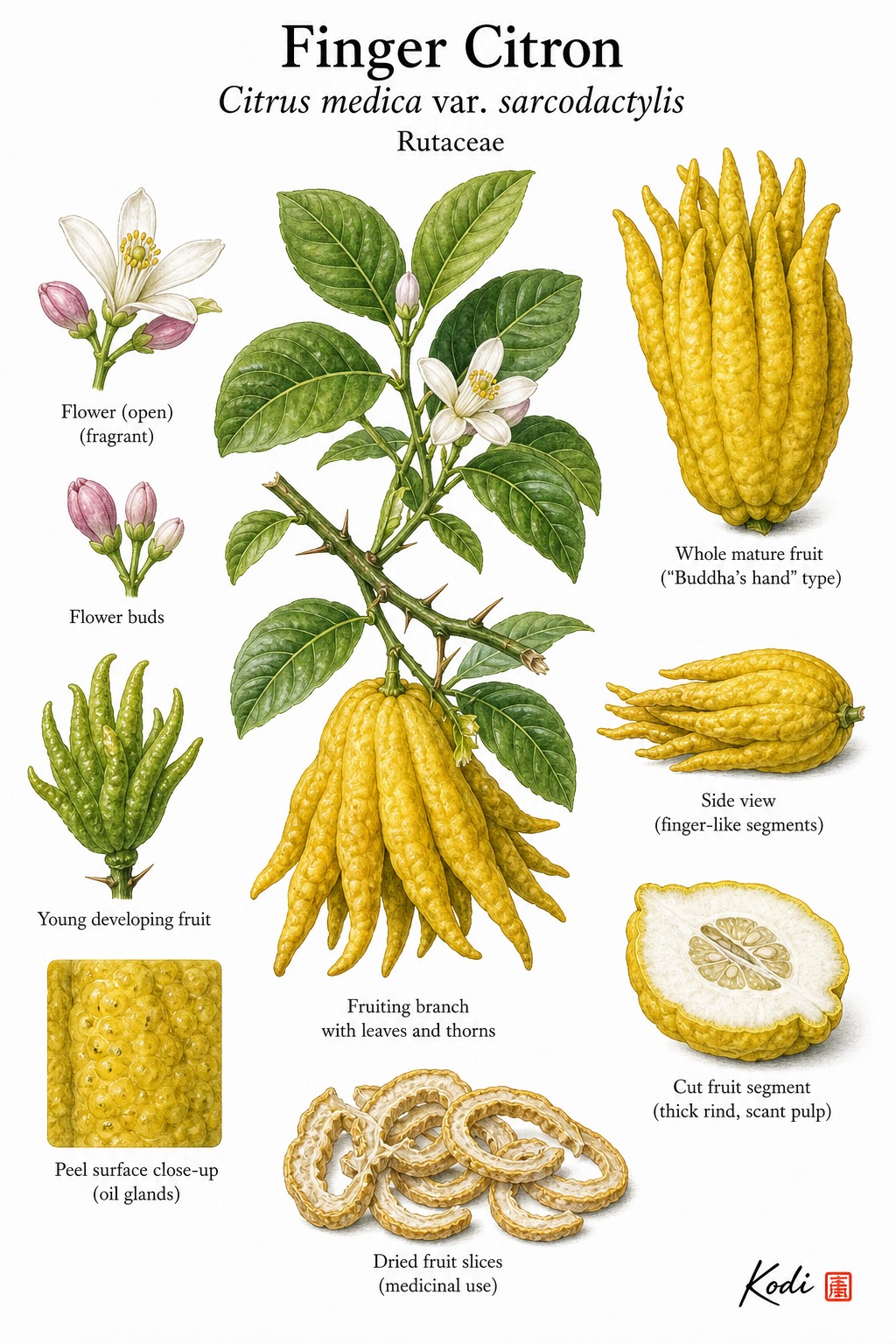
Known in TCM as Fo Shou (佛手), this acrid and bitter and sour, warm herb enters the Liver, Lung, Spleen, and Stomach. Traditionally, it soothes Liver qi and relieves constraint - Fo Shou is one of the classic citrus fruits for chest, flank, and hypochondriac distention associated with emotional or digestive stagnation, most often applied for hypochondriac pain, indigestion, and nausea. Modern research has identified Coumarins among its active constituents.
Part used: Fruit
Also Known As
Latin: Fructus Citri Sarcodactylis | Pinyin: Fo Shou | Chinese: 佛手
TCM Properties
- Taste
- acrid, bitter, sour
- Temperature
- warm
- Channels
- Liver, Lung, Spleen, Stomach
Traditional Use
Primary Actions
- Soothes Liver qi and relieves constraint - Fo Shou is one of the classic citrus fruits for chest, flank, and hypochondriac distention associated with emotional or digestive stagnation.
- Harmonizes the Stomach and alleviates pain - it is used for nausea, poor appetite, epigastric fullness, and abdominal discomfort when qi is not moving smoothly.
- Transforms phlegm and benefits the Lung - compared with more purely digestive citrus herbs, Fo Shou retains a useful role when qi stagnation and phlegm cause cough, chest oppression, or a blocked breathing sensation.
Secondary Actions
- Fo Shou overlaps with Xiang Yuan, but traditional comparisons often describe Fo Shou as somewhat more Liver-Stomach and mood-constraint oriented while Xiang Yuan leans more toward Lung-Spleen and phlegm.
- Because it is aromatic and moving yet relatively gentle, Fo Shou is commonly used in formulas for mixed emotional-digestive presentations.
Classic Formulas
- Fo Shou with Chai Hu, Xiang Fu, or Yu Jin - common Liver-qi-regulating pairing logic for flank distention, emotional oppression, and poor appetite.
- Fo Shou with Chen Pi, Ban Xia, and Mu Xiang - middle-burner stagnation and phlegm approach for nausea and chest fullness.
- Fo Shou with Xiang Yuan and Gua Lou - traditional citrus-phlegm strategy when stagnation constrains the chest and affects breathing.
Classical References
- Traditional materia medica classify Fo Shou as acrid, bitter, sour, and warm, entering the Liver, Spleen, Stomach, and Lung to regulate qi, harmonize the middle, transform phlegm, and stop pain.
- Its name and imagery of a 'Buddha's hand' fruit helped preserve a long cultural association with fragrance, pleasant movement, and gentle emotional easing.
- Fo Shou is usually chosen for stagnation and constraint, not for clear deficiency or blazing heat.
Modern Research
Active Compounds
- Coumarins such as 6,7-dimethoxy-coumarin - among the better studied Fo Shou constituents
- Volatile terpenes and citrus aroma compounds - central to its qi-moving and digestive sensory profile
- Polysaccharides - studied for anti-inflammatory and immunomodulatory activity
- Flavonoids and phenolic compounds - part of the fruit's broader antioxidant and metabolic research interest
Studied Effects
- Finger citron extract improved glycolipid metabolism and inflammatory markers in obese rats through GLP-1 and TGR5-related signaling, supporting modern interest in digestive-metabolic applications (PMID 33854556).
- A polysaccharide isolated from Citrus medica var. sarcodactylis showed anti-inflammatory activity, providing a modern correlate for Fo Shou's traditional use in constrained, irritated patterns (PMID 35757248).
- Constituents from the fruit, including 6,7-dimethoxy-coumarin, inhibited superoxide anion formation and elastase release in experimental work, supporting anti-inflammatory pharmacologic relevance (PMID 28862688).
PubMed References
- Finger Citron Extract Ameliorates Glycolipid Metabolism and Inflammation by Regulating GLP-1 Secretion via TGR5 Receptors in Obese Rats (2021)
- Structural Characterization and Anti-inflammatory Activity of a Galactorhamnan Polysaccharide From Citrus medica L. var. sarcodactylis (2022)
- Constituents of the Fruits of Citrus medica L. var. sarcodactylis and the Effect of 6,7-Dimethoxy-coumarin on Superoxide Anion Formation and Elastase Release (2017)
Safety & Interactions
Contraindications
- Marked yin deficiency or dryness without qi stagnation
- Weak digestive deficiency without fullness, distention, or phlegm
Cautions
- Fo Shou is generally mild, but its aromatic moving nature may be too dispersing for very dry or depleted constitutions.
- Most modern evidence is preclinical and should not be overstated as proof of clinical benefit.
- MSK page not found - drug interaction data not available from Memorial Sloan Kettering integrative medicine database
Conditions
- Hypochondriac Pain Traditional ★★★★☆ JSON
- Indigestion Traditional ★★★☆☆ JSON
- Nausea Traditional ★★★☆☆ JSON
- Productive Cough Traditional ★★☆☆☆ JSON
Frequently Asked Questions
What is Finger Citron used for?
Finger Citron is traditionally used to Soothes Liver qi and relieves constraint - Fo Shou is one of the classic citrus fruits for chest, flank, and hypochondriac distention associated with emotional or digestive stagnation., Harmonizes the Stomach and alleviates pain - it is used for nausea, poor appetite, epigastric fullness, and abdominal discomfort when qi is not moving smoothly., Transforms phlegm and benefits the Lung - compared with more purely digestive citrus herbs, Fo Shou retains a useful role when qi stagnation and phlegm cause cough, chest oppression, or a blocked breathing sensation.. Research has investigated its effects on: Finger citron extract improved glycolipid metabolism and inflammatory markers in obese rats through GLP-1 and TGR5-related signaling, supporting modern interest in digestive-metabolic applications (PMID 33854556).; A polysaccharide isolated from Citrus medica var. sarcodactylis showed anti-inflammatory activity, providing a modern correlate for Fo Shou's traditional use in constrained, irritated patterns (PMID 35757248)..
What are other names for Finger Citron?
Finger Citron is also known as Citri. In TCM: 佛手 (Fo Shou); Fructus Citri Sarcodactylis.
Is Finger Citron safe during pregnancy?
The safety of Finger Citron during pregnancy has not been established. Consult a qualified healthcare provider before use.
What are the contraindications for Finger Citron?
Finger Citron should not be used in: Marked yin deficiency or dryness without qi stagnation; Weak digestive deficiency without fullness, distention, or phlegm. Consult a qualified practitioner before use.