Coltsfoot Flower Bud
- Chinese
- 款冬花
- Pinyin
- Kuan Dong Hua
- Latin
- Flos Farfarae
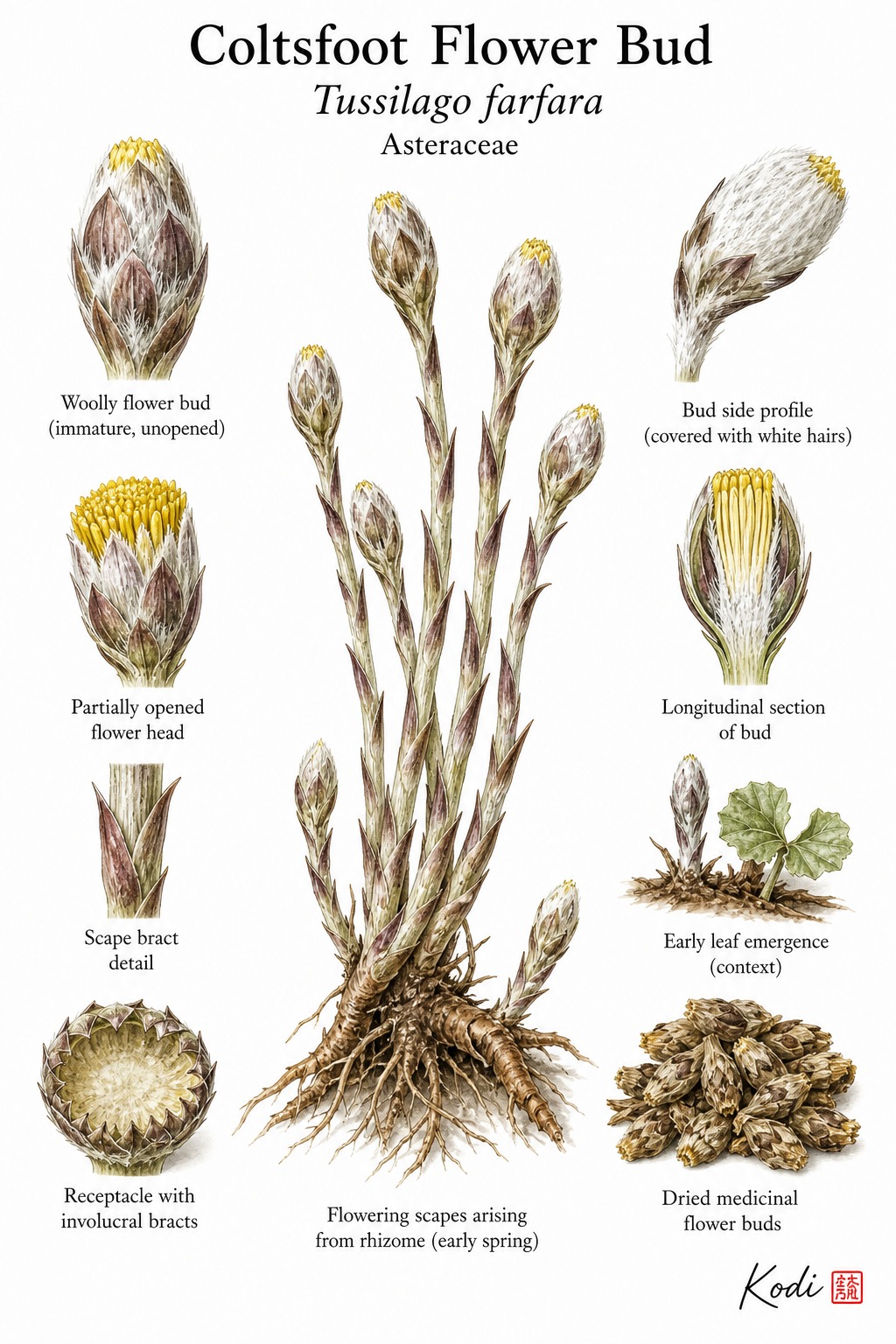
Known in TCM as Kuan Dong Hua (款冬花), this acrid and slightly bitter, warm herb enters the Lung. Traditionally, it moistens the Lung and stops cough - Kuan Dong Hua is a classic herb for chronic or lingering cough and is notable for helping both deficiency-type dryness and phlegm-associated cough when properly combined, most often applied for cough, wheezing, and bronchitis. Modern research has identified Tussilagone among its active constituents.
Part used: Flower
Also Known As
Latin: Flos Farfarae | Pinyin: Kuan Dong Hua | Chinese: 款冬花
TCM Properties
- Taste
- acrid, slightly bitter
- Temperature
- warm
- Channels
- Lung
Traditional Use
Primary Actions
- Moistens the Lung and stops cough - Kuan Dong Hua is a classic herb for chronic or lingering cough and is notable for helping both deficiency-type dryness and phlegm-associated cough when properly combined.
- Transforms phlegm and descends rebellious Lung qi - it is used for wheezing, copious sputum, and breath obstruction when the Lung is failing to descend.
- Can address cold or heat presentations depending on formula context - traditional use is flexible, with the herb combined differently for cold phlegm, Lung heat, or consumptive dry cough.
Secondary Actions
- Honey-frying is a common processing method that aligns with the herb's moistening and cough-relieving role.
- Although classically versatile, modern safety concerns mean Kuan Dong Hua should be approached more cautiously than many older texts suggest.
Classic Formulas
- She Gan Ma Huang Tang - classic wheezing formula that uses Kuan Dong Hua for phlegm-obstructing cough and difficult breathing.
- Kuan Dong Hua with Zi Wan - one of the best-known pairings for cough with stubborn phlegm or chronic Lung weakness.
- Combinations with Sang Bai Pi, Xing Ren, or Bai Bu reflect its adaptable use across heat, cold, and deficiency cough patterns.
Classical References
- Traditional herbology classifies Kuan Dong Hua as acrid, slightly bitter, and warm, entering the Lung to moisten, transform phlegm, and stop cough.
- Its long-standing reputation is for versatility across many cough patterns, provided the rest of the formula correctly distinguishes cold, heat, dryness, or deficiency.
- Older use predated modern awareness of pyrrolizidine alkaloid toxicity, which changes current safety interpretation.
Modern Research
Active Compounds
- Tussilagone and related sesquiterpenes - widely discussed anti-inflammatory constituents
- Flavonoids and phenolic compounds - supportive antioxidant and airway-related phytochemicals
- Mucilage-like soothing fractions - plausible contributors to traditional demulcent logic
- Pyrrolizidine alkaloids - the key modern toxicology concern for some coltsfoot materials
Studied Effects
- A 2021 review summarized the ethnobotany, phytochemistry, pharmacology, toxicity, and quality-control issues of Tussilago farfara, emphasizing that traditional cough use now has to be weighed against pyrrolizidine alkaloid safety concerns (PMID 33069788).
- Spectrum-effect research identified major antitussive, expectorant, and anti-inflammatory bioactive constituents in Tussilago farfara, supporting the herb's classical airway reputation (PMID 32023945).
- A 2021 survey of toxic pyrrolizidine alkaloids in traditional Chinese medicines included products relevant to human exposure risk, reinforcing why Kuan Dong Hua requires careful sourcing and processing (PMID 33809536).
PubMed References
- A review of the ethnobotanical value, phytochemistry, pharmacology, toxicity and quality control of Tussilago farfara L. (coltsfoot) (2021)
- Discovering the Major Antitussive, Expectorant, and Anti-Inflammatory Bioactive Constituents in Tussilago Farfara L. Based on the Spectrum-Effect Relationship Combined with Chemometrics (2020)
- Determination of Toxic Pyrrolizidine Alkaloids in Traditional Chinese Herbal Medicines by UPLC-MS/MS and Accompanying Risk Assessment for Human Health (2021)
Safety & Interactions
Contraindications
- Pregnancy and breastfeeding
- Chronic liver disease or use of hepatotoxic medications
- Use of uncertified coltsfoot products with unknown pyrrolizidine alkaloid content
- Long-term unsupervised use
Cautions
- Coltsfoot products may contain hepatotoxic pyrrolizidine alkaloids, so authenticated low-PA or PA-free sourcing is essential.
- Traditional versatility in cough treatment should not be mistaken for modern safety in casual self-prescribing.
- MSK page not found - drug interaction data not available from Memorial Sloan Kettering integrative medicine database
Drug Interactions
- Hepatotoxic medications - theoretical additive liver injury risk
- Other pyrrolizidine-alkaloid-containing herbs or supplements - additive toxic exposure risk
Conditions
Frequently Asked Questions
What is Coltsfoot Flower Bud used for?
Coltsfoot Flower Bud is traditionally used to Moistens the Lung and stops cough - Kuan Dong Hua is a classic herb for chronic or lingering cough and is notable for helping both deficiency-type dryness and phlegm-associated cough when properly combined., Transforms phlegm and descends rebellious Lung qi - it is used for wheezing, copious sputum, and breath obstruction when the Lung is failing to descend., Can address cold or heat presentations depending on formula context - traditional use is flexible, with the herb combined differently for cold phlegm, Lung heat, or consumptive dry cough.. Research has investigated its effects on: A 2021 review summarized the ethnobotany, phytochemistry, pharmacology, toxicity, and quality-control issues of Tussilago farfara, emphasizing that traditional cough use now has to be weighed against pyrrolizidine alkaloid safety concerns (PMID 33069788).; Spectrum-effect research identified major antitussive, expectorant, and anti-inflammatory bioactive constituents in Tussilago farfara, supporting the herb's classical airway reputation (PMID 32023945)..
What are other names for Coltsfoot Flower Bud?
Coltsfoot Flower Bud is also known as Farfara. In TCM: 款冬花 (Kuan Dong Hua); Flos Farfarae.
Is Coltsfoot Flower Bud safe during pregnancy?
Coltsfoot Flower Bud is not recommended during pregnancy.
What are the contraindications for Coltsfoot Flower Bud?
Coltsfoot Flower Bud should not be used in: Pregnancy and breastfeeding; Chronic liver disease or use of hepatotoxic medications; Use of uncertified coltsfoot products with unknown pyrrolizidine alkaloid content; Long-term unsupervised use. Consult a qualified practitioner before use.
Does Coltsfoot Flower Bud interact with any medications?
Coltsfoot Flower Bud may interact with: Hepatotoxic medications - theoretical additive liver injury risk; Other pyrrolizidine-alkaloid-containing herbs or supplements - additive toxic exposure risk. Always inform your healthcare provider of any herbal supplements you are taking.