Japanese Pagodatree Flower Bud
- Chinese
- 槐花
- Pinyin
- Huai Hua
- Latin
- Flos Sophorae
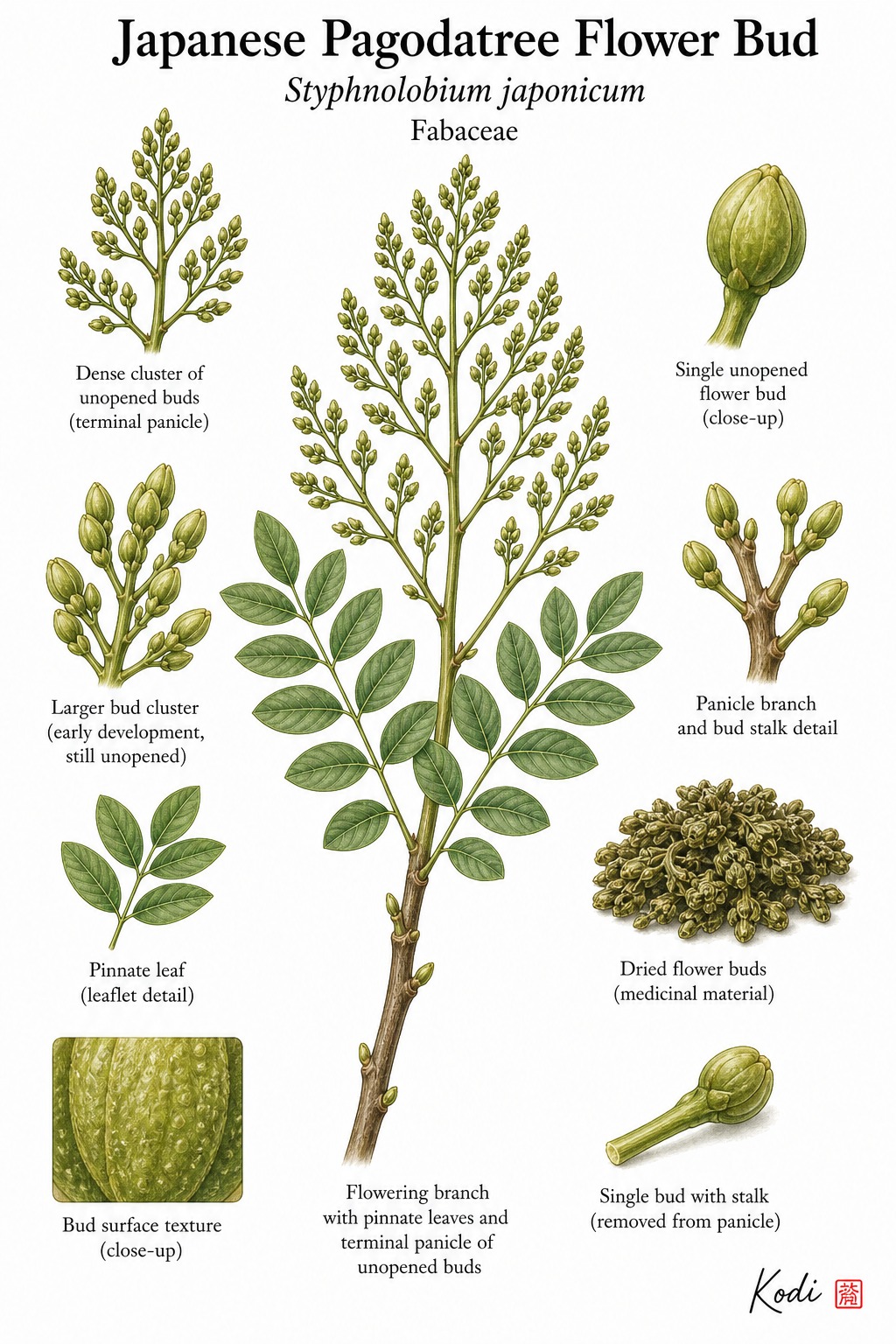
Known in TCM as Huai Hua (槐花), this bitter, cool herb enters the Liver and Large Intestine. Traditionally, it cools the blood and stops bleeding - Huai Hua is a classic herb for bleeding from heat, especially hemorrhoidal bleeding, intestinal bleeding, and other lower-tract blood loss, most often applied for hemorrhoids, hematuria, and uterine bleeding. Modern research has identified Rutin among its active constituents.
Part used: Flower
Also Known As
Latin: Flos Sophorae | Pinyin: Huai Hua | Chinese: 槐花
TCM Properties
- Taste
- bitter
- Temperature
- cool
- Channels
- Liver, Large Intestine
Traditional Use
Primary Actions
- Cools the blood and stops bleeding - Huai Hua is a classic herb for bleeding from heat, especially hemorrhoidal bleeding, intestinal bleeding, and other lower-tract blood loss.
- Clears Liver fire - it is also used for headache, red eyes, and upward-rising heat signs when the Liver channel is involved.
- Can be used for uterine and urinary bleeding patterns with heat - though famous for hemorrhoids, its cooling-blood logic extends more broadly when heat agitates the vessels.
Secondary Actions
- Traditional trade sometimes distinguishes Huai Hua from Huai Mi, the more tightly closed flower-bud form, but both belong to the same overall medicinal lineage.
- It is often charred when the goal is stronger hemostatic effect, which reflects a common TCM processing strategy for stopping bleeding.
Classic Formulas
- Huai Hua San - the signature formula for intestinal wind and blood in the stool, with Huai Hua as the central cooling-hemostatic herb.
- Bleeding formulas may combine Huai Hua with Di Yu, Ce Bai Ye, or Jing Jie Tan depending on the bleeding site and pattern.
- Liver-fire and red-eye combinations may pair Huai Hua with Ju Hua, Xia Ku Cao, or Jue Ming Zi.
Classical References
- Traditional herbology describes Huai Hua as bitter and cool, entering the Liver and Large Intestine to cool blood, stop bleeding, and clear Liver heat.
- Its strongest classical identity is hemorrhoidal or intestinal bleeding from heat, which is why it anchors Huai Hua San.
- The flower-bud form is especially associated with cooling and hemostatic use.
Modern Research
Active Compounds
- Rutin - the best-known flavonoid associated with vascular and anti-inflammatory effects
- Quercetin and related flavonoids - supportive compounds in inflammatory and endothelial research
- Isoflavonoids and phenolic constituents - part of the broader Sophora flower phytochemical profile
- Polysaccharide and microbiota-active fractions - implicated in some newer gut-focused studies
Studied Effects
- Sophora japonica flowers and rutin improved murine colitis measures in a 2022 study linked to NF-kB regulation and gut microbiota, which is relevant to Huai Hua's classical lower-tract heat indications (PMID 35691061).
- Network pharmacology work examined the potential mechanism of Sophora japonica flower buds in contact dermatitis, supporting continuing interest in anti-inflammatory actions beyond bleeding indications (PMID 33493588).
- A 2010 study on Huaihua and cerebral infarction reflects wider modern pharmacologic interest in vascular and blood-related actions of Sophora japonica flowers (PMID 20875105).
PubMed References
- Sophora japonica flowers and their main phytochemical, rutin, regulate chemically induced murine colitis in association with targeting the NF-kB signaling pathway and gut microbiota (2022)
- Prediction of the therapeutic mechanism responsible for the effects of Sophora japonica flower buds on contact dermatitis by network-based pharmacological analysis (2021)
- Effects of Sophora japonica flowers (Huaihua) on cerebral infarction (2010)
Safety & Interactions
Contraindications
- Cold deficiency bleeding without heat
- Weak digestion with significant loose stools if large cooling doses are used
Cautions
- Huai Hua is generally well tolerated, but serious unexplained bleeding should be medically evaluated rather than self-treated.
- Raw and charred forms are not fully interchangeable in traditional use.
- MSK page not found - drug interaction data not available from Memorial Sloan Kettering integrative medicine database
Drug Interactions
- Anticoagulants or antiplatelet drugs - theoretical interaction risk when concentrated extracts are used
Conditions
- Hemorrhoids Traditional ★★★★☆ JSON
- Hematuria Traditional ★★★☆☆ JSON
- Uterine Bleeding Traditional ★★★☆☆ JSON
- Headache Traditional ★★☆☆☆ JSON
Frequently Asked Questions
What is Japanese Pagodatree Flower Bud used for?
Japanese Pagodatree Flower Bud is traditionally used to Cools the blood and stops bleeding - Huai Hua is a classic herb for bleeding from heat, especially hemorrhoidal bleeding, intestinal bleeding, and other lower-tract blood loss., Clears Liver fire - it is also used for headache, red eyes, and upward-rising heat signs when the Liver channel is involved., Can be used for uterine and urinary bleeding patterns with heat - though famous for hemorrhoids, its cooling-blood logic extends more broadly when heat agitates the vessels.. Research has investigated its effects on: Sophora japonica flowers and rutin improved murine colitis measures in a 2022 study linked to NF-kB regulation and gut microbiota, which is relevant to Huai Hua's classical lower-tract heat indications (PMID 35691061).; Network pharmacology work examined the potential mechanism of Sophora japonica flower buds in contact dermatitis, supporting continuing interest in anti-inflammatory actions beyond bleeding indications (PMID 33493588)..
What are other names for Japanese Pagodatree Flower Bud?
Japanese Pagodatree Flower Bud is also known as Sophora. In TCM: 槐花 (Huai Hua); Flos Sophorae.
Is Japanese Pagodatree Flower Bud safe during pregnancy?
The safety of Japanese Pagodatree Flower Bud during pregnancy has not been established. Consult a qualified healthcare provider before use.
What are the contraindications for Japanese Pagodatree Flower Bud?
Japanese Pagodatree Flower Bud should not be used in: Cold deficiency bleeding without heat; Weak digestion with significant loose stools if large cooling doses are used. Consult a qualified practitioner before use.
Does Japanese Pagodatree Flower Bud interact with any medications?
Japanese Pagodatree Flower Bud may interact with: Anticoagulants or antiplatelet drugs - theoretical interaction risk when concentrated extracts are used. Always inform your healthcare provider of any herbal supplements you are taking.