Lilac Daphne Flower Bud
- Chinese
- 芫花
- Pinyin
- Yuan Hua
- Latin
- Flos Genkwa
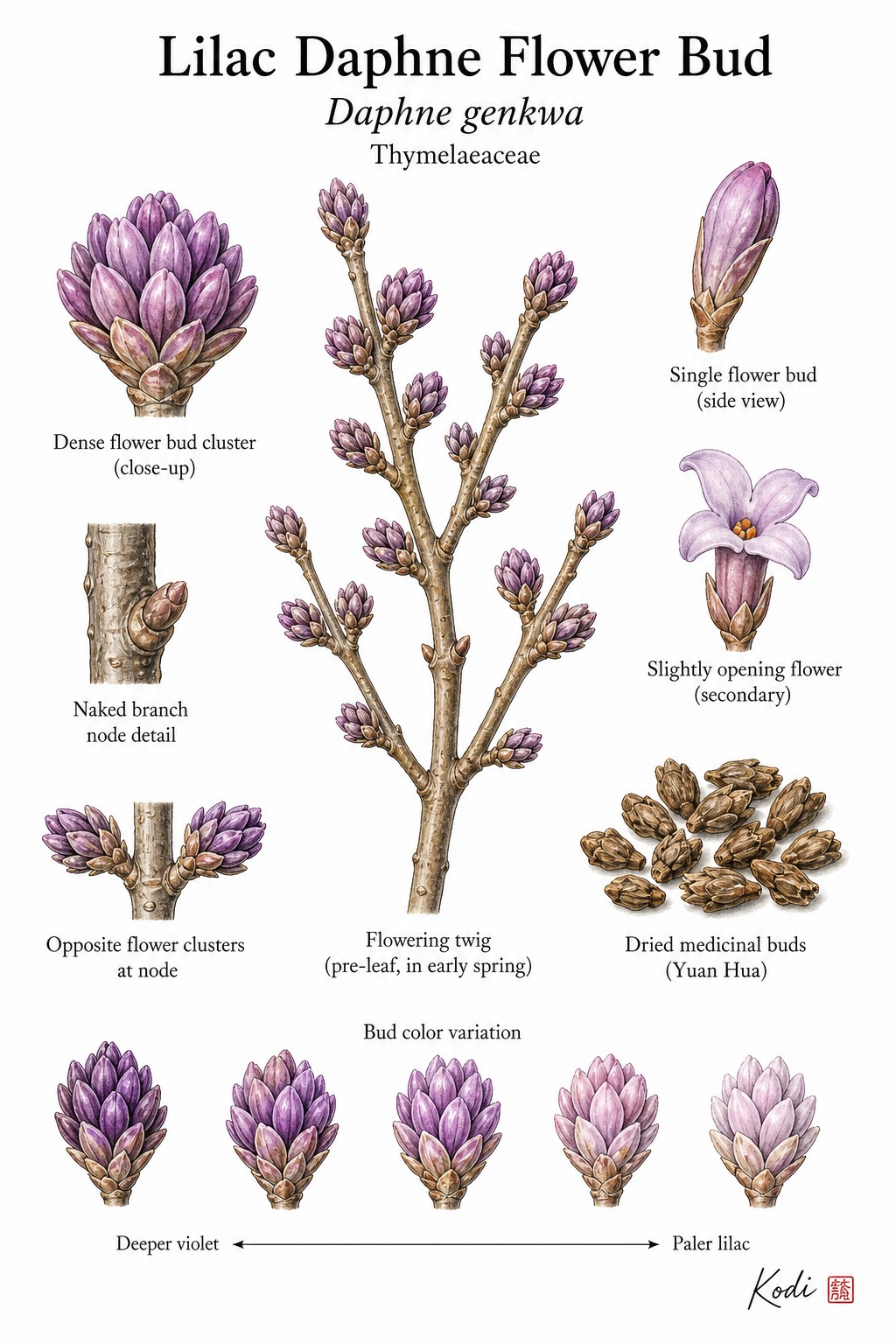
Known in TCM as Yuan Hua (芫花), this bitter and acrid, warm herb enters the Lung, Kidney, and Large Intestine. Traditionally, it drives out retained water and reduces edema - Yuan Hua is a drastic, strongly downward-moving toxic herb used historically for severe fluid retention, ascites, and water binding in the chest or flanks, most often applied for edema, cough, and wheezing. Modern research has identified Daphnane-type among its active constituents.
Part used: Flower
Also Known As
Latin: Flos Genkwa | Pinyin: Yuan Hua | Chinese: 芫花
TCM Properties
- Taste
- bitter, acrid
- Temperature
- warm
- Channels
- Lung, Kidney, Large Intestine
Traditional Use
Primary Actions
- Drives out retained water and reduces edema - Yuan Hua is a drastic, strongly downward-moving toxic herb used historically for severe fluid retention, ascites, and water binding in the chest or flanks.
- Expels phlegm and relieves cough and wheezing - it is used when stubborn phlegm, fluid, or cold obstruction in the Lung is severe enough to warrant a harsh attacking medicine.
- Kills parasites and can be used externally - powdered or topical use appears in older practice for tinea-like lesions and other difficult superficial infestations.
Secondary Actions
- Yuan Hua is not a gentle diuretic; it is a powerful toxic expeller chosen for serious excess patterns and generally avoided in weak or pregnant patients.
- Modern clinicians use it far less casually than classical texts might suggest because its therapeutic range is narrow.
Classic Formulas
- Shi Zao Tang - the signature formula pairing Yuan Hua with Gan Sui and Da Ji to drive out water retention from the chest and hypochondrium.
- Traditional severe phlegm-fluid formulas use Yuan Hua only when gentler Lung-resolving herbs are judged insufficient.
- External parasite and tinea applications use Yuan Hua differently from internal dosing and still require caution because the herb is irritating and toxic.
Classical References
- Traditional herbology classifies Yuan Hua as bitter, acrid, warm, and toxic, entering the Lung, Kidney, and Large Intestine to expel water, dispel phlegm, and kill parasites.
- Its classical role is reserved for excess fluid accumulation, not for ordinary swelling or mild cough.
- Because it is one of the harsher toxic herbs in the materia medica, classical use assumes experienced supervision.
Modern Research
Active Compounds
- Daphnane-type diterpenes - major bioactive and toxicity-associated constituents
- Flavonoids such as genkwanin - studied for antimicrobial and anti-inflammatory effects
- Lignans and related phenolic constituents - supportive compounds in broader pharmacology work
- Multiple toxic metabolites identified in Genkwa Flos preparations - central to current safety concerns
Studied Effects
- A 2018 study identified potential toxic components and metabolites of Genkwa Flos, reinforcing why modern use must remain highly cautious despite historical precedent (PMID 29957847).
- Research on Glycyrrhiza and Genkwa Flos interactions showed toxicity-enhancing effects in some contexts, underscoring that combining toxic herbs is not automatically benign (PMID 35004606).
- Experimental work has explored antimicrobial and immune-related effects of Genkwa flos constituents, but these findings do not outweigh the herb's narrow safety margin for self-use (PMID 35870686).
- Daphne genkwa flower extract has also been studied in neuroimmune models, showing that modern research remains largely experimental rather than directly clinical (PMID 36240609).
PubMed References
- Investigation of potential toxic components based on the identification of Genkwa Flos chemical constituents and their metabolites by high-performance liquid chromatography coupled with a Q Exactive high-resolution benchtop quadrupole Orbitrap mass spectrometer (2018)
- Revealing the Toxicity-Enhancing Essence of Glycyrrhiza on Genkwa Flos Based on Ultra-high-performance Liquid Chromatography Coupled With Quadrupole-Orbitrap High-Resolution Mass Spectrometry and Self-Assembled Supramolecular Technology (2021)
- Uncovering the efficacy and mechanisms of Genkwa flos and bioactive ingredient genkwanin against L. monocytogenes infection (2022)
- Daphne genkwa flower extract promotes the neuroprotective effects of microglia (2023)
Safety & Interactions
Contraindications
- Pregnancy
- Frailty, deficiency, or dehydration
- Mild edema that does not require a drastic expelling herb
- Unsupervised internal use of raw Genkwa Flos products
Cautions
- Yuan Hua is a toxic drastic herb with a narrow therapeutic window and is not appropriate for casual self-treatment.
- Serious gastrointestinal irritation and other toxic reactions are possible, especially with excessive dosing or poor-quality material.
- MSK page not found - drug interaction data not available from Memorial Sloan Kettering integrative medicine database
Drug Interactions
- Other harsh cathartic, toxic, or dehydrating herbs and drugs - additive toxicity risk
- Potentially hepatotoxic or highly bioactive herbal combinations - unpredictable enhancement of adverse effects
Conditions
Frequently Asked Questions
What is Lilac Daphne Flower Bud used for?
Lilac Daphne Flower Bud is traditionally used to Drives out retained water and reduces edema - Yuan Hua is a drastic, strongly downward-moving toxic herb used historically for severe fluid retention, ascites, and water binding in the chest or flanks., Expels phlegm and relieves cough and wheezing - it is used when stubborn phlegm, fluid, or cold obstruction in the Lung is severe enough to warrant a harsh attacking medicine., Kills parasites and can be used externally - powdered or topical use appears in older practice for tinea-like lesions and other difficult superficial infestations.. Research has investigated its effects on: A 2018 study identified potential toxic components and metabolites of Genkwa Flos, reinforcing why modern use must remain highly cautious despite historical precedent (PMID 29957847).; Research on Glycyrrhiza and Genkwa Flos interactions showed toxicity-enhancing effects in some contexts, underscoring that combining toxic herbs is not automatically benign (PMID 35004606)..
What are other names for Lilac Daphne Flower Bud?
Lilac Daphne Flower Bud is also known as Genkwa. In TCM: 芫花 (Yuan Hua); Flos Genkwa.
Is Lilac Daphne Flower Bud safe during pregnancy?
Lilac Daphne Flower Bud is not recommended during pregnancy.
What are the contraindications for Lilac Daphne Flower Bud?
Lilac Daphne Flower Bud should not be used in: Pregnancy; Frailty, deficiency, or dehydration; Mild edema that does not require a drastic expelling herb; Unsupervised internal use of raw Genkwa Flos products. Consult a qualified practitioner before use.
Does Lilac Daphne Flower Bud interact with any medications?
Lilac Daphne Flower Bud may interact with: Other harsh cathartic, toxic, or dehydrating herbs and drugs - additive toxicity risk; Potentially hepatotoxic or highly bioactive herbal combinations - unpredictable enhancement of adverse effects. Always inform your healthcare provider of any herbal supplements you are taking.