Magnolia Flower Bud
- Chinese
- 辛夷
- Pinyin
- Xin Yi
- Latin
- Flos Magnoliae
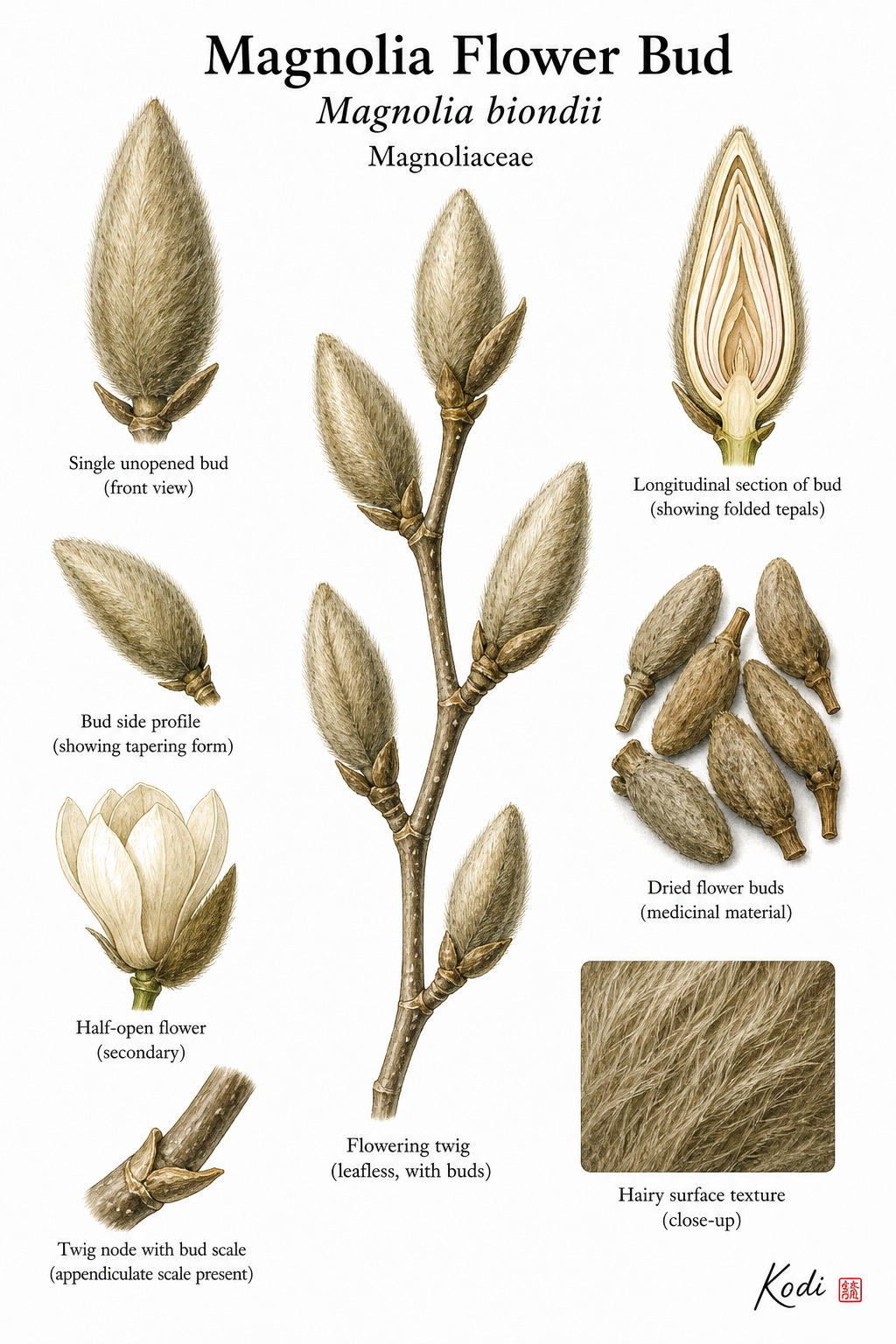
Known in TCM as Xin Yi (辛夷), this acrid, warm herb enters the Lung and Stomach. Traditionally, it disperses wind-cold from the upper burner and opens the nasal passages - Xin Yi is one of the classic herbs for stubborn nasal obstruction with frontal headache, reduced smell, and turbid sinus discharge, most often applied for sinusitis, headache, and wind cold. Modern research has identified Volatile among its active constituents.
Part used: Flower
Also Known As
Latin: Flos Magnoliae | Pinyin: Xin Yi | Chinese: 辛夷
TCM Properties
- Taste
- acrid
- Temperature
- warm
- Channels
- Lung, Stomach
Traditional Use
Primary Actions
- Disperses wind-cold from the upper burner and opens the nasal passages - Xin Yi is one of the classic herbs for stubborn nasal obstruction with frontal headache, reduced smell, and turbid sinus discharge.
- Reduces sinus swelling and unblocks the orifices - it is especially valued when congestion is lodged deep in the sinuses rather than only in the throat or exterior.
- Relieves headache related to blocked nasal passages - traditional use often targets brow-line pain, sinus pressure, and heaviness of the head caused by retained wind-cold or wind-heat.
Secondary Actions
- Xin Yi is usually paired with herbs such as Cang Er Zi, Bai Zhi, Bo He, or Gao Ben rather than used alone, because its specialty is directing a broader formula into the nose.
- Because the fuzzy buds can irritate the throat, they are often wrapped for decoction instead of simmered loose in the pot.
Classic Formulas
- Cang Er Zi San - classic combination with Cang Er Zi, Bai Zhi, and Bo He for rhinitis, sinus congestion, and sinus headache.
- Xin Yi San - traditional nasal-opening strategy for chronic obstruction, reduced smell, and lingering sinus blockage.
- Bi Yuan Wan and related sinus formulas - use Xin Yi when thick discharge, frontal pressure, and blocked breathing through the nose dominate the picture.
Classical References
- Traditional materia medica place Xin Yi among warm, acrid herbs that expel external pathogens from the head and specifically open the nose.
- Modern classroom teaching emphasizes that its true niche is fixed obstruction and sinus pain rather than broad exterior release on its own.
- It is generally used in small doses within formulas because its action is strongly upward and focused on the nasal passages.
Modern Research
Active Compounds
- Volatile oils rich in eucalyptol and related terpenes - important for the herb's aromatic nasal-opening profile
- Lignans such as fargesin and magnolin - among the best studied Magnoliae Flos constituents
- Tetrahydrofurofuranoid lignans - increasingly investigated for anti-inflammatory and signaling effects
- Other aromatic phenolics from magnolia buds - relevant to quality control and species authentication studies
Studied Effects
- Magnoliae Flos essential oil and eucalyptol suppressed JAK1-linked inflammatory signaling in macrophage testing, supporting the herb's traditional use in inflamed upper-airway patterns (PMID 41779444).
- A 2025 quality study of Xinyi volatile oils confirmed that source species and developmental stage materially change aromatic composition, which matters clinically because nasal-opening activity depends heavily on the oil profile (PMID 40011674).
- A 2025 pharmacology review of Magnoliae Flos lignans mapped multiple anti-inflammatory and signaling targets, reinforcing why the herb remains of interest for rhinitis and sinus-focused research (PMID 41064597).
PubMed References
- Magnoliae flos (Shin-i) Essential Oil and Its Principal Component Eucalyptol Inhibit JAK1 to Counteract the LPS-Induced RAW264.7 Inflammation. (2026)
- Assessment of quality in volatile oil from three basic sources of Xinyi from Hubei by anatomy, GC-MS, and chemometric methods. (2025)
- Pharmacological Potential and Molecular Targets of Tetrahydrofurofuranoid Lignans From Magnoliae Flos. (2025)
Safety & Interactions
Contraindications
- Headache or nasal symptoms primarily due to yin deficiency heat rather than obstructive external or damp patterns
- Dry irritated nasal passages without congestion or turbid blockage
Cautions
- The fuzzy bud surface can irritate the throat or stomach, so the herb is often bag-decocted rather than boiled loose.
- Xin Yi is most appropriate when obstruction is the main problem and is less suitable as a stand-alone choice for simple dryness or irritation.
- MSK page not found - drug interaction data not available from Memorial Sloan Kettering integrative medicine database
Conditions
Frequently Asked Questions
What is Magnolia Flower Bud used for?
Magnolia Flower Bud is traditionally used to Disperses wind-cold from the upper burner and opens the nasal passages - Xin Yi is one of the classic herbs for stubborn nasal obstruction with frontal headache, reduced smell, and turbid sinus discharge., Reduces sinus swelling and unblocks the orifices - it is especially valued when congestion is lodged deep in the sinuses rather than only in the throat or exterior., Relieves headache related to blocked nasal passages - traditional use often targets brow-line pain, sinus pressure, and heaviness of the head caused by retained wind-cold or wind-heat.. Research has investigated its effects on: Magnoliae Flos essential oil and eucalyptol suppressed JAK1-linked inflammatory signaling in macrophage testing, supporting the herb's traditional use in inflamed upper-airway patterns (PMID 41779444).; A 2025 quality study of Xinyi volatile oils confirmed that source species and developmental stage materially change aromatic composition, which matters clinically because nasal-opening activity depends heavily on the oil profile (PMID 40011674)..
What are other names for Magnolia Flower Bud?
Magnolia Flower Bud is also known as Magnolia. In TCM: 辛夷 (Xin Yi); Flos Magnoliae.
Is Magnolia Flower Bud safe during pregnancy?
The safety of Magnolia Flower Bud during pregnancy has not been established. Consult a qualified healthcare provider before use.
What are the contraindications for Magnolia Flower Bud?
Magnolia Flower Bud should not be used in: Headache or nasal symptoms primarily due to yin deficiency heat rather than obstructive external or damp patterns; Dry irritated nasal passages without congestion or turbid blockage. Consult a qualified practitioner before use.