Kudzu Flower
- Chinese
- 葛花
- Pinyin
- Ge Hua
- Latin
- Flos Puerariae
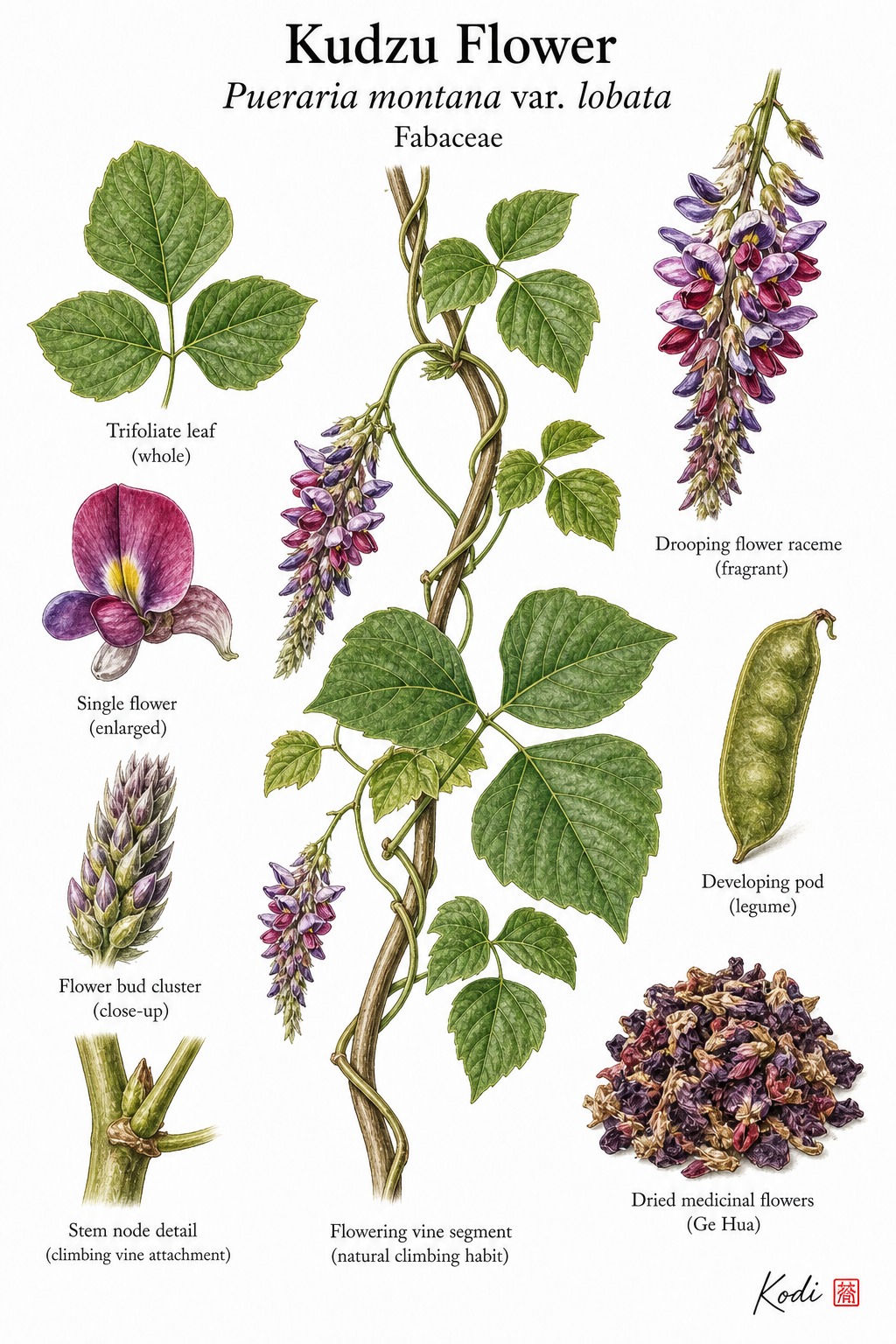
Known in TCM as Ge Hua (葛花), this sweet, neutral herb enters the Spleen and Stomach. Traditionally, it releases alcohol toxicity and clears the head - Ge Hua is best known for headache, nausea, thirst, and mental clouding after excessive drinking, most often applied for nausea, headache, and diarrhea. Modern research has identified Isoflavones among its active constituents.
Part used: Flower
Also Known As
Latin: Flos Puerariae | Pinyin: Ge Hua | Chinese: 葛花
TCM Properties
- Taste
- sweet
- Temperature
- neutral
- Channels
- Spleen, Stomach
Traditional Use
Primary Actions
- Releases alcohol toxicity and clears the head - Ge Hua is best known for headache, nausea, thirst, and mental clouding after excessive drinking.
- Harmonizes the Stomach and descends rebellious qi - traditional use includes alcohol-related vomiting, epigastric upset, foul belching, and poor appetite after food or drink excess.
- Lifts clear yang and helps stop diarrhea - some lineages extend its use to diarrhea and loose stool when dampness and Spleen weakness are worsened by dietary excess.
Secondary Actions
- Ge Hua is lighter and more alcohol-focused than Ge Gen, so although both come from kudzu, the flower is used more for intoxication and middle-burner turbidity than for exterior neck patterns.
- It commonly appears with aromatic damp-transforming herbs or digestive harmonizers when drinking has caused mixed nausea, fullness, and turbid damp heat.
Classic Formulas
- Ge Hua Jie Cheng San - the best known classical strategy for alcohol excess with nausea, vomiting, foul breath, and intoxication-type discomfort.
- Ge Hua with Bai Dou Kou or Sha Ren - common pairing logic when alcohol has damaged the Stomach and left fullness, nausea, or poor appetite.
- Ge Hua with Ge Gen and Sheng Ma - traditional approach when clear yang fails to rise and loose stool or heaviness follow overindulgence.
Classical References
- Traditional herbology describes Ge Hua as the flower form of kudzu that specifically relieves drunkenness and harmonizes alcohol-damaged digestion.
- Its actions are usually discussed in relation to food and drink excess rather than as a general heat-clearing or exterior-releasing flower herb.
- Modern teachers often summarize its niche simply as the herb for alcohol-related nausea and head discomfort.
Modern Research
Active Compounds
- Isoflavones such as tectoridin and tectorigenin - the most studied Ge Hua constituents
- Kakkalide and related glycosides - often highlighted in alcohol-metabolism research
- Broader pueraria flavonoid fraction - relevant to hepatoprotective and anti-inflammatory studies
- Phenolic constituents that change with processing and extraction method - important in quality assessment
Studied Effects
- Tectoridin derived from Puerariae Flos reduced acute ethanol-induced ataxia in rats through adenosine A1 receptor-related mechanisms, offering a modern correlate to the herb's anti-intoxication reputation (PMID 41328621).
- A spectrum-effect study of the Flos Puerariae and Semen Hoveniae pairing identified likely active substances for protecting against alcohol-induced liver damage, supporting the longstanding Ge Hua alcohol formulas (PMID 37196817).
- Flos puerariae extract reduced the impact of acute alcohol intoxication in mice in older preclinical work, reinforcing the consistency of the species-level alcohol-protection signal (PMID 24931816).
PubMed References
- Tectoridin Derived from Puerariae Flos Alleviates Acute Ethanol-Induced Ataxia in Rats by Targeting the Adenosine A1 Receptor via Its Aglycone. (2025)
- Spectrum-effect relationship study to reveal the pharmacodynamic substances in Flos Puerariae-Semen Hoveniae medicine pair for the treatment of alcohol-induced liver damage. (2023)
- Protective effect of Flos puerariae extract following acute alcohol intoxication in mice. (2014)
Safety & Interactions
Contraindications
- Marked deficiency without food, damp, or alcohol-related turbidity
- Very dry constitutions in which aromatic dispersing herbs aggravate fluid depletion
Cautions
- Ge Hua may help with alcohol-related symptoms, but it is not a substitute for emergency care in severe intoxication or alcohol poisoning.
- Most modern evidence is preclinical and should not be treated as proof that the herb reverses heavy alcohol injury in humans.
- MSK page not found - drug interaction data not available from Memorial Sloan Kettering integrative medicine database
Conditions
Frequently Asked Questions
What is Kudzu Flower used for?
Kudzu Flower is traditionally used to Releases alcohol toxicity and clears the head - Ge Hua is best known for headache, nausea, thirst, and mental clouding after excessive drinking., Harmonizes the Stomach and descends rebellious qi - traditional use includes alcohol-related vomiting, epigastric upset, foul belching, and poor appetite after food or drink excess., Lifts clear yang and helps stop diarrhea - some lineages extend its use to diarrhea and loose stool when dampness and Spleen weakness are worsened by dietary excess.. Research has investigated its effects on: Tectoridin derived from Puerariae Flos reduced acute ethanol-induced ataxia in rats through adenosine A1 receptor-related mechanisms, offering a modern correlate to the herb's anti-intoxication reputation (PMID 41328621).; A spectrum-effect study of the Flos Puerariae and Semen Hoveniae pairing identified likely active substances for protecting against alcohol-induced liver damage, supporting the longstanding Ge Hua alcohol formulas (PMID 37196817)..
What are other names for Kudzu Flower?
Kudzu Flower is also known as Pueraria. In TCM: 葛花 (Ge Hua); Flos Puerariae.
Is Kudzu Flower safe during pregnancy?
The safety of Kudzu Flower during pregnancy has not been established. Consult a qualified healthcare provider before use.
What are the contraindications for Kudzu Flower?
Kudzu Flower should not be used in: Marked deficiency without food, damp, or alcohol-related turbidity; Very dry constitutions in which aromatic dispersing herbs aggravate fluid depletion. Consult a qualified practitioner before use.