Chinese Globeflower
- Chinese
- 金莲花
- Pinyin
- Jin Lian Hua
- Latin
- Flos Trollii
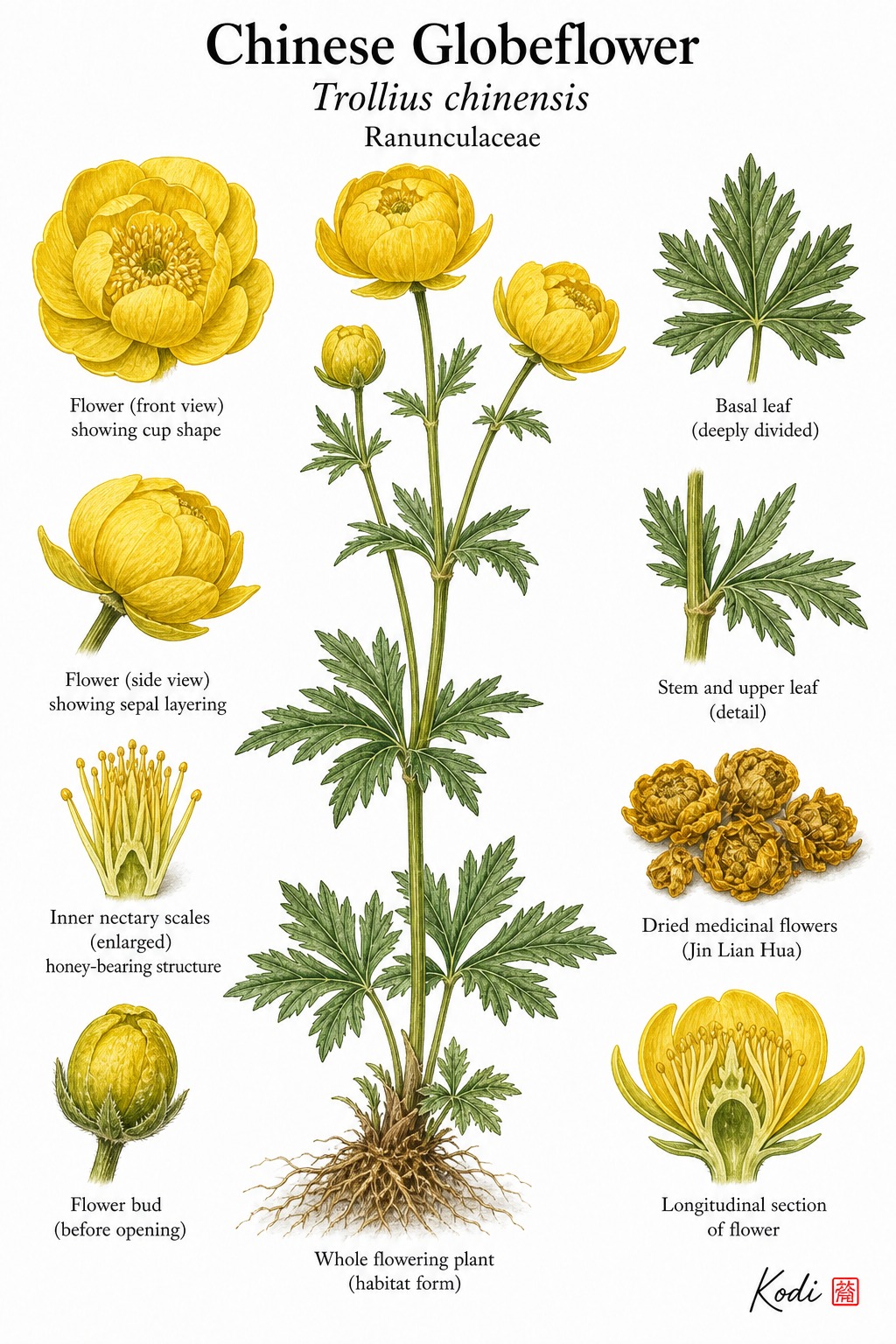
Known in TCM as Jin Lian Hua (金莲花), this bitter, cold herb enters the Lung and Stomach. Traditionally, it clears heat and resolves fire toxicity - Jin Lian Hua is classically used for sore throat, swollen painful throat, and upper-respiratory heat with red inflamed mucosa, most often applied for sore throat, tonsillitis, and pharyngitis. Modern research has identified Flavonoids among its active constituents.
Part used: Flower
Also Known As
Latin: Flos Trollii | Pinyin: Jin Lian Hua | Chinese: 金莲花
TCM Properties
- Taste
- bitter
- Temperature
- cold
- Channels
- Lung, Stomach
Traditional Use
Primary Actions
- Clears heat and resolves fire toxicity - Jin Lian Hua is classically used for sore throat, swollen painful throat, and upper-respiratory heat with red inflamed mucosa.
- Relieves wind-heat affecting the throat and lungs - it is commonly selected when fever, cough, and painful swallowing appear together in early respiratory infection patterns.
- Reduces toxic swelling - traditional and modern Chinese use extends to mouth sores, tonsillar inflammation, and hot swollen lesions in the upper burner.
Secondary Actions
- Jin Lian Hua is often chosen when the throat is the center of the pattern, making it more focused than many broader heat-clearing flowers.
- It appears frequently in modern respiratory patent medicines, but classical use still treats it as a supporting herb rather than a single universal infection remedy.
Classic Formulas
- Jin Lian Hua with Ban Lan Gen and Lian Qiao - common upper-respiratory heat combination for sore throat, swollen tonsils, and fever.
- Jin Lian Hua with Niu Bang Zi and Jie Geng - throat-focused pairing logic when painful swallowing and pharyngeal heat predominate.
- Modern Jin Lian Hua capsules and lozenges - contemporary extension of the herb's traditional role in throat and upper-airway heat.
Classical References
- Traditional use centers on clearing heat, resolving toxicity, and benefiting the throat, which explains its continued prominence in pharyngitis-focused products.
- Teaching lineages often describe it as a northern Chinese flower herb especially suitable for hot sore-throat disorders.
- Its main strength is upper-burner heat and toxicity rather than deficiency patterns or chronic cold cough.
Modern Research
Active Compounds
- Flavonoids such as orientin and vitexin - among the best known Trollius chinensis markers
- Phenolic acids including veratric acid - commonly discussed in quality and pharmacology work
- Other glycosides and anti-inflammatory fractions isolated from the flowers - important in throat-disease studies
- Quality-marker compounds used in modern Flos Trollii authentication
Studied Effects
- A 2025 study isolated a new compound from Trollius chinensis flowers and demonstrated anti-inflammatory activity through NF-kB pathway modulation, supporting the herb's heat-toxin reputation (PMID 40696764).
- Researchers identified likely active fractions and constituents from the flowers responsible for treating acute pharyngitis, giving modern pharmacologic support to Jin Lian Hua's classic throat indication (PMID 39218126).
- A 2024 network-pharmacology study on Trollius chinensis capsule for upper respiratory tract infection further reinforced the herb's current respiratory focus, although the evidence remains formula-level rather than definitive clinical proof (PMID 39252243).
PubMed References
- A new compound from the flowers of Trollius chinensis Bunge and its anti-inflammatory activity by modulating NF-kB signalling pathway. (2025)
- Potential active fractions and constituents in the flowers of Trollius chinensis Bunge responsible for treating acute pharyngitis. (2025)
- Network pharmacology-based study on the mechanism of action of Trollius chinensis capsule in the treatment of upper respiratory tract infection. (2024)
Safety & Interactions
Contraindications
- Cold from deficiency without signs of heat or toxicity
- Loose stool from Spleen deficiency when there is no clear upper-burner heat pattern
Cautions
- Jin Lian Hua is best matched to hot inflamed throat patterns and is less appropriate for dry, weak, or purely deficiency-type chronic irritation.
- Most modern studies are preclinical or formula-based rather than direct proof of stand-alone clinical benefit.
- MSK page not found - drug interaction data not available from Memorial Sloan Kettering integrative medicine database
Conditions
- Sore Throat Traditional ★★★★☆ JSON
- Tonsillitis Traditional ★★★☆☆ JSON
- Pharyngitis Traditional ★★★☆☆ JSON
- Upper Respiratory Infection Traditional ★★☆☆☆ JSON
Frequently Asked Questions
What is Chinese Globeflower used for?
Chinese Globeflower is traditionally used to Clears heat and resolves fire toxicity - Jin Lian Hua is classically used for sore throat, swollen painful throat, and upper-respiratory heat with red inflamed mucosa., Relieves wind-heat affecting the throat and lungs - it is commonly selected when fever, cough, and painful swallowing appear together in early respiratory infection patterns., Reduces toxic swelling - traditional and modern Chinese use extends to mouth sores, tonsillar inflammation, and hot swollen lesions in the upper burner.. Research has investigated its effects on: A 2025 study isolated a new compound from Trollius chinensis flowers and demonstrated anti-inflammatory activity through NF-kB pathway modulation, supporting the herb's heat-toxin reputation (PMID 40696764).; Researchers identified likely active fractions and constituents from the flowers responsible for treating acute pharyngitis, giving modern pharmacologic support to Jin Lian Hua's classic throat indication (PMID 39218126)..
What are other names for Chinese Globeflower?
Chinese Globeflower is also known as Trollium. In TCM: 金莲花 (Jin Lian Hua); Flos Trollii.
Is Chinese Globeflower safe during pregnancy?
The safety of Chinese Globeflower during pregnancy has not been established. Consult a qualified healthcare provider before use.
What are the contraindications for Chinese Globeflower?
Chinese Globeflower should not be used in: Cold from deficiency without signs of heat or toxicity; Loose stool from Spleen deficiency when there is no clear upper-burner heat pattern. Consult a qualified practitioner before use.