Campsis Flower
- Chinese
- 凌霄花
- Pinyin
- Ling Xiao Hua
- Latin
- Flos Campsis
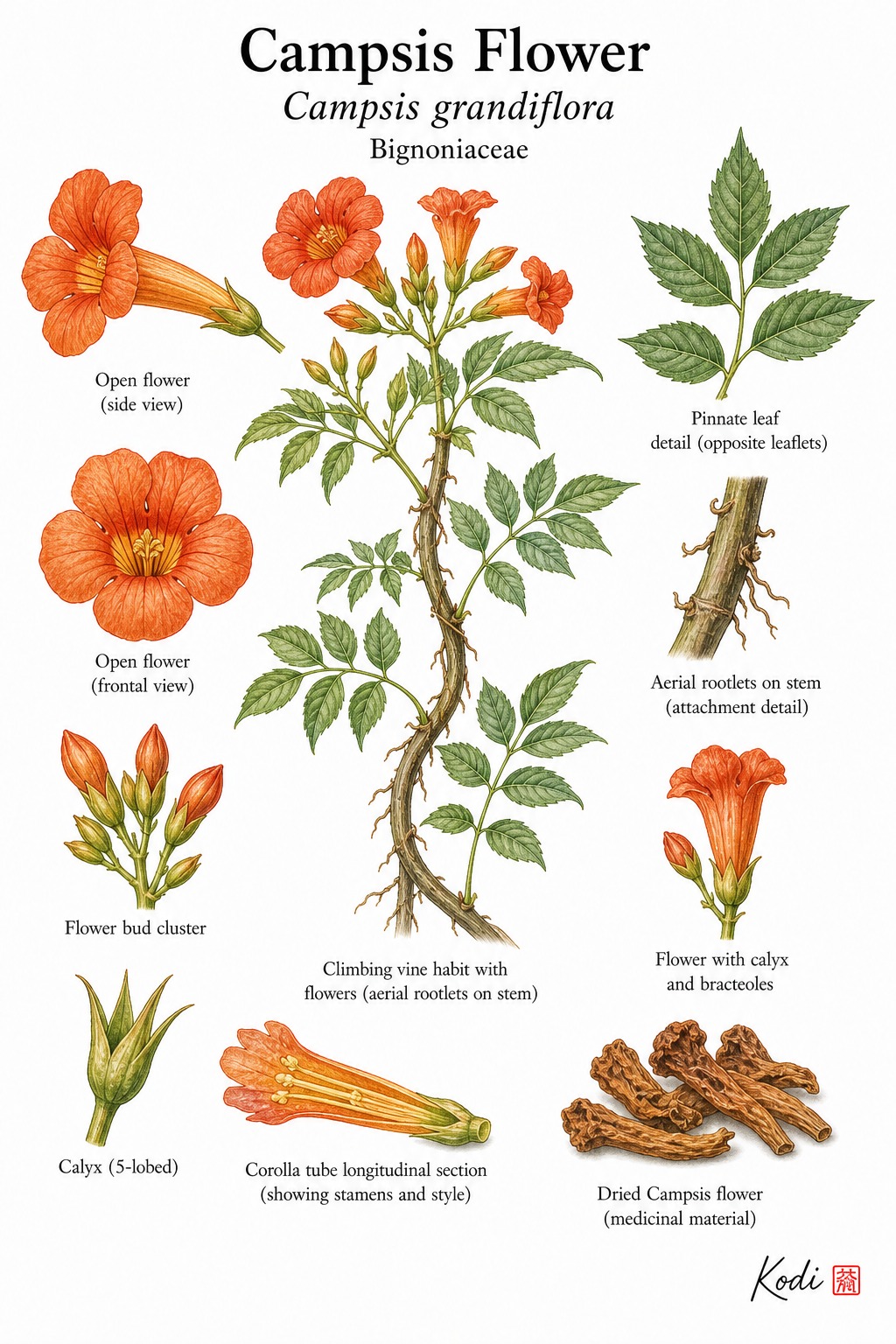
Known in TCM as Ling Xiao Hua (凌霄花), this sweet and sour, slightly cold herb enters the Liver and Pericardium. Traditionally, it invigorates blood and dispels stasis - Ling Xiao Hua is classically used for amenorrhea, painful menstruation, postpartum stagnant pain, and fixed blood-stasis discomfort, most often applied for amenorrhea, dysmenorrhea, and menstrual irregularities. Modern research has identified Acteoside among its active constituents.
Part used: Flower
Also Known As
Latin: Flos Campsis | Pinyin: Ling Xiao Hua | Chinese: 凌霄花
TCM Properties
- Taste
- sweet, sour
- Temperature
- slightly cold
- Channels
- Liver, Pericardium
Traditional Use
Primary Actions
- Invigorates blood and dispels stasis - Ling Xiao Hua is classically used for amenorrhea, painful menstruation, postpartum stagnant pain, and fixed blood-stasis discomfort.
- Cools blood and reduces hot eruptions - traditional use extends to red itchy skin lesions, wind-heat eruptions, and blood-heat swelling.
- Reduces swelling from trauma or toxic heat - folk practice applies it to bruising and inflammatory lesions when blood stasis and heat overlap.
Secondary Actions
- Ling Xiao Hua is more moving than nourishing, so it is typically chosen when there is obvious stasis, heat, or obstructed flow rather than empty deficiency.
- Its menstrual applications often overlap with Tao Ren, Hong Hua, Chi Shao, and Dan Pi, especially when heat and stasis are both present.
Classic Formulas
- Ling Xiao Hua with Tao Ren and Hong Hua - standard blood-moving pairing logic for amenorrhea, clotted painful periods, and postpartum stasis.
- Ling Xiao Hua with Dan Pi and Chi Shao - cooling-blood combination for hot blood-stasis patterns with rash, irritability, or red lesions.
- Ling Xiao Hua with Niu Xi - lower-jiao directing strategy when menstrual stasis or traumatic swelling needs stronger downward movement.
Classical References
- Traditional sources place Ling Xiao Hua among blood-regulating flowers that move stasis while also cooling heat from the blood level.
- Teaching texts consistently emphasize gynecologic blood stasis and red swollen skin conditions as the herb's main territory.
- It is not a gentle tonic herb and is usually prescribed when there is a clear excess pattern to move or cool.
Modern Research
Active Compounds
- Acteoside - a well-measured marker compound in Campsis flower quality work
- Oleanolic acid and ursolic acid - major triterpenes quantified in the herb
- Flavonoids including apigenin-related constituents - increasingly discussed in mechanistic studies
- Broader antioxidant phenolic fraction - likely relevant to the flower's anti-inflammatory profile
Studied Effects
- Campsis grandiflora flower showed antioxidative and acute anti-inflammatory activity in experimental work, offering a modern correlate to its traditional use in hot swollen patterns (PMID 16169696).
- A 2011 HPLC study quantified acteoside, oleanolic acid, and ursolic acid in the flower, helping define modern quality markers for the crude herb (PMID 21809582).
- A 2024 network-pharmacology and experimental paper identified apigenin as an anti-inflammatory active ingredient of Campsis grandiflora flower in a neuroinflammatory disease model, suggesting broader biologic relevance beyond its classic blood-stasis indications (PMID 39383141).
PubMed References
- Antioxidative and acute anti-inflammatory effects of Campsis grandiflora flower. (2006)
- [Simultaneous determination of acteoside, oleanolic acid and ursolic acid in flower of Campsis grandiflora by HPLC]. (2011)
- Network pharmacology combined with experimental validation show that apigenin as the active ingredient of Campsis grandiflora flower against Parkinson's disease by inhibiting the PI3K/AKT/NF-kB pathway. (2024)
Safety & Interactions
Contraindications
- Pregnancy
- Heavy bleeding or weak menstrual loss without signs of blood stasis
- Dry deficiency states without heat or obstructive stasis
Cautions
- Because Ling Xiao Hua moves blood, it should be matched carefully to the pattern and is not appropriate for routine unsupervised use in pregnancy.
- Authentication matters - dried flower materials can be confused with unrelated toxic flowers in trade channels, so source quality is important.
- MSK page not found - drug interaction data not available from Memorial Sloan Kettering integrative medicine database
Conditions
- Amenorrhea Traditional ★★★★☆ JSON
- Dysmenorrhea Traditional ★★★☆☆ JSON
- Menstrual Irregularities Traditional ★★★☆☆ JSON
- Traumatic Injury Traditional ★★☆☆☆ JSON
Frequently Asked Questions
What is Campsis Flower used for?
Campsis Flower is traditionally used to Invigorates blood and dispels stasis - Ling Xiao Hua is classically used for amenorrhea, painful menstruation, postpartum stagnant pain, and fixed blood-stasis discomfort., Cools blood and reduces hot eruptions - traditional use extends to red itchy skin lesions, wind-heat eruptions, and blood-heat swelling., Reduces swelling from trauma or toxic heat - folk practice applies it to bruising and inflammatory lesions when blood stasis and heat overlap.. Research has investigated its effects on: Campsis grandiflora flower showed antioxidative and acute anti-inflammatory activity in experimental work, offering a modern correlate to its traditional use in hot swollen patterns (PMID 16169696).; A 2011 HPLC study quantified acteoside, oleanolic acid, and ursolic acid in the flower, helping define modern quality markers for the crude herb (PMID 21809582)..
What are other names for Campsis Flower?
Campsis Flower is also known as Campsis. In TCM: 凌霄花 (Ling Xiao Hua); Flos Campsis.
Is Campsis Flower safe during pregnancy?
Campsis Flower is not recommended during pregnancy. Because Ling Xiao Hua moves blood, it should be matched carefully to the pattern and is not appropriate for routine unsupervised use in pregnancy.
What are the contraindications for Campsis Flower?
Campsis Flower should not be used in: Pregnancy; Heavy bleeding or weak menstrual loss without signs of blood stasis; Dry deficiency states without heat or obstructive stasis. Consult a qualified practitioner before use.