Globe Amaranth Flower
- Chinese
- 千日红
- Pinyin
- Qian Ri Hong
- Latin
- Flos Gomphrenae
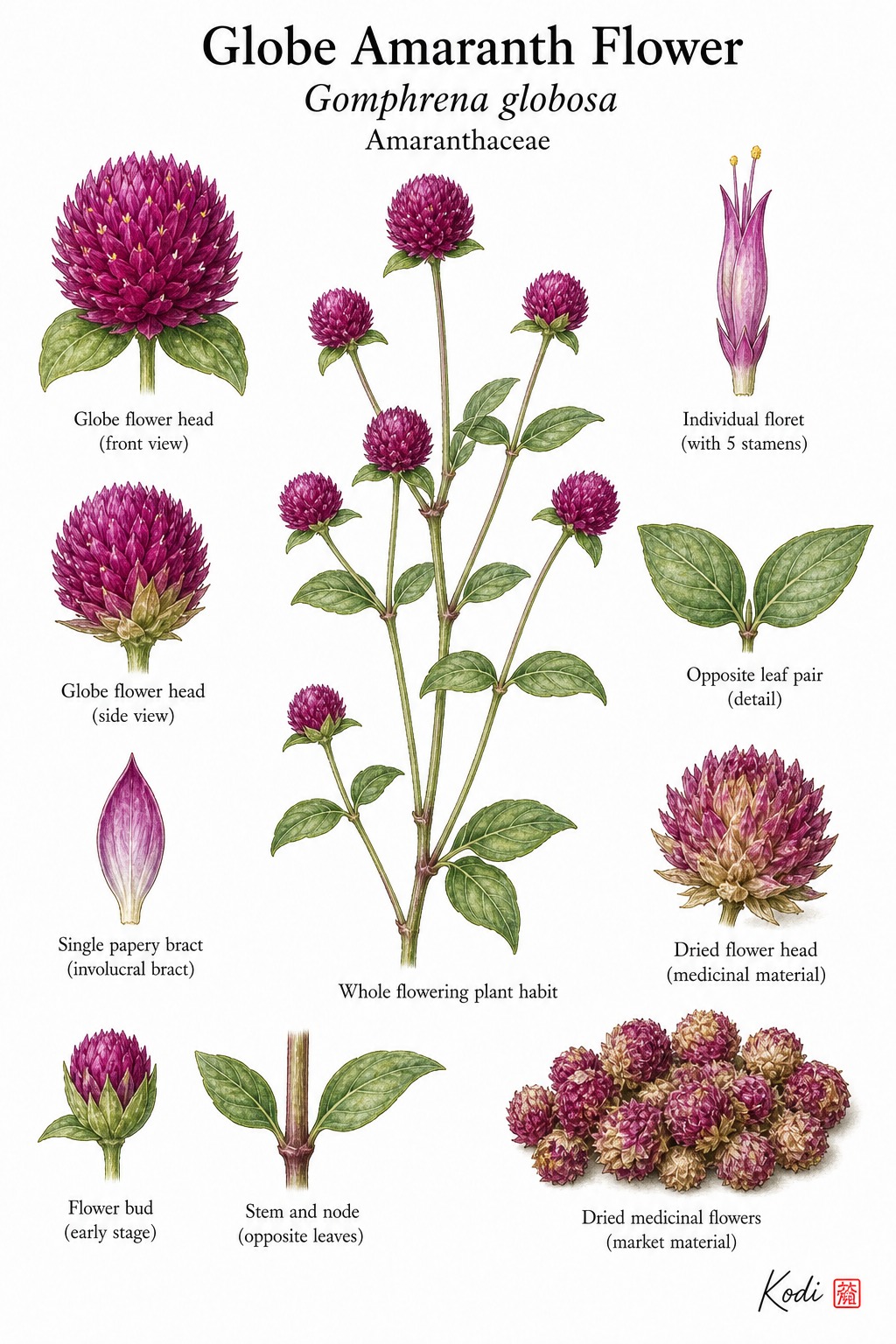
Known in TCM as Qian Ri Hong (千日红), this sweet and slightly salty, neutral herb enters the Liver and Lung. Traditionally, it relieves cough and wheezing - Qian Ri Hong is used for persistent cough, asthma-style shortness of breath, and whooping-cough patterns in folk and textbook tradition, most often applied for cough, wheezing, and conjunctivitis. Modern research has identified Betacyanins among its active constituents.
Part used: Flower
Also Known As
Latin: Flos Gomphrenae | Pinyin: Qian Ri Hong | Chinese: 千日红
TCM Properties
- Taste
- sweet, slightly salty
- Temperature
- neutral
- Channels
- Liver, Lung
Traditional Use
Primary Actions
- Relieves cough and wheezing - Qian Ri Hong is used for persistent cough, asthma-style shortness of breath, and whooping-cough patterns in folk and textbook tradition.
- Clears Liver heat and benefits the eyes - traditional use includes red swollen painful eyes, eye irritation, and headache associated with rising heat.
- Resolves toxicity - the flower and whole herb may be used internally or externally for sores, furuncles, and hot inflammatory lesions.
Secondary Actions
- Qian Ri Hong is often used as a lighter adjunct herb or decocted tea rather than the central heavy hitter in a formula.
- Its dual lung-and-eye reputation makes it distinctive among flower herbs, linking cough and red-eye heat presentations.
Classic Formulas
- Qian Ri Hong with Sang Bai Pi and Pi Pa Ye - common folk pairing for cough, wheezing, and hot phlegm irritation.
- Qian Ri Hong with Ju Hua and Xia Ku Cao - eye-heat combination for red painful eyes with headache or dizziness.
- Topical washes or fresh-pounded applications - traditional method for sores, furuncles, and inflamed skin lesions.
Classical References
- Traditional references describe Qian Ri Hong as sweet, slightly salty, and neutral, entering the Lung and Liver to stop cough, calm wheezing, clear Liver heat, and improve vision.
- Its indications span whooping cough, chronic bronchitic cough, eye redness, headache, and toxic sores, though it is less famous than many standard textbook flower herbs.
- Because it is relatively mild, it is often better as part of a formula than as a stand-alone solution for severe disease.
Modern Research
Active Compounds
- Betacyanins such as gomphrenin and amaranthin derivatives - signature pigments of the flowers
- Arabinoglucan and other polysaccharides - important in hepatoprotective and metabolic studies
- Flavonoids and broader polyphenols - linked to antioxidant and antimicrobial activity
- Coloring-extract fractions from the flowers - studied as food-active antimicrobial materials
Studied Effects
- An active arabinoglucan from Gomphrena globosa protected against metabolic dysfunction-associated steatohepatitis in experimental work, showing meaningful anti-inflammatory and liver-protective potential at the species level (PMID 39567112).
- Gomphrena globosa extract reduced carbon-tetrachloride-induced liver injury in mice by enhancing antioxidant signaling and autophagy, reinforcing the plant's broader anti-inflammatory profile (PMID 36308582).
- Betacyanin-rich flower extracts showed enhanced antimicrobial and antifungal activity in modern testing, supporting the plant's traditional reputation for toxic sores and irritative lesions (PMID 30467561).
PubMed References
- Structural elucidation of an active arabinoglucan from Gomphrena globosa and its protection effect and mechanism against metabolic dysfunction-associated steatohepatitis. (2025)
- Gomphrena globosa L. extract alleviates carbon tetrachoride-induced liver injury in mice by activating antioxidant signaling pathways and promoting autophagy. (2023)
- Enhancing the antimicrobial and antifungal activities of a coloring extract agent rich in betacyanins obtained from Gomphrena globosa L. flowers. (2018)
Safety & Interactions
Contraindications
- Cough or wheezing from severe deficiency cold without heat or irritation
- Eye complaints due purely to deficiency without redness, heat, or inflammation
Cautions
- Qian Ri Hong is relatively mild and is better viewed as supportive rather than as a replacement for urgent care in significant asthma, eye infection, or respiratory distress.
- Most modern evidence comes from species-level preclinical work rather than direct clinical trials of the TCM flower drug itself.
- MSK page not found - drug interaction data not available from Memorial Sloan Kettering integrative medicine database
Conditions
Frequently Asked Questions
What is Globe Amaranth Flower used for?
Globe Amaranth Flower is traditionally used to Relieves cough and wheezing - Qian Ri Hong is used for persistent cough, asthma-style shortness of breath, and whooping-cough patterns in folk and textbook tradition., Clears Liver heat and benefits the eyes - traditional use includes red swollen painful eyes, eye irritation, and headache associated with rising heat., Resolves toxicity - the flower and whole herb may be used internally or externally for sores, furuncles, and hot inflammatory lesions.. Research has investigated its effects on: An active arabinoglucan from Gomphrena globosa protected against metabolic dysfunction-associated steatohepatitis in experimental work, showing meaningful anti-inflammatory and liver-protective potential at the species level (PMID 39567112).; Gomphrena globosa extract reduced carbon-tetrachloride-induced liver injury in mice by enhancing antioxidant signaling and autophagy, reinforcing the plant's broader anti-inflammatory profile (PMID 36308582)..
What are other names for Globe Amaranth Flower?
Globe Amaranth Flower is also known as Gomphrena. In TCM: 千日红 (Qian Ri Hong); Flos Gomphrenae.
Is Globe Amaranth Flower safe during pregnancy?
The safety of Globe Amaranth Flower during pregnancy has not been established. Consult a qualified healthcare provider before use.
What are the contraindications for Globe Amaranth Flower?
Globe Amaranth Flower should not be used in: Cough or wheezing from severe deficiency cold without heat or irritation; Eye complaints due purely to deficiency without redness, heat, or inflammation. Consult a qualified practitioner before use.