Hyacinth Bean Flower
- Chinese
- 扁豆花
- Pinyin
- Bian Dou Hua
- Latin
- Flos Dolichoris
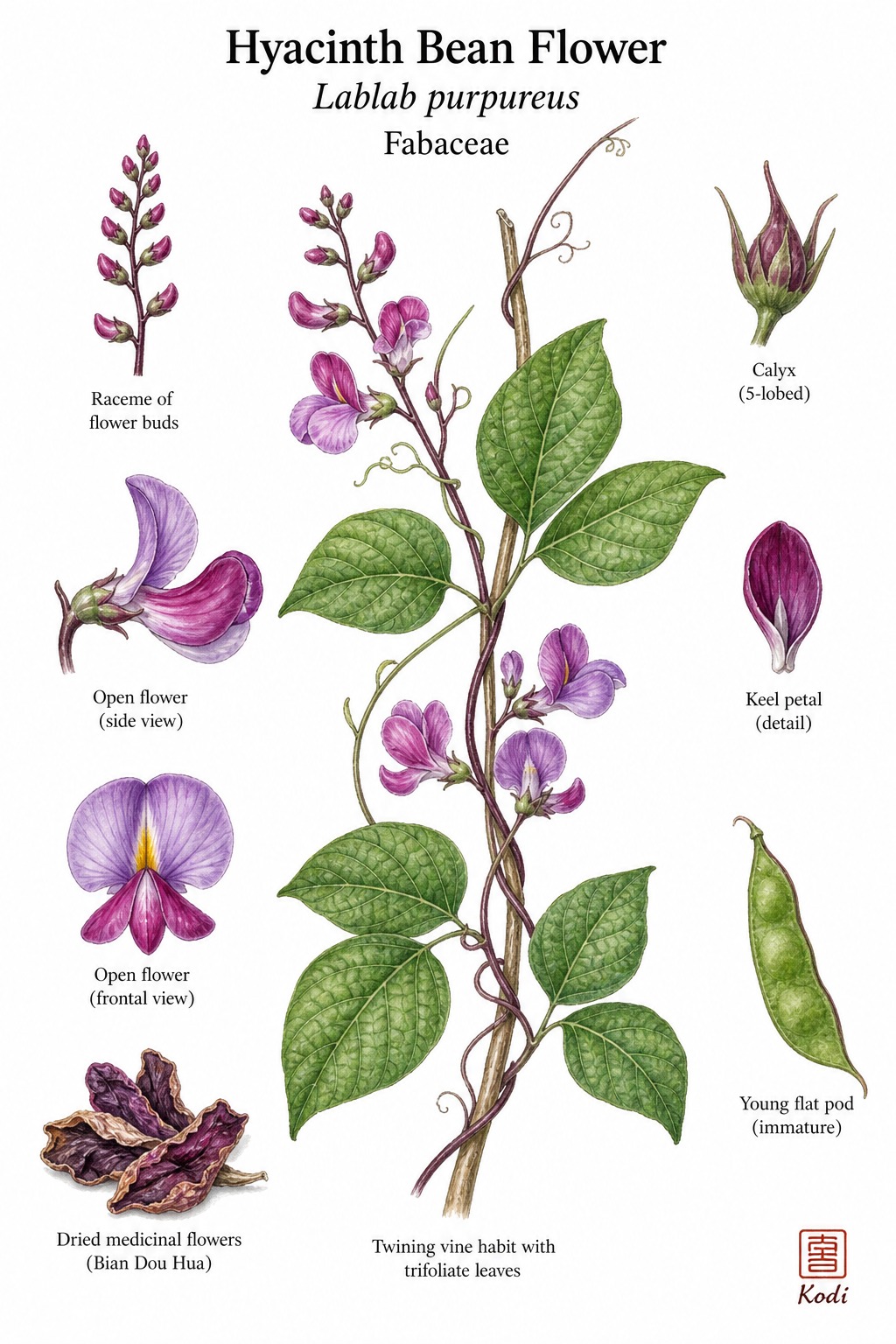
Known in TCM as Bian Dou Hua (扁豆花), this sweet, neutral herb enters the Spleen, Stomach, and Large Intestine. Traditionally, it relieves summer-heat and transforms dampness - Bian Dou Hua is used when hot humid weather disrupts digestion with loose stool, nausea, heaviness, or poor appetite, most often applied for diarrhea, leukorrhea, and poor appetite. Modern research has identified Flavonoids among its active constituents.
Part used: Flower
Also Known As
Latin: Flos Dolichoris | Pinyin: Bian Dou Hua | Chinese: 扁豆花
TCM Properties
- Taste
- sweet
- Temperature
- neutral
- Channels
- Spleen, Stomach, Large Intestine
Traditional Use
Primary Actions
- Relieves summer-heat and transforms dampness - Bian Dou Hua is used when hot humid weather disrupts digestion with loose stool, nausea, heaviness, or poor appetite.
- Strengthens the Spleen and harmonizes the middle burner - it supports weak digestion when dampness and food stagnation make the abdomen feel uncomfortable or sluggish.
- Stops diarrhea and addresses abnormal discharge - textbook indications include summer-damp diarrhea and leukorrhea, especially when the discharge is persistent but not severely cold.
Secondary Actions
- Bian Dou Hua is milder and more damp-harmonizing than many bitter heat-clearing herbs, so it often suits mixed deficiency-and-damp presentations.
- The flower is distinct from Bai Bian Dou seed: the seed is better known for tonifying the Spleen, while the flower is more summer-damp and discharge focused.
Classic Formulas
- Bian Dou Hua with Huo Xiang and Pei Lan - summer-damp combination for loose stool, nausea, heaviness, and poor appetite in humid weather.
- Bian Dou Hua with Bai Bian Dou and Fu Ling - Spleen-supporting approach for damp diarrhea and chronic digestive weakness.
- Bian Dou Hua with Qian Shi or Bai Zhu - traditional pairing for leukorrhea and lower-burner dampness with weak digestion.
Classical References
- TCM references describe Bian Dou Hua as sweet and neutral, entering the Spleen, Stomach, and Large Intestine to relieve summer-heat, resolve dampness, and harmonize digestion.
- Its key indications are diarrhea from summer-damp and leukorrhea, which makes it more specific than many generic Spleen-tonifying beans or flowers.
- Because it is gentle, it is commonly used in moderate mixed patterns instead of severe acute heat-toxin states.
Modern Research
Active Compounds
- Flavonoids from Lablab Flos Alba - major anti-inflammatory candidates in the white flower
- Phenolic acids - repeatedly identified in flower-focused chemical studies
- Species-level polysaccharide and polyphenol fractions - relevant to gut and inflammatory research
- Other secondary metabolites from flowers and aerial parts - increasingly studied for inflammasome effects
Studied Effects
- Flavonoids and phenolic acids isolated from Lablab Flos Alba showed anti-inflammatory activity through the NLRP3 inflammasome pathway, directly supporting the flower's modern pharmacology profile (PMID 40233859).
- A 2024 study on constituents from Dolichos lablab flowers found anti-inflammatory effects via inhibition of IL-1beta release, reinforcing the relevance of the flower rather than only the seed (PMID 39202831).
- Whole-plant chemical-composition work showed anti-ulcerative-colitis effects linked to gut microbiota and host-metabolism modulation, which fits the broader digestive-damp tradition around Lablab species (PMID 38135234).
PubMed References
- Flavonoids and phenolic acids from Lablab Flos Alba and their anti-inflammatory activity via NLRP3 inflammasome. (2025)
- Constituents from Dolichos lablab L. Flowers and Their Anti-Inflammatory Effects via Inhibition of IL-1beta Release. (2024)
- Characterization of the chemical composition of different parts of Dolichos lablab L. and revelation of its anti-ulcerative colitis effects by modulating the gut microbiota and host metabolism. (2024)
Safety & Interactions
Contraindications
- Constipation or dry heat without dampness
- Acute invasive infection in which a mild harmonizing herb is too weak for the severity of the pattern
Cautions
- Bian Dou Hua is a gentle damp-summer herb and should not be expected to manage severe dehydration, persistent high fever, or serious infectious diarrhea by itself.
- Most modern evidence is preclinical and often species-level rather than direct clinical proof for the classical flower indications.
- MSK page not found - drug interaction data not available from Memorial Sloan Kettering integrative medicine database
Conditions
- Diarrhea Traditional ★★★★☆ JSON
- Leukorrhea Traditional ★★★☆☆ JSON
- Poor Appetite Traditional ★★☆☆☆ JSON
- Digestive Weakness Traditional ★★☆☆☆ JSON
Frequently Asked Questions
What is Hyacinth Bean Flower used for?
Hyacinth Bean Flower is traditionally used to Relieves summer-heat and transforms dampness - Bian Dou Hua is used when hot humid weather disrupts digestion with loose stool, nausea, heaviness, or poor appetite., Strengthens the Spleen and harmonizes the middle burner - it supports weak digestion when dampness and food stagnation make the abdomen feel uncomfortable or sluggish., Stops diarrhea and addresses abnormal discharge - textbook indications include summer-damp diarrhea and leukorrhea, especially when the discharge is persistent but not severely cold.. Research has investigated its effects on: Flavonoids and phenolic acids isolated from Lablab Flos Alba showed anti-inflammatory activity through the NLRP3 inflammasome pathway, directly supporting the flower's modern pharmacology profile (PMID 40233859).; A 2024 study on constituents from Dolichos lablab flowers found anti-inflammatory effects via inhibition of IL-1beta release, reinforcing the relevance of the flower rather than only the seed (PMID 39202831)..
What are other names for Hyacinth Bean Flower?
Hyacinth Bean Flower is also known as Dolichoris. In TCM: 扁豆花 (Bian Dou Hua); Flos Dolichoris.
Is Hyacinth Bean Flower safe during pregnancy?
The safety of Hyacinth Bean Flower during pregnancy has not been established. Consult a qualified healthcare provider before use.
What are the contraindications for Hyacinth Bean Flower?
Hyacinth Bean Flower should not be used in: Constipation or dry heat without dampness; Acute invasive infection in which a mild harmonizing herb is too weak for the severity of the pattern. Consult a qualified practitioner before use.