Inula Flower
- Chinese
- 旋覆花
- Pinyin
- Xuan Fu Hua
- Latin
- Flos Inulae
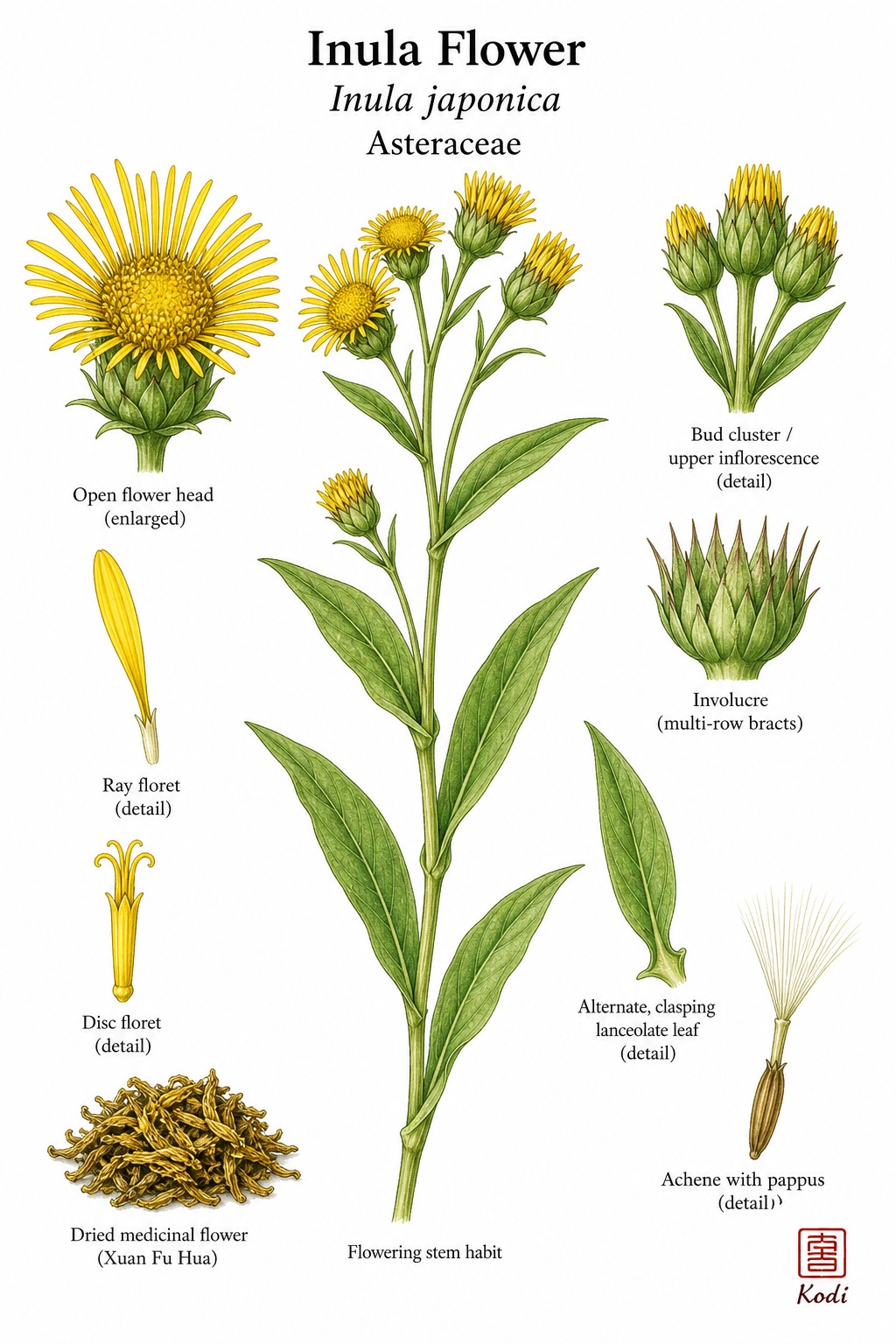
Known in TCM as Xuan Fu Hua (旋覆花), this bitter and acrid and salty, slightly warm herb enters the Liver, Lung, Spleen, and Stomach. Traditionally, it descends rebellious qi and transforms phlegm - Xuan Fu Hua is classically used for productive cough, chest fullness, wheezing, and a sense that qi is stuck in the chest or diaphragm, most often applied for productive cough, wheezing, and nausea. Modern research has identified Sesquiterpene among its active constituents.
Part used: Flower
Also Known As
Latin: Flos Inulae | Pinyin: Xuan Fu Hua | Chinese: 旋覆花
TCM Properties
- Taste
- bitter, acrid, salty
- Temperature
- slightly warm
- Channels
- Liver, Lung, Spleen, Stomach
Traditional Use
Primary Actions
- Descends rebellious qi and transforms phlegm - Xuan Fu Hua is classically used for productive cough, chest fullness, wheezing, and a sense that qi is stuck in the chest or diaphragm.
- Stops vomiting and redirects Stomach qi downward - it is especially valued when nausea, hiccup, belching, or retching occur together with phlegm, fullness, or weakness after illness.
- Softens clumps and disperses constrained phlegm - later uses extend to hard phlegm accumulation or focal chest oppression when the phlegm is stubborn and difficult to move.
Secondary Actions
- Xuan Fu Hua sits at the intersection of Lung and Stomach patterns, which is why it appears in formulas for both cough and rebellious digestion.
- Because the flower hairs can irritate the throat, it is often wrapped for decoction rather than simmered loose.
Classic Formulas
- Xuan Fu Dai Zhe Tang - classic formula for belching, hiccup, nausea, and focal epigastric fullness from rebellious Stomach qi.
- Xuan Fu Hua with Ban Xia and Chen Pi - common phlegm-and-cough pairing for chest oppression, nausea, and productive cough.
- Xuan Fu Hua with Dai Zhe Shi and Sheng Jiang - downward-directing strategy when vomiting and phlegm obstruction occur together.
Classical References
- Traditional herbology lists Xuan Fu Hua as bitter, acrid, salty, and slightly warm, with a special ability to direct Lung and Stomach qi downward.
- Its best-known textbook role is the combination of phlegm, cough, nausea, and belching rather than isolated dry cough or simple indigestion alone.
- Modern teaching also stresses the need to decoct it in a bag because of its irritating hairs.
Modern Research
Active Compounds
- Sesquiterpene lactones such as inula flower anti-inflammatory constituents - central to modern pharmacology work
- Flavonoids and phenolic acids - supportive antioxidant and anti-inflammatory fractions
- Chlorogenic-acid-related compounds - part of the broader aerial-part profile
- Other bioactive constituents from Inula japonica flowers - studied for inflammatory and enzyme-modulating activity
Studied Effects
- A 2023 review summarized the phytochemistry and pharmacology of Inula japonica, emphasizing anti-inflammatory, antioxidant, antitumor, and hepatoprotective signals while noting that clinical confirmation remains limited (PMID 36617177).
- A 2019 review of Inula species documented antioxidant, antibacterial, hepatoprotective, cytotoxic, and neuroprotective activities across the genus, supporting the relevance of sesquiterpene-rich flower chemistry (PMID 31398451).
- An Inula japonica extract inhibited airway-allergic responses in experimental asthma work, offering a modern bridge to the herb's classic use for cough and wheezing with phlegm (PMID 22728246).
PubMed References
Safety & Interactions
Contraindications
- Dry cough from yin deficiency without phlegm or qi rebellion
- Active bleeding or severe heat that is worsened by warm descending herbs
Cautions
- The flower hairs can irritate the throat or trigger coughing if the herb is not properly wrapped during decoction.
- Xuan Fu Hua is best when phlegm and rebellious qi are central; it is less appropriate for simple dry irritation without sputum or fullness.
- MSK page not found - drug interaction data not available from Memorial Sloan Kettering integrative medicine database
Conditions
- Productive Cough Traditional ★★★★☆ JSON
- Wheezing Traditional ★★★☆☆ JSON
- Nausea Traditional ★★★☆☆ JSON
- Phlegm Accumulation Traditional ★★★☆☆ JSON
Frequently Asked Questions
What is Inula Flower used for?
Inula Flower is traditionally used to Descends rebellious qi and transforms phlegm - Xuan Fu Hua is classically used for productive cough, chest fullness, wheezing, and a sense that qi is stuck in the chest or diaphragm., Stops vomiting and redirects Stomach qi downward - it is especially valued when nausea, hiccup, belching, or retching occur together with phlegm, fullness, or weakness after illness., Softens clumps and disperses constrained phlegm - later uses extend to hard phlegm accumulation or focal chest oppression when the phlegm is stubborn and difficult to move.. Research has investigated its effects on: A 2023 review summarized the phytochemistry and pharmacology of Inula japonica, emphasizing anti-inflammatory, antioxidant, antitumor, and hepatoprotective signals while noting that clinical confirmation remains limited (PMID 36617177).; A 2019 review of Inula species documented antioxidant, antibacterial, hepatoprotective, cytotoxic, and neuroprotective activities across the genus, supporting the relevance of sesquiterpene-rich flower chemistry (PMID 31398451)..
What are other names for Inula Flower?
Inula Flower is also known as Inula. In TCM: 旋覆花 (Xuan Fu Hua); Flos Inulae.
Is Inula Flower safe during pregnancy?
The safety of Inula Flower during pregnancy has not been established. Consult a qualified healthcare provider before use.
What are the contraindications for Inula Flower?
Inula Flower should not be used in: Dry cough from yin deficiency without phlegm or qi rebellion; Active bleeding or severe heat that is worsened by warm descending herbs. Consult a qualified practitioner before use.