Largeleaf Gentian Flower
- Chinese
- 秦艽花
- Pinyin
- Qin Jiao Hua
- Latin
- Flos Gentianae Macrophyllae
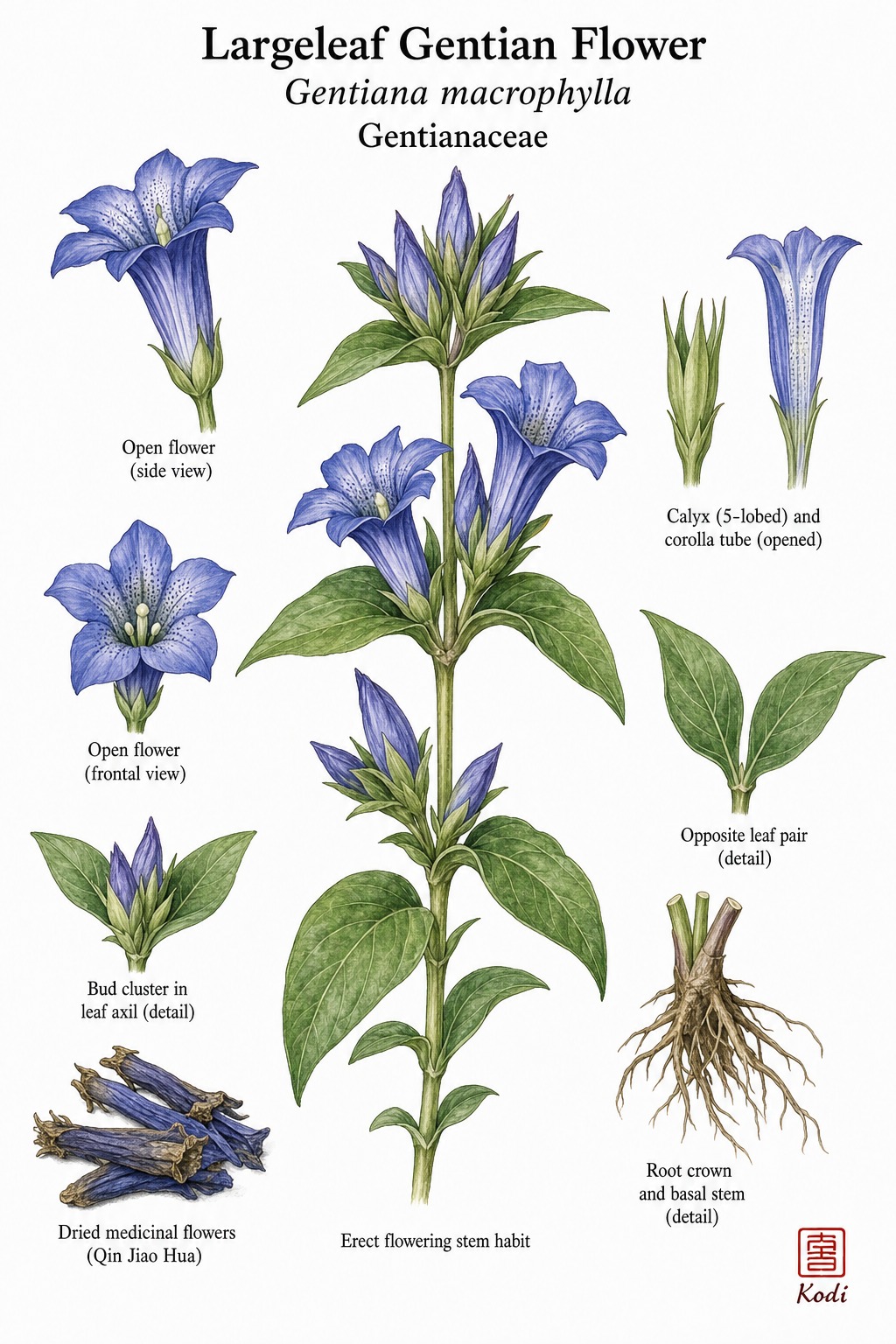
Known in TCM as Qin Jiao Hua (秦艽花), this bitter, slightly cold herb enters the Liver and Stomach. Traditionally, it clears heat and reduces inflammatory swelling - regional Mongolian and Tibetan usage emphasizes the flower for hot painful conditions and inflammatory disorders, most often applied for rheumatoid arthritis, joint pain, and tonsillitis. Modern research has identified Iridoid among its active constituents.
Part used: Flower
Also Known As
Latin: Flos Gentianae Macrophyllae | Pinyin: Qin Jiao Hua | Chinese: 秦艽花
TCM Properties
- Taste
- bitter
- Temperature
- slightly cold
- Channels
- Liver, Stomach
Traditional Use
Primary Actions
- Clears heat and reduces inflammatory swelling - regional Mongolian and Tibetan usage emphasizes the flower for hot painful conditions and inflammatory disorders.
- Relieves painful obstruction in the joints - traditional use extends to rheumatic pain, swollen joints, and stiffness, especially when heat and inflammation are obvious.
- Benefits the throat and damp-heat disorders - later regional practice also uses the flower for sore throat, tonsillar inflammation, jaundice, and hepatitis-type heat patterns.
Secondary Actions
- Qin Jiao Hua is not as mainstream in standard Han herbology as Qin Jiao root, and much of its traditional identity comes through regional northern, Mongolian, and Tibetan medicine.
- The flower shares gentian-style bitter iridoid chemistry with the root but has its own quality profile and should not be assumed identical in emphasis.
Classic Formulas
- Qin Jiao Hua with Qin Jiao root and other wind-damp herbs - regional strategy for hot arthralgia and swollen painful joints.
- Qin Jiao Hua with Ban Lan Gen or other heat-clearing herbs - throat and toxic-heat approach for inflamed upper-airway patterns.
- Regional decoctions and capsules for jaundice-hepatitis and inflammatory pain - more characteristic than famous pan-Chinese classical formulas for this entry.
Classical References
- Ethnopharmacologic literature notes that Gentiana macrophylla flowers are traditionally used in Mongolian medicine as anti-inflammatory agents to clear heat.
- Modern regional summaries describe Qin Jiao Hua as a distinct flower drug for rheumatoid-style pain, jaundice, hepatitis, tonsillitis, and inflammatory swelling.
- Its tradition is narrower and more regional than the textbook reputation of Qin Jiao root, so conservative wording is appropriate.
Modern Research
Active Compounds
- Iridoid glycosides such as loganic acid and gentiopicroside - major quality and activity markers
- Sweroside and related seco-iridoids - repeatedly reported in flower and root profiling
- Swertiamarin-class gentian compounds - part of the broader anti-inflammatory fraction
- Other bitter gentian constituents that vary by plant part - important in quality-comparison studies
Studied Effects
- A 2025 comparative analysis of Gentiana macrophylla found meaningful chemical differences across plant parts, supporting the need to evaluate the flower on its own rather than assuming the same profile as the root (PMID 40740219).
- Iridoid glycosides isolated from Gentiana macrophylla flowers improved collagen-induced arthritis in rats, directly supporting the flower's traditional inflammatory-joint use (PMID 27180880).
- Ethnopharmacologic investigation highlighted that the flowers are traditionally used in Mongolian medicine as anti-inflammatory agents to clear heat, giving context for their continued regional medicinal use (PMID 26116164).
PubMed References
- A comparative chemical composition and main component content of various parts of Gentiana macrophylla Pall. by UPLC-Q-orbitrap MS and HPLC. (2025)
- Iridoid glycosides from the flowers of Gentiana macrophylla Pall. ameliorate collagen-induced arthritis in rats. (2016)
- Anti-inflammatory activity-guided chemical constituents of Gentiana macrophylla Pall. on lipopolysaccharide-stimulated RAW 264.7 cells. (2015)
Safety & Interactions
Contraindications
- Cold deficiency without signs of heat or inflammatory obstruction
- Very weak digestion that does not tolerate bitter cold herbs
Cautions
- Qin Jiao Hua has a more regional evidence base than many mainstream TCM herbs, so its traditional indications should be stated conservatively.
- The flower and root are related but not interchangeable in chemistry, and quality standards for flower material are still developing.
- MSK page not found - drug interaction data not available from Memorial Sloan Kettering integrative medicine database
Conditions
- Rheumatoid Arthritis Traditional ★★★☆☆ JSON
- Joint Pain Traditional ★★★☆☆ JSON
- Tonsillitis Traditional ★★☆☆☆ JSON
- Hepatitis Traditional ★★☆☆☆ JSON
Frequently Asked Questions
What is Largeleaf Gentian Flower used for?
Largeleaf Gentian Flower is traditionally used to Clears heat and reduces inflammatory swelling - regional Mongolian and Tibetan usage emphasizes the flower for hot painful conditions and inflammatory disorders., Relieves painful obstruction in the joints - traditional use extends to rheumatic pain, swollen joints, and stiffness, especially when heat and inflammation are obvious., Benefits the throat and damp-heat disorders - later regional practice also uses the flower for sore throat, tonsillar inflammation, jaundice, and hepatitis-type heat patterns.. Research has investigated its effects on: A 2025 comparative analysis of Gentiana macrophylla found meaningful chemical differences across plant parts, supporting the need to evaluate the flower on its own rather than assuming the same profile as the root (PMID 40740219).; Iridoid glycosides isolated from Gentiana macrophylla flowers improved collagen-induced arthritis in rats, directly supporting the flower's traditional inflammatory-joint use (PMID 27180880)..
What are other names for Largeleaf Gentian Flower?
Largeleaf Gentian Flower is also known as Gentiana. In TCM: 秦艽花 (Qin Jiao Hua); Flos Gentianae Macrophyllae.
Is Largeleaf Gentian Flower safe during pregnancy?
The safety of Largeleaf Gentian Flower during pregnancy has not been established. Consult a qualified healthcare provider before use.
What are the contraindications for Largeleaf Gentian Flower?
Largeleaf Gentian Flower should not be used in: Cold deficiency without signs of heat or inflammatory obstruction; Very weak digestion that does not tolerate bitter cold herbs. Consult a qualified practitioner before use.