Buddleja Flower
- Chinese
- 密蒙花
- Pinyin
- Mi Meng Hua
- Latin
- Flos Buddlejae
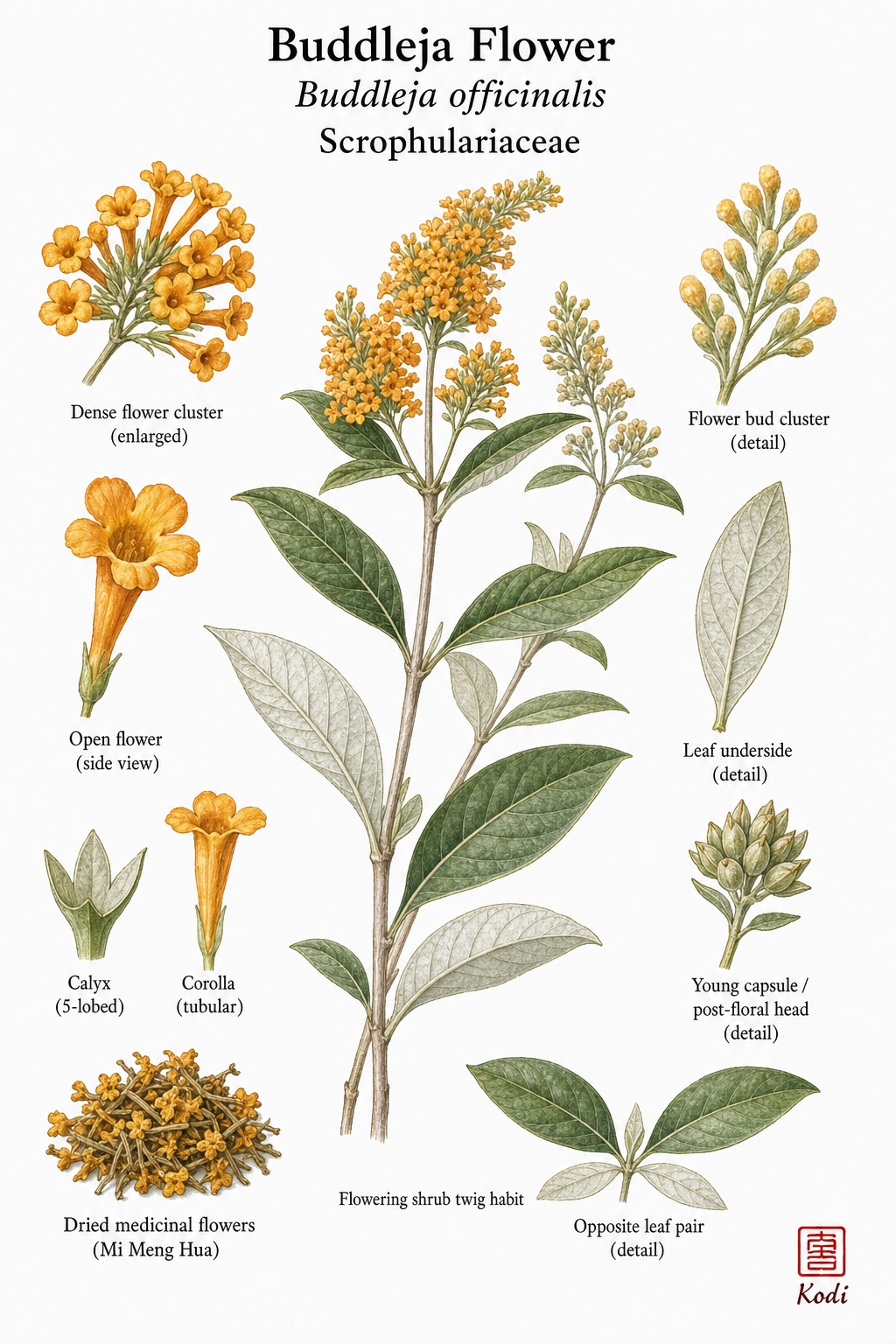
Known in TCM as Mi Meng Hua (密蒙花), this sweet, slightly cold herb enters the Liver. Traditionally, it clears Liver heat and improves vision - Mi Meng Hua is classically used for red painful eyes, glare, tearing, and blurred vision when heat or wind rises to the eyes, most often applied for blurred vision, conjunctivitis, and headache. Modern research has identified Acidic among its active constituents.
Part used: Flower
Also Known As
Latin: Flos Buddlejae | Pinyin: Mi Meng Hua | Chinese: 密蒙花
TCM Properties
- Taste
- sweet
- Temperature
- slightly cold
- Channels
- Liver
Traditional Use
Primary Actions
- Clears Liver heat and improves vision - Mi Meng Hua is classically used for red painful eyes, glare, tearing, and blurred vision when heat or wind rises to the eyes.
- Removes superficial visual obstruction - it is especially valued for nebula-style opacity, corneal haze, photophobia, and lingering eye cloudiness.
- Supports deficient or irritated vision patterns when paired appropriately - compared with harsher wind-dispersing eye herbs, Mi Meng Hua can be used in more mixed eye patterns that include weakness or chronicity.
Secondary Actions
- Mi Meng Hua is commonly paired with Mu Zei, Ju Hua, Jue Ming Zi, or Qing Xiang Zi, depending on whether the problem is more wind-heat, superficial obstruction, or Liver-fire excess.
- Its action is highly eye-specific and it is rarely chosen for broad systemic heat-clearing without a visual complaint.
Classic Formulas
- Mi Meng Hua with Mu Zei and Jue Ming Zi - classic vision-clearing combination for corneal haze, glare, and blurred vision.
- Mi Meng Hua with Ju Hua and Chan Tui - wind-heat eye strategy for redness, tearing, photophobia, and superficial irritation.
- Mi Meng Hua with Gou Qi Zi or Nu Zhen Zi - more mixed formulas when chronic visual weakness coexists with heat or irritation.
Classical References
- Traditional herbology describes Mi Meng Hua as sweet and slightly cold, entering the Liver to clear heat and improve vision.
- It is best known for tui yi-style superficial eye opacity and chronic blurred vision rather than for severe systemic heat disorders.
- Modern teaching often contrasts it with more dispersing eye herbs by noting that Mi Meng Hua can fit somewhat more chronic or deficiency-mixed presentations.
Modern Research
Active Compounds
- Acidic polysaccharides - studied for retinal and angiogenesis-related effects
- Flavonoids including linarin-related compounds - central to dry-eye and ocular-inflammation work
- Glycosides from Buddleja officinalis - investigated for photoreceptor protection
- Phenylethanoid and other eye-active plant constituents - part of the flower's modern ophthalmic profile
Studied Effects
- Acidic polysaccharides from Buddleja officinalis inhibited angiogenesis through the Nrf2/ARE pathway in a diabetic-retinopathy model, directly supporting modern interest in the herb's eye focus (PMID 35942925).
- Glycosides from Buddleja officinalis protected photoreceptor cells in light-damaged mouse retinas, offering a modern correlate for Mi Meng Hua's traditional vision-support role (PMID 34176391).
- A 2024 in vitro profiling study explored Buddleja officinalis flower extracts in the setting of dry eye disease, adding contemporary mechanistic support to the herb's classical ophthalmic niche (PMID 39541792).
PubMed References
- Acidic polysaccharides from Buddleja officinalis inhibit angiogenesis via the Nrf2/ARE pathway to attenuate diabetic retinopathy. (2022)
- Glycosides from Buddleja officinalis with their protective effects on photoreceptor cells in light-damaged mouse retinas. (2022)
- Pharmacological in vitro profiling of Buddleja officinalis flower extracts in the context of dry eye disease. (2024)
Safety & Interactions
Contraindications
- Visual complaints from marked deficiency without redness, irritation, or superficial obstruction
- Digestive weakness that worsens with repeated use of cooling eye herbs
Cautions
- Mi Meng Hua is an eye-focused herb and should not delay urgent ophthalmic evaluation for acute vision loss, severe pain, or eye trauma.
- Most modern evidence is preclinical or in vitro, so classical eye indications still rely mainly on traditional use rather than confirmed clinical trials.
- MSK page not found - drug interaction data not available from Memorial Sloan Kettering integrative medicine database
Conditions
- Blurred Vision Traditional ★★★★☆ JSON
- Conjunctivitis Traditional ★★★☆☆ JSON
- Headache Traditional ★★☆☆☆ JSON
- Wind Heat Traditional ★★☆☆☆ JSON
Frequently Asked Questions
What is Buddleja Flower used for?
Buddleja Flower is traditionally used to Clears Liver heat and improves vision - Mi Meng Hua is classically used for red painful eyes, glare, tearing, and blurred vision when heat or wind rises to the eyes., Removes superficial visual obstruction - it is especially valued for nebula-style opacity, corneal haze, photophobia, and lingering eye cloudiness., Supports deficient or irritated vision patterns when paired appropriately - compared with harsher wind-dispersing eye herbs, Mi Meng Hua can be used in more mixed eye patterns that include weakness or chronicity.. Research has investigated its effects on: Acidic polysaccharides from Buddleja officinalis inhibited angiogenesis through the Nrf2/ARE pathway in a diabetic-retinopathy model, directly supporting modern interest in the herb's eye focus (PMID 35942925).; Glycosides from Buddleja officinalis protected photoreceptor cells in light-damaged mouse retinas, offering a modern correlate for Mi Meng Hua's traditional vision-support role (PMID 34176391)..
What are other names for Buddleja Flower?
Buddleja Flower is also known as Buddleja. In TCM: 密蒙花 (Mi Meng Hua); Flos Buddlejae.
Is Buddleja Flower safe during pregnancy?
The safety of Buddleja Flower during pregnancy has not been established. Consult a qualified healthcare provider before use.
What are the contraindications for Buddleja Flower?
Buddleja Flower should not be used in: Visual complaints from marked deficiency without redness, irritation, or superficial obstruction; Digestive weakness that worsens with repeated use of cooling eye herbs. Consult a qualified practitioner before use.