Fourleaf Ladybell Root
- Chinese
- 南沙参
- Pinyin
- Nan Sha Shen
- Latin
- Radix Adenophorae
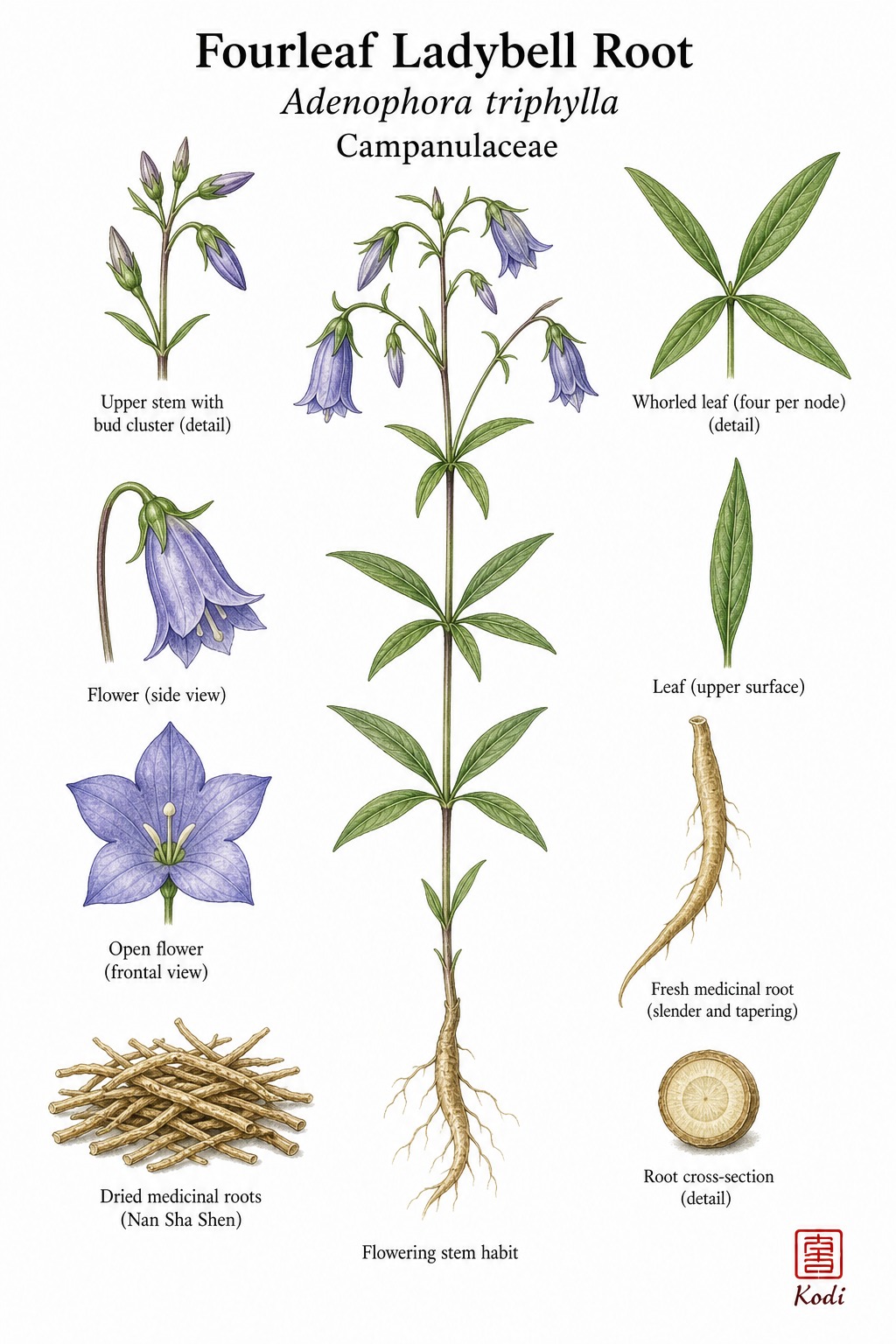
Known in TCM as Nan Sha Shen (南沙参), this sweet and slightly bitter, slightly cold herb enters the Lung and Stomach. Traditionally, it nourishes Lung Yin and moistens dryness - Nan Sha Shen is used for chronic dry cough, scant sticky sputum, throat dryness, hoarseness, and mild blood-streaking from dryness-heat, most often applied for dry cough, yin deficiency, and cough. Modern research has identified Pectic among its active constituents.
Part used: Root
Also Known As
Latin: Radix Adenophorae | Pinyin: Nan Sha Shen | Chinese: 南沙参
TCM Properties
- Taste
- sweet, slightly bitter
- Temperature
- slightly cold
- Channels
- Lung, Stomach
Traditional Use
Primary Actions
- Nourishes Lung Yin and moistens dryness - Nan Sha Shen is used for chronic dry cough, scant sticky sputum, throat dryness, hoarseness, and mild blood-streaking from dryness-heat.
- Nourishes Stomach Yin and generates fluids - it is chosen for dry mouth, thirst, hunger without appetite, and fluid depletion after warm disease or chronic illness.
- Benefits deficient Lung Qi while helping loosen phlegm - compared with Bei Sha Shen it is often considered somewhat better when dryness and deficiency coexist with lingering phlegm or weak appetite.
Secondary Actions
- Nan Sha Shen is usually described as gentler and a little less cold than Bei Sha Shen, while being somewhat better at benefiting Qi within dryness patterns.
- It is especially useful when Lung and Stomach dryness coexist with fragile digestion rather than with robust excess heat.
Classic Formulas
- Sha Shen Mai Dong Tang - classic Lung-Stomach dryness formula in which Sha Shen moistens and rebuilds depleted fluids.
- Yi Wei Tang - Stomach-Yin formula that commonly pairs Nan Sha Shen with Yu Zhu, Mai Men Dong, and Sheng Di Huang.
Classical References
- TCM Wiki describes Nan Sha Shen as sweet, slightly bitter, and slightly cold, entering the Lung and Stomach to nourish yin, clear heat, tonify qi, and dispel phlegm.
- Traditional formula commentary repeatedly places Nan Sha Shen in Lung-Stomach dryness patterns with cough, thirst, and weak appetite.
Modern Research
Active Compounds
- Pectic polysaccharides and other water-soluble saccharides - major macromolecular fractions of Adenophora root
- Lupenone, lupeol, and related triterpenes - bioactive constituents reported from medicinal Adenophora species
- Phenylpropanoid and polyphenolic fractions - supportive antioxidant constituents in modern profiling work
Studied Effects
- An animal study reported that Adenophorae Radix powder had antitussive, expectorant, and anti-inflammatory effects, supporting the traditional respiratory use of the herb family (PMID 31039428).
- A 2025 study on Adenophora tetraphylla pectins found meaningful antioxidant capacity and characterized the structural features of the polysaccharide fraction (PMID 40142075).
- Modern literature often spans several medicinal Adenophora species, so species-level extrapolation should stay conservative when moving from pharmacology papers back to the exact Chinese crude drug.
PubMed References
Safety & Interactions
Contraindications
- Cold-damp cough with copious thin sputum and loose stool from Spleen Yang deficiency
- Traditional incompatibility with Li Lu
Cautions
- Traditional materia medica note antagonism with Li Lu.
- Modern research often combines multiple Adenophora species or regional substitutes, so authenticated identity remains helpful.
- MSK page not found - drug interaction data not available from Memorial Sloan Kettering integrative medicine database
Conditions
- Dry Cough Traditional ★★★★☆ JSON
- Yin Deficiency Traditional ★★★★☆ JSON
- Cough Traditional ★★★☆☆ JSON
- Poor Appetite Traditional ★★☆☆☆ JSON
Frequently Asked Questions
What is Fourleaf Ladybell Root used for?
Fourleaf Ladybell Root is traditionally used to Nourishes Lung Yin and moistens dryness - Nan Sha Shen is used for chronic dry cough, scant sticky sputum, throat dryness, hoarseness, and mild blood-streaking from dryness-heat., Nourishes Stomach Yin and generates fluids - it is chosen for dry mouth, thirst, hunger without appetite, and fluid depletion after warm disease or chronic illness., Benefits deficient Lung Qi while helping loosen phlegm - compared with Bei Sha Shen it is often considered somewhat better when dryness and deficiency coexist with lingering phlegm or weak appetite.. Research has investigated its effects on: An animal study reported that Adenophorae Radix powder had antitussive, expectorant, and anti-inflammatory effects, supporting the traditional respiratory use of the herb family (PMID 31039428).; A 2025 study on Adenophora tetraphylla pectins found meaningful antioxidant capacity and characterized the structural features of the polysaccharide fraction (PMID 40142075)..
What are other names for Fourleaf Ladybell Root?
Fourleaf Ladybell Root is also known as Adenophora. In TCM: 南沙参 (Nan Sha Shen); Radix Adenophorae.
Is Fourleaf Ladybell Root safe during pregnancy?
The safety of Fourleaf Ladybell Root during pregnancy has not been established. Consult a qualified healthcare provider before use.
What are the contraindications for Fourleaf Ladybell Root?
Fourleaf Ladybell Root should not be used in: Cold-damp cough with copious thin sputum and loose stool from Spleen Yang deficiency; Traditional incompatibility with Li Lu. Consult a qualified practitioner before use.