Fourstamen Stephania Root
- Chinese
- 汉防己
- Pinyin
- Han Fang Ji
- Latin
- Radix Stephaniae Tetrandrae
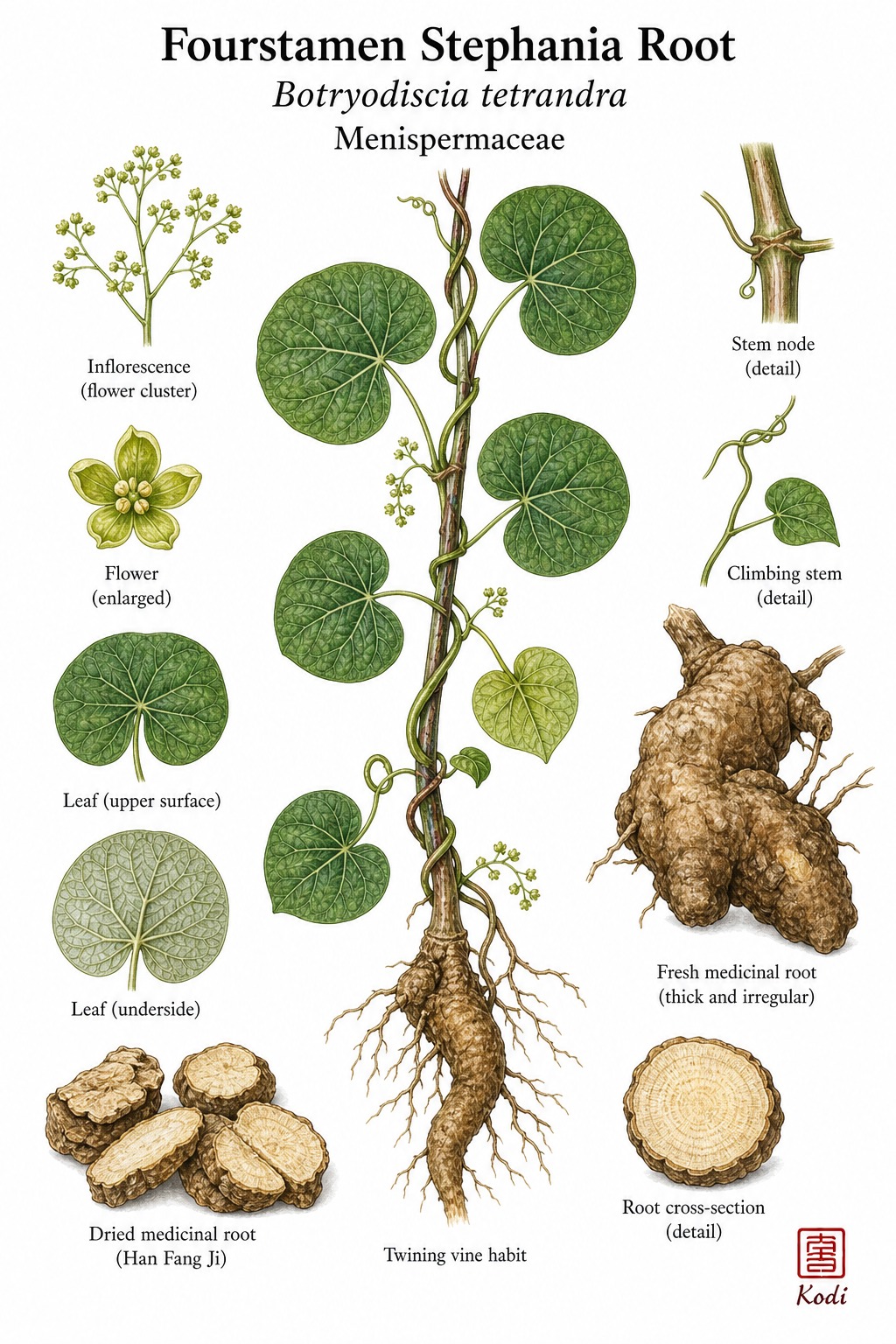
Known in TCM as Han Fang Ji (汉防己), this bitter and pungent, cold herb enters the Liver, Kidney, and Bladder. Traditionally, it dispels wind-damp and alleviates painful obstruction - Han Fang Ji is especially valued for red, swollen, heavy, painful joints when damp-heat predominates in the channels, most often applied for edema, joint pain, and rheumatoid arthritis. Modern research has identified Tetrandrine among its active constituents.
Part used: Root
Also Known As
Latin: Radix Stephaniae Tetrandrae | Pinyin: Han Fang Ji | Chinese: 汉防己
TCM Properties
- Taste
- bitter, pungent
- Temperature
- cold
- Channels
- Liver, Kidney, Bladder
Traditional Use
Primary Actions
- Dispels wind-damp and alleviates painful obstruction - Han Fang Ji is especially valued for red, swollen, heavy, painful joints when damp-heat predominates in the channels.
- Promotes urination and reduces edema - it is used for lower-body swelling, difficult urination, and damp accumulation in the lower burner.
- Clears damp-heat from the skin and limbs - traditional use extends to eczema, damp sores, and painful swollen feet or legs.
Secondary Actions
- Han Fang Ji is stronger for damp-heat bi and edema than for cold-type bi, so warming pain-dispelling herbs may be better when cold predominates.
- Identity is safety-critical: authentic Han Fang Ji is Stephania tetrandra and must not be confused with aristolochic-acid-containing Guang Fang Ji or other substitutions.
Classic Formulas
- Fang Ji Huang Qi Tang - classic edema and wind-damp formula in which Fang Ji promotes urination while relieving painful heaviness.
- Fang Ji Fu Ling Tang - water-damp formula lineage that uses Fang Ji for edema and difficult urination.
- Xuan Bi Tang - damp-heat bi formula that highlights Fang Ji for hot, swollen, painful joints.
Classical References
- TCM Wiki describes Fang Ji as bitter, pungent, and cold, entering the Liver, Kidney, and Bladder to dispel wind-damp, relieve pain, clear heat, and induce diuresis.
- Classical formula commentary repeatedly places Fang Ji in both edema formulas and damp-heat bi formulas, especially when heaviness and swelling are prominent.
- Modern materia medica standards emphasize Fen Fang Ji / Stephania tetrandra as the authentic source and warn against aristolochia substitution.
Modern Research
Active Compounds
- Tetrandrine - the best-known bisbenzylisoquinoline alkaloid from Stephania tetrandra
- Fangchinoline - major alkaloid linked to anti-inflammatory and anticancer research
- Cycleanine and related bisbenzylisoquinoline alkaloids - supportive constituents in modern pharmacology
- Stephania alkaloid fraction - the broader pharmacologically active class discussed in review literature
Studied Effects
- A critical 2020 review summarized the traditional uses, phytochemistry, pharmacology, pharmacokinetics, and toxicology of Stephania tetrandra, reinforcing its roles in anti-inflammatory, immunomodulatory, antifibrotic, and anticancer research (PMID 32336965).
- Much of the modern pharmacology is attributed to tetrandrine and fangchinoline, which are potent enough that the herb should not be treated as a benign casual supplement.
- Modern toxicology discussions emphasize both dose-related adverse effects and the historic substitution problem with aristolochic-acid-containing Guang Fang Ji.
PubMed References
Safety & Interactions
Contraindications
- Weak appetite, marked Spleen-Stomach deficiency, or frail constitution without true damp-heat
- Use of unverified Fang Ji products because aristolochia substitution is unacceptable
Cautions
- Its bitter-cold draining nature can injure the stomach in weak or anorectic patients.
- Verify that the product is authentic Stephania tetrandra; confusion with Guang Fang Ji and other Aristolochia materials carries severe nephrotoxic risk.
- Potent alkaloid fractions such as tetrandrine give the herb meaningful pharmacologic activity, so supervised dosing is prudent.
- MSK page not found - drug interaction data not available from Memorial Sloan Kettering integrative medicine database
Conditions
- Edema Traditional ★★★★☆ JSON
- Joint Pain Traditional ★★★★☆ JSON
- Rheumatoid Arthritis Traditional ★★★☆☆ JSON
- Eczema Traditional ★★☆☆☆ JSON
Frequently Asked Questions
What is Fourstamen Stephania Root used for?
Fourstamen Stephania Root is traditionally used to Dispels wind-damp and alleviates painful obstruction - Han Fang Ji is especially valued for red, swollen, heavy, painful joints when damp-heat predominates in the channels., Promotes urination and reduces edema - it is used for lower-body swelling, difficult urination, and damp accumulation in the lower burner., Clears damp-heat from the skin and limbs - traditional use extends to eczema, damp sores, and painful swollen feet or legs.. Research has investigated its effects on: A critical 2020 review summarized the traditional uses, phytochemistry, pharmacology, pharmacokinetics, and toxicology of Stephania tetrandra, reinforcing its roles in anti-inflammatory, immunomodulatory, antifibrotic, and anticancer research (PMID 32336965).; Much of the modern pharmacology is attributed to tetrandrine and fangchinoline, which are potent enough that the herb should not be treated as a benign casual supplement..
What are other names for Fourstamen Stephania Root?
Fourstamen Stephania Root is also known as Stephania. In TCM: 汉防己 (Han Fang Ji); Radix Stephaniae Tetrandrae.
Is Fourstamen Stephania Root safe during pregnancy?
The safety of Fourstamen Stephania Root during pregnancy has not been established. Consult a qualified healthcare provider before use.
What are the contraindications for Fourstamen Stephania Root?
Fourstamen Stephania Root should not be used in: Weak appetite, marked Spleen-Stomach deficiency, or frail constitution without true damp-heat; Use of unverified Fang Ji products because aristolochia substitution is unacceptable. Consult a qualified practitioner before use.