Flowering Quince Fruit
- Chinese
- 木瓜
- Pinyin
- Mu Gua
- Latin
- Fructus Chaenomelis
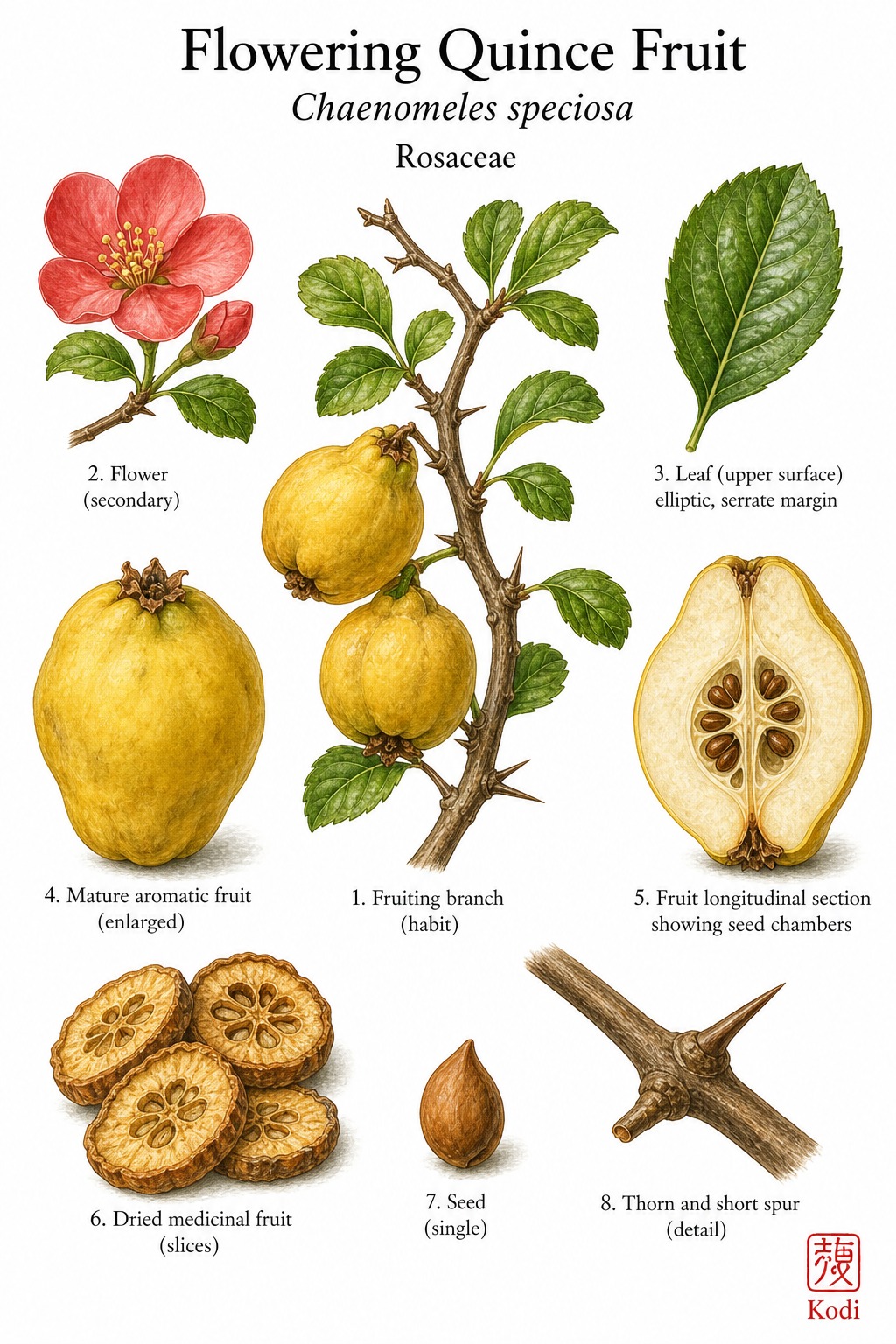
Known in TCM as Mu Gua (木瓜), this sour, warm herb enters the Liver and Spleen. Traditionally, it relaxes the sinews and unblocks the channels - Mu Gua is classically used for cramped calves, tendon tightness, weakness in the legs, and wind-damp painful obstruction affecting mobility, most often applied for joint pain, rheumatism, and nausea. Modern research has identified Oleanolic among its active constituents.
Part used: Fruit
Also Known As
Latin: Fructus Chaenomelis | Pinyin: Mu Gua | Chinese: 木瓜
TCM Properties
- Taste
- sour
- Temperature
- warm
- Channels
- Liver, Spleen
Traditional Use
Primary Actions
- Relaxes the sinews and unblocks the channels - Mu Gua is classically used for cramped calves, tendon tightness, weakness in the legs, and wind-damp painful obstruction affecting mobility.
- Transforms dampness and harmonizes the middle - it is chosen when damp turbidity causes abdominal fullness, diarrhea, or a heavy constrained feeling after food stagnation or summer dampness.
- Harmonizes the Stomach and stops vomiting - sour-warm Mu Gua can help redirect rebellious Stomach qi downward when nausea or vomiting is linked to dampness and constraint.
- Reduces edema and supports movement of fluids - traditional practice also uses it for swelling in the legs or feet when dampness and qi stagnation coexist.
Secondary Actions
- Although Mu Gua is sour, classical teaching does not treat it as a strongly astringent fruit; its more important role is to soften and relax tense sinews.
- It is especially valued when cramping follows prolonged damp exposure, overuse, or fluid loss, making it a bridge herb between channel treatment and digestive harmonizing.
Classic Formulas
- Mu Gua Wan - classical formula lineage using Mu Gua for lower-limb weakness, cramping, and wind-damp pain with underlying deficiency.
- Traditional pain and stiffness formulas pair Mu Gua with Niu Xi, Ba Ji Tian, or Rou Gui when tendon spasm and heavy aching are prominent.
- Digestive formulas may combine Mu Gua with Huo Xiang, Chen Pi, or Sha Ren when dampness and rebellious Stomach qi produce nausea and fullness.
Classical References
- TCMWiki describes Mu Gua as sour and warm, emphasizing its ability to soothe tendons, activate the channels, transform dampness, and support treatment of edema and digestive disruption.
- Me and Qi classifies Mu Gua among wind-damp-dispelling herbs while also highlighting its useful stomach-harmonizing role.
Modern Research
Active Compounds
- Oleanolic acid and ursolic acid - triterpenes frequently discussed in Chaenomeles pharmacology
- Flavonoids and polyphenols - antioxidant constituents studied across inflammatory and cartilage models
- Organic acids - fruit acids that contribute to both chemistry and traditional sour profile
- Polysaccharides and broader triterpenoid fractions - emerging compounds in modern extract research
Studied Effects
- A 2014 review summarized the chemistry and pharmacology of Chaenomeles speciosa, establishing the main research foundation for anti-inflammatory, analgesic, and metabolic interest in Mu Gua (PMID 24649061).
- A 2023 integrated network-pharmacology and animal study explored chondroprotective effects in an arthritis model, supporting ongoing interest in joint and tendon applications (PMID 37178981).
- A 2025 study examined Chaenomeles speciosa extracts in alcohol-related liver injury and reported antioxidant, lipid-modulating, and gut-microbiota effects in preclinical work (PMID 40227436).
PubMed References
- Chaenomeles speciosa: A review of chemistry and pharmacology. (2014)
- Exploring the chondroprotective effect of Chaenomeles speciosa on Glucose-6-Phosphate Isomerase model mice using an integrated approach of network pharmacology and experimental validation. (2023)
- Hepatoprotective Effects of Citri reticulatae Pericarpium and Chaenomelese speciosa (Sweet) Nakai Extracts in Alcohol-Related Liver Injury: Modulation of Oxidative Stress, Lipid Metabolism, and Gut Microbiota. (2025)
Safety & Interactions
Contraindications
- Marked yin deficiency heat without dampness or channel obstruction
- Very dry depleted patterns where additional sour-moving herbs may be irritating
Cautions
- Mu Gua is generally safe in decoction, but large amounts of the sour fruit may aggravate sensitive stomachs.
- Extract studies are not directly interchangeable with routine decoction slices or culinary quince use.
- MSK page not found - drug interaction data not available from Memorial Sloan Kettering integrative medicine database
Conditions
- Joint Pain Traditional ★★★★☆ JSON
- Rheumatism Traditional ★★★☆☆ JSON
- Nausea Traditional ★★★☆☆ JSON
- Abdominal Distension Traditional ★★★☆☆ JSON
- Edema Traditional ★★☆☆☆ JSON
Frequently Asked Questions
What is Flowering Quince Fruit used for?
Flowering Quince Fruit is traditionally used to Relaxes the sinews and unblocks the channels - Mu Gua is classically used for cramped calves, tendon tightness, weakness in the legs, and wind-damp painful obstruction affecting mobility., Transforms dampness and harmonizes the middle - it is chosen when damp turbidity causes abdominal fullness, diarrhea, or a heavy constrained feeling after food stagnation or summer dampness., Harmonizes the Stomach and stops vomiting - sour-warm Mu Gua can help redirect rebellious Stomach qi downward when nausea or vomiting is linked to dampness and constraint., Reduces edema and supports movement of fluids - traditional practice also uses it for swelling in the legs or feet when dampness and qi stagnation coexist.. Research has investigated its effects on: A 2014 review summarized the chemistry and pharmacology of Chaenomeles speciosa, establishing the main research foundation for anti-inflammatory, analgesic, and metabolic interest in Mu Gua (PMID 24649061).; A 2023 integrated network-pharmacology and animal study explored chondroprotective effects in an arthritis model, supporting ongoing interest in joint and tendon applications (PMID 37178981)..
What are other names for Flowering Quince Fruit?
Flowering Quince Fruit is also known as Chaenomelis. In TCM: 木瓜 (Mu Gua); Fructus Chaenomelis.
Is Flowering Quince Fruit safe during pregnancy?
The safety of Flowering Quince Fruit during pregnancy has not been established. Consult a qualified healthcare provider before use.
What are the contraindications for Flowering Quince Fruit?
Flowering Quince Fruit should not be used in: Marked yin deficiency heat without dampness or channel obstruction; Very dry depleted patterns where additional sour-moving herbs may be irritating. Consult a qualified practitioner before use.