Round Cardamom Fruit
- Chinese
- 白豆蔻
- Pinyin
- Bai Dou Kou
- Latin
- Fructus Amomi Rotundus
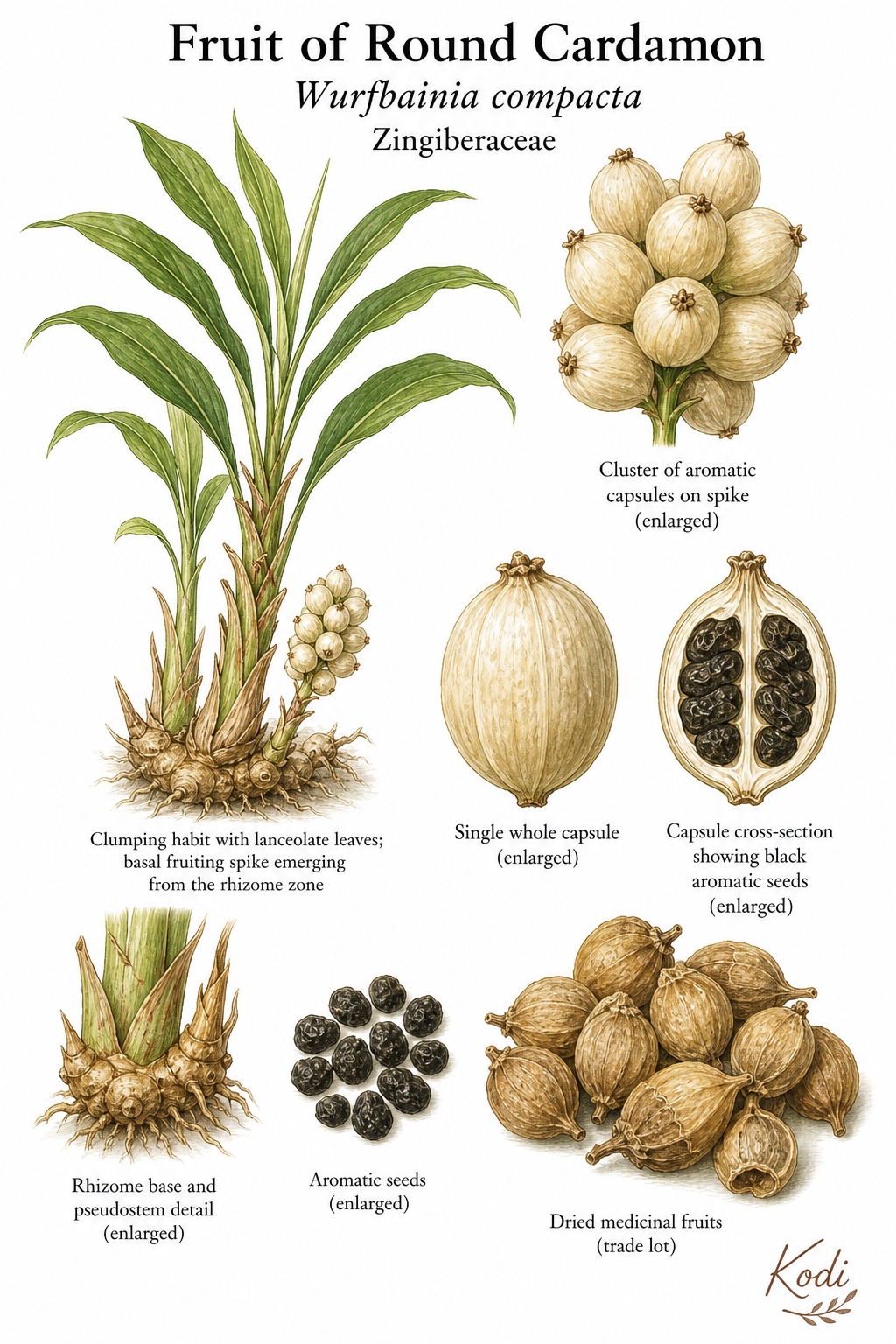
Known in TCM as Bai Dou Kou (白豆蔻), this pungent and aromatic, warm herb enters the Lung, Spleen, and Stomach. Traditionally, it transforms dampness and moves qi - Bai Dou Kou is a classic aromatic herb for heavy, stagnant middle-burner patterns with bloating, chest oppression, and poor appetite, most often applied for nausea, dyspepsia, and abdominal distension. Modern research has identified 1,8-Cineole among its active constituents.
Part used: Fruit
Also Known As
Latin: Fructus Amomi Rotundus | Pinyin: Bai Dou Kou | Chinese: 白豆蔻
TCM Properties
- Taste
- pungent, aromatic
- Temperature
- warm
- Channels
- Lung, Spleen, Stomach
Traditional Use
Primary Actions
- Transforms dampness and moves qi - Bai Dou Kou is a classic aromatic herb for heavy, stagnant middle-burner patterns with bloating, chest oppression, and poor appetite.
- Warms the Stomach and stops vomiting - it is especially useful when cold-damp or turbid dampness causes nausea, retching, or epigastric fullness.
- Opens the middle burner and improves digestion - its fragrant volatile oils are traditionally used when food sits heavily and the patient feels no hunger.
- Treats early damp-warmth with damp predominance - it appears in formulas when heaviness, chest stuffiness, and lack of appetite are more prominent than high fever.
Secondary Actions
- Bai Dou Kou is traditionally crushed and added near the end of decoction so its aromatic oils are not boiled away.
- It should be distinguished from the harsher Cao Dou Kou, the aromatic digestive Sha Ren, and the unrelated spice nutmeg, because the TCM functions overlap only partially.
Classic Formulas
- San Ren Tang - classic damp-warmth formula using Bai Dou Kou with Xing Ren and Yi Yi Ren when dampness obstructs the upper and middle burner.
- Damp-obstruction digestive formulas pair Bai Dou Kou with Huo Xiang, Chen Pi, or Sha Ren for nausea, poor appetite, and epigastric fullness.
- Cold-damp middle-burner formulas combine it with Hou Po, Gan Jiang, or Cang Zhu when the Stomach is heavy, cool, and vomiting-prone.
Classical References
- Ming Yi Bie Lu records Dou Kou among the aromatic digestive herbs, and later materia medica distinguishes the imported round-cardamom types from rougher cardamom relatives.
- Traditional herbology consistently emphasizes that Bai Dou Kou is warm and fragrant but should be added late or taken as powder to preserve effectiveness.
Modern Research
Active Compounds
- 1,8-Cineole (eucalyptol) - a major volatile constituent highlighted in modern Amomi Fructus Rotundus oil analysis
- Beta-pinene - one of the main monoterpenes repeatedly identified in the essential oil
- D-limonene - a prominent aromatic terpene contributing to fragrance and current pharmacology interest
- Alpha-pinene - another major volatile marker used in species and quality characterization
Studied Effects
- A 2026 GC-MS study of Amomi Fructus Rotundus essential oil identified 32 compounds dominated by eucalyptol, beta-pinene, D-limonene, and alpha-pinene, and linked the oil to anti-gastritis and antibacterial activity in experimental models (PMID 41918280).
- A 2023 study reported that 1,8-cineole, a main compound of Amomum compactum volatile oil, reduced experimental colitis by inhibiting macrophage M1 polarization and the HSP90-NLRP3-SGT1 complex, supporting anti-inflammatory interest in the herb's volatile fraction (PMID 37842654).
- A 2022 volatilomics and in silico study of Indonesian Zingiberaceae spices identified antioxidant and antidiabetic candidate compounds in Amomum compactum, illustrating the growing functional-food literature around round cardamom chemistry (PMID 35342880).
PubMed References
- Chemical Composition Analysis of Amomi Fructus Rotundus Essential Oil at Different States by GC-MS and Its Anti-Gastritis Mechanism and Antibacterial Activity Based on Network Pharmacology and Molecular Docking. (2026)
- 1,8-cineole ameliorates colon injury by downregulating macrophage M1 polarization via inhibiting the HSP90-NLRP3-SGT1 complex. (2023)
- Antioxidant and antidiabetic compounds identification in several Indonesian underutilized Zingiberaceae spices using SPME-GC/MS-based volatilomics and in silico methods. (2022)
Safety & Interactions
Contraindications
- Yin deficiency or dryness-heat patterns without cold-damp or qi stagnation
- Vomiting caused by clear excess heat rather than cold-damp Stomach disharmony
Cautions
- Because the effect depends on volatile oils, excessive simmering weakens the herb and encourages people to overuse it unnecessarily.
- Round cardamom preparations sold as culinary spice, essential oil, or supplement are not interchangeable with traditional decoction dosing.
- Published clinical drug-interaction data are sparse, so medically complex patients should still treat concentrated products cautiously.
Conditions
- Nausea Traditional ★★★★☆ JSON
- Dyspepsia Traditional ★★★★☆ JSON
- Abdominal Distension Traditional ★★★★☆ JSON
- Poor Appetite Traditional ★★★☆☆ JSON
- Acid Reflux Traditional ★★☆☆☆ JSON
Frequently Asked Questions
What is Round Cardamom Fruit used for?
Round Cardamom Fruit is traditionally used to Transforms dampness and moves qi - Bai Dou Kou is a classic aromatic herb for heavy, stagnant middle-burner patterns with bloating, chest oppression, and poor appetite., Warms the Stomach and stops vomiting - it is especially useful when cold-damp or turbid dampness causes nausea, retching, or epigastric fullness., Opens the middle burner and improves digestion - its fragrant volatile oils are traditionally used when food sits heavily and the patient feels no hunger., Treats early damp-warmth with damp predominance - it appears in formulas when heaviness, chest stuffiness, and lack of appetite are more prominent than high fever.. Research has investigated its effects on: A 2026 GC-MS study of Amomi Fructus Rotundus essential oil identified 32 compounds dominated by eucalyptol, beta-pinene, D-limonene, and alpha-pinene, and linked the oil to anti-gastritis and antibacterial activity in experimental models (PMID 41918280).; A 2023 study reported that 1,8-cineole, a main compound of Amomum compactum volatile oil, reduced experimental colitis by inhibiting macrophage M1 polarization and the HSP90-NLRP3-SGT1 complex, supporting anti-inflammatory interest in the herb's volatile fraction (PMID 37842654)..
What are other names for Round Cardamom Fruit?
Round Cardamom Fruit is also known as Amomi. In TCM: 白豆蔻 (Bai Dou Kou); Fructus Amomi Rotundus.
Is Round Cardamom Fruit safe during pregnancy?
The safety of Round Cardamom Fruit during pregnancy has not been established. Consult a qualified healthcare provider before use.
What are the contraindications for Round Cardamom Fruit?
Round Cardamom Fruit should not be used in: Yin deficiency or dryness-heat patterns without cold-damp or qi stagnation; Vomiting caused by clear excess heat rather than cold-damp Stomach disharmony. Consult a qualified practitioner before use.