Sharpleaf Galangal Fruit
- Chinese
- 益智仁
- Pinyin
- Yi Zhi Ren
- Latin
- Fructus Alpiniae Oxyphyllae
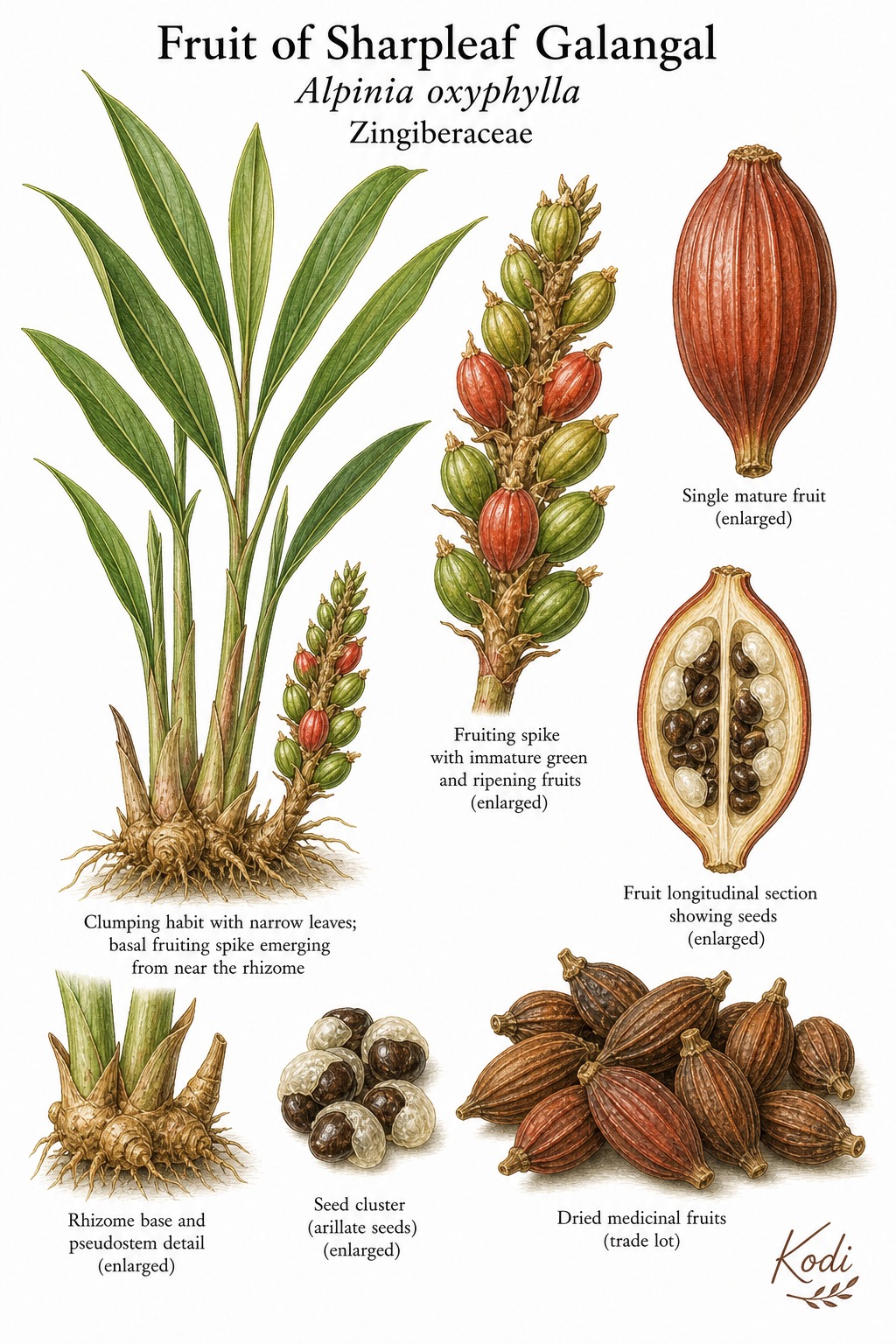
Known in TCM as Yi Zhi Ren (益智仁), this pungent and sweet and astringent, warm herb enters the Kidney and Spleen. Traditionally, it warms the Kidney and secures the lower burner - Yi Zhi Ren is used for frequent urination, enuresis, urinary dribbling, and deficiency-cold leakage, most often applied for frequent urination, kidney yang deficiency, and diarrhea. Modern research has identified Nootkatone among its active constituents.
Part used: Fruit
Also Known As
Latin: Fructus Alpiniae Oxyphyllae | Pinyin: Yi Zhi Ren | Chinese: 益智仁
TCM Properties
- Taste
- pungent, sweet, astringent
- Temperature
- warm
- Channels
- Kidney, Spleen
Traditional Use
Primary Actions
- Warms the Kidney and secures the lower burner - Yi Zhi Ren is used for frequent urination, enuresis, urinary dribbling, and deficiency-cold leakage.
- Warms the Spleen and stops diarrhea - it is especially suited to chronic cold-type loose stool or dawn diarrhea rooted in spleen-kidney weakness.
- Retains essence - traditional use includes spermatorrhea and seminal leakage when warming and astringing are both needed.
- Controls excessive salivation and cold middle-burner rebellion - it is valued for drooling, nausea, or vomiting that reflect cold deficiency rather than heat.
Secondary Actions
- Classical writers note that Yi Zhi Ren has both dispersing and securing qualities, so it is usually paired with more directly tonifying herbs rather than used by itself for long periods.
- Salt processing is often preferred when the target is urinary leakage or kidney deficiency, while the unprocessed seed is more often used for spleen-cold diarrhea or salivation.
Classic Formulas
- Suo Quan Wan - classic lower-burner deficiency-cold formula pairing Yi Zhi Ren with Wu Yao and Shan Yao for frequent urination and enuresis.
- Spleen-warming diarrhea formulas pair Yi Zhi Ren with Bu Gu Zhi or Shan Yao when chronic cold-type diarrhea persists.
- Stomach-cold or saliva-controlling formulas combine it with Sha Ren, Chen Pi, or other warming digestive herbs when drooling, nausea, or cold indigestion accompany weakness.
Classical References
- Ben Cao Shi Yi and later materia medica describe Yi Zhi Ren as a pungent warm fruit that treats urinary dribbling, seminal leakage, vomiting, and excess salivation.
- Classical commentaries also warn that Yi Zhi Ren disperses as well as tonifies, so it should match deficiency-cold patterns rather than dry-heat or yin-deficient ones.
Modern Research
Active Compounds
- Nootkatone - the best-known sesquiterpene marker of Alpinia oxyphylla fruit
- Yakuchinone A and yakuchinone B - diarylheptanoids discussed in anti-inflammatory and neurologic research
- Chrysin - a flavonoid repeatedly profiled in Alpinia oxyphylla phytochemistry
- Protocatechuic acid - a phenolic constituent frequently cited in neuroprotective studies
Studied Effects
- A 2015 mouse study reported significant antidiarrheal effects from Alpinia oxyphylla and explored mechanisms involving intestinal motility and secretion, aligning closely with one of Yi Zhi Ren's oldest traditional uses (PMID 25861952).
- A 2023 multi-omics study found that Alpinia oxyphylla water extract improved bladder overactivity in spontaneously hypertensive rats, giving modern support to the herb's long-standing role in frequent urination and lower-burner instability (PMID 37976696).
- A 2024 study of an arabinoxylan isolated from Alpinia oxyphylla found reduced neuroinflammation and neurotoxicity through the TLR4/MyD88/NF-kB pathway, reflecting the herb's growing modern reputation in CNS research (PMID 39089558).
PubMed References
- Antidiarrheal effect of Alpinia oxyphylla Miq. (Zingiberaceae) in experimental mice and its possible mechanism of action. (2015)
- Multi-omic analysis revealed the therapeutic mechanisms of Alpinia oxyphylla fructus water extract against bladder overactivity in spontaneously hypertensive rats. (2023)
- An arabinoxylan (AOP70-1) isolated from Alpinia oxyphylla alleviates neuroinflammation and neurotoxicity by TLR4/MyD88/NF-kB pathway. (2024)
Safety & Interactions
Contraindications
- Yin deficiency with heat, dryness, or internal fire
- Diarrhea, vomiting, or urinary leakage caused by damp-heat rather than deficiency-cold
Cautions
- Yi Zhi Ren is more warming and securing than nourishing, so prolonged use without complementary tonics may aggravate dry or depleted constitutions.
- Most published modern evidence is preclinical, and concentrated extracts are not interchangeable with ordinary decoction seed.
- No strong clinical herb-drug interaction literature was identified, but urinary or neurologic medications still warrant practitioner review when concentrated products are used.
Conditions
- Frequent Urination Traditional ★★★★☆ JSON
- Kidney Yang Deficiency Traditional ★★★★☆ JSON
- Diarrhea Traditional ★★★★☆ JSON
- Abdominal Pain Traditional ★★★☆☆ JSON
- Nausea Traditional ★★☆☆☆ JSON
Frequently Asked Questions
What is Sharpleaf Galangal Fruit used for?
Sharpleaf Galangal Fruit is traditionally used to Warms the Kidney and secures the lower burner - Yi Zhi Ren is used for frequent urination, enuresis, urinary dribbling, and deficiency-cold leakage., Warms the Spleen and stops diarrhea - it is especially suited to chronic cold-type loose stool or dawn diarrhea rooted in spleen-kidney weakness., Retains essence - traditional use includes spermatorrhea and seminal leakage when warming and astringing are both needed., Controls excessive salivation and cold middle-burner rebellion - it is valued for drooling, nausea, or vomiting that reflect cold deficiency rather than heat.. Research has investigated its effects on: A 2015 mouse study reported significant antidiarrheal effects from Alpinia oxyphylla and explored mechanisms involving intestinal motility and secretion, aligning closely with one of Yi Zhi Ren's oldest traditional uses (PMID 25861952).; A 2023 multi-omics study found that Alpinia oxyphylla water extract improved bladder overactivity in spontaneously hypertensive rats, giving modern support to the herb's long-standing role in frequent urination and lower-burner instability (PMID 37976696)..
What are other names for Sharpleaf Galangal Fruit?
Sharpleaf Galangal Fruit is also known as Alpinia. In TCM: 益智仁 (Yi Zhi Ren); Fructus Alpiniae Oxyphyllae.
Is Sharpleaf Galangal Fruit safe during pregnancy?
The safety of Sharpleaf Galangal Fruit during pregnancy has not been established. Consult a qualified healthcare provider before use.
What are the contraindications for Sharpleaf Galangal Fruit?
Sharpleaf Galangal Fruit should not be used in: Yin deficiency with heat, dryness, or internal fire; Diarrhea, vomiting, or urinary leakage caused by damp-heat rather than deficiency-cold. Consult a qualified practitioner before use.