Siberian Cocklebur Fruit
- Chinese
- 苍耳子
- Pinyin
- Cang Er Zi
- Latin
- Fructus Xanthii
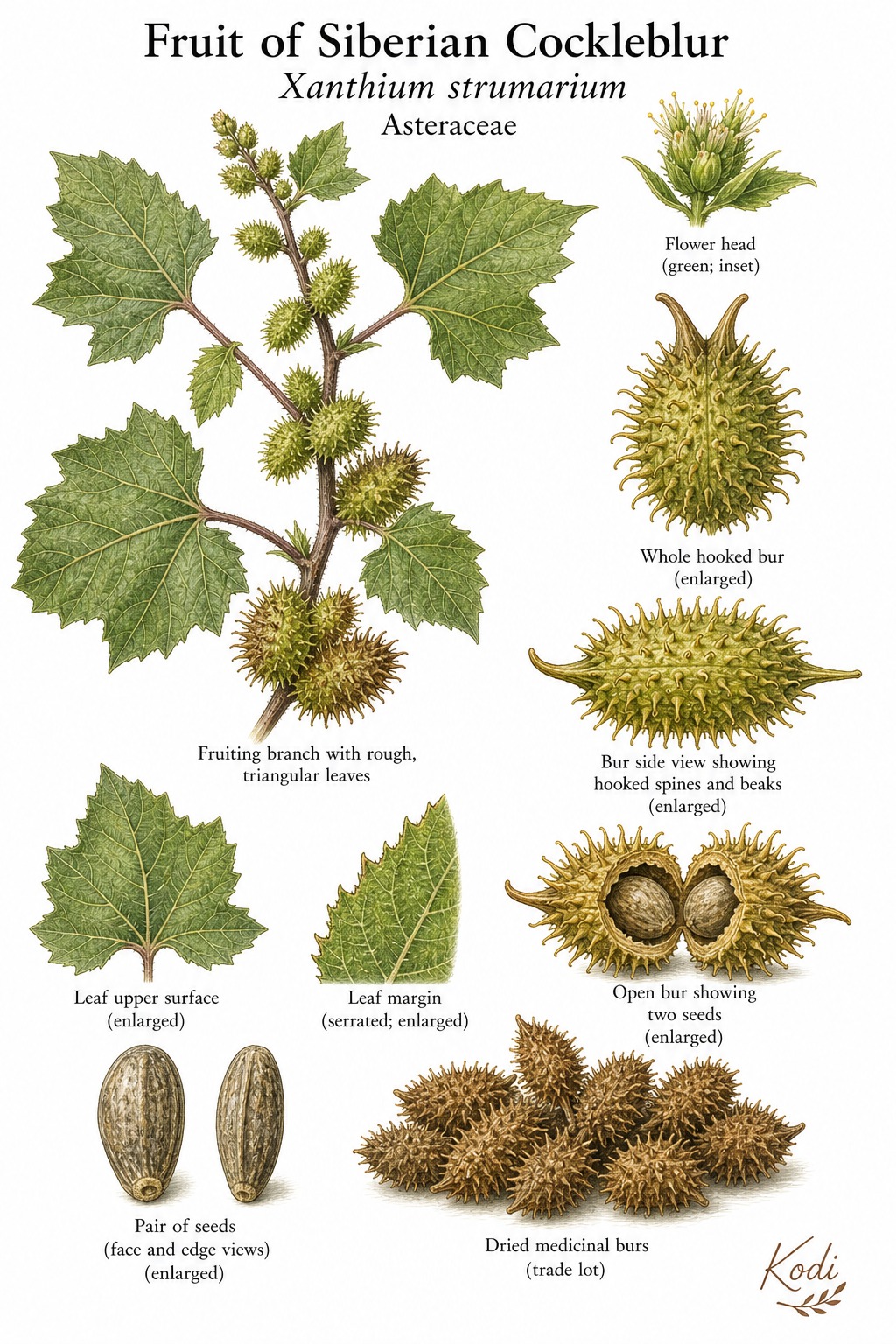
Known in TCM as Cang Er Zi (苍耳子), this pungent and bitter, warm herb enters the Lung. Traditionally, it disperses wind-cold and opens the nasal passages - Cang Er Zi is one of the classic herbs for chronic nasal obstruction, turbid discharge, and loss of smell, most often applied for sinusitis, headache, and joint pain. Modern research has identified Carboxyatractyloside among its active constituents.
Part used: Fruit
Also Known As
Latin: Fructus Xanthii | Pinyin: Cang Er Zi | Chinese: 苍耳子
TCM Properties
- Taste
- pungent, bitter
- Temperature
- warm
- Channels
- Lung
Traditional Use
Primary Actions
- Disperses wind-cold and opens the nasal passages - Cang Er Zi is one of the classic herbs for chronic nasal obstruction, turbid discharge, and loss of smell.
- Relieves frontal headache and sinus pressure - it is especially associated with forehead and nasal-root pain when the nose is blocked.
- Dispels wind-damp and alleviates pain - beyond nasal use, it is sometimes added for joint pain and stiffness aggravated by cold and damp.
- Addresses wind-related itching - topical or internal use appears in traditional practice for pruritus and certain wind-dominant skin eruptions.
Secondary Actions
- Cang Er Zi is far more dangerous in the raw form; proper stir-baking and thorn removal before internal use are a traditional safety requirement, not a minor preference.
- Its nasal-opening specialty explains why it is repeatedly paired with Xin Yi and Bai Zhi rather than used alone for sinus patterns.
Classic Formulas
- Cang Er Zi San - classic nasal-obstruction formula pairing Cang Er Zi with Xin Yi, Bai Zhi, and Bo He for sinus congestion, turbid discharge, and frontal headache.
- Wind-damp pain formulas pair Cang Er Zi with herbs such as Qin Jiao or Du Huo when joint pain accompanies an exterior wind-damp presentation.
- Itching formulas may use processed Cang Er Zi internally or externally with other wind-dispelling herbs when pruritus or urticaria are dominant.
Classical References
- Shen Nong Ben Cao Jing and later herbology traditions treat Cang Er Zi as a wind herb that became especially famous for opening the nose.
- Traditional processing instructions consistently require roasting and de-thorning before internal use because toxicity is a core part of the herb's identity.
Modern Research
Active Compounds
- Carboxyatractyloside - the major toxic glycoside most responsible for serious cocklebur poisoning
- Atractyloside - a related toxic glycoside relevant to mitochondrial toxicity
- Xanthinin - a sesquiterpene lactone frequently cited in Xanthium phytochemistry
- Xanthinosin and related sesquiterpenes - compounds investigated in anti-inflammatory and other preclinical studies
Studied Effects
- A 2019 review summarized more than 170 constituents of Xanthium strumarium and outlined broad preclinical work in allergic rhinitis, anti-inflammatory, antimicrobial, antidiabetic, and toxicology research, while emphasizing the herb's real safety liabilities (PMID 30669496).
- A 2020 integrated phytochemistry, network-pharmacology, and metabolomics study explored mechanisms of Xanthium strumarium for allergic rhinitis, reinforcing why Cang Er Zi remains so strongly linked to nasal disorders in modern research (PMID 35519219).
- A 2005 human case series on carboxyatractyloside poisoning documented severe multiorgan toxicity and deaths after cocklebur ingestion, underscoring why this herb belongs in the high-risk category when misused (PMID 15949201).
PubMed References
- Traditional Uses, Botany, Phytochemistry, Pharmacology, Pharmacokinetics and Toxicology of Xanthium strumarium L.: A Review. (2019)
- An integrated approach based on phytochemistry, network pharmacology and metabolomics reveals the mechanism of action of Xanthium strumarium L. for allergic rhinitis. (2020)
- Carboxyatractyloside poisoning in humans. (2005)
Safety & Interactions
Contraindications
- Pregnancy
- Pre-existing liver or kidney dysfunction
- Internal use of raw or unprocessed cocklebur fruits
Cautions
- The primary toxic components are carboxyatractyloside and atractyloside, which can cause severe hepatic, renal, neurologic, and cardiac injury.
- Children are especially susceptible to poisoning, and even a small number of raw seeds can be dangerous.
- Do not use continuously or casually as a home sinus remedy; the herb belongs under practitioner supervision and proper processing standards.
Conditions
Frequently Asked Questions
What is Siberian Cocklebur Fruit used for?
Siberian Cocklebur Fruit is traditionally used to Disperses wind-cold and opens the nasal passages - Cang Er Zi is one of the classic herbs for chronic nasal obstruction, turbid discharge, and loss of smell., Relieves frontal headache and sinus pressure - it is especially associated with forehead and nasal-root pain when the nose is blocked., Dispels wind-damp and alleviates pain - beyond nasal use, it is sometimes added for joint pain and stiffness aggravated by cold and damp., Addresses wind-related itching - topical or internal use appears in traditional practice for pruritus and certain wind-dominant skin eruptions.. Research has investigated its effects on: A 2019 review summarized more than 170 constituents of Xanthium strumarium and outlined broad preclinical work in allergic rhinitis, anti-inflammatory, antimicrobial, antidiabetic, and toxicology research, while emphasizing the herb's real safety liabilities (PMID 30669496).; A 2020 integrated phytochemistry, network-pharmacology, and metabolomics study explored mechanisms of Xanthium strumarium for allergic rhinitis, reinforcing why Cang Er Zi remains so strongly linked to nasal disorders in modern research (PMID 35519219)..
What are other names for Siberian Cocklebur Fruit?
Siberian Cocklebur Fruit is also known as Xanthium. In TCM: 苍耳子 (Cang Er Zi); Fructus Xanthii.
Is Siberian Cocklebur Fruit safe during pregnancy?
Siberian Cocklebur Fruit is not recommended during pregnancy.
What are the contraindications for Siberian Cocklebur Fruit?
Siberian Cocklebur Fruit should not be used in: Pregnancy; Pre-existing liver or kidney dysfunction; Internal use of raw or unprocessed cocklebur fruits. Consult a qualified practitioner before use.