Common Camptotheca Fruit or Root
- Chinese
- 喜树
- Pinyin
- Xi Shu
- Latin
- Fructus et Radix Camptothecae
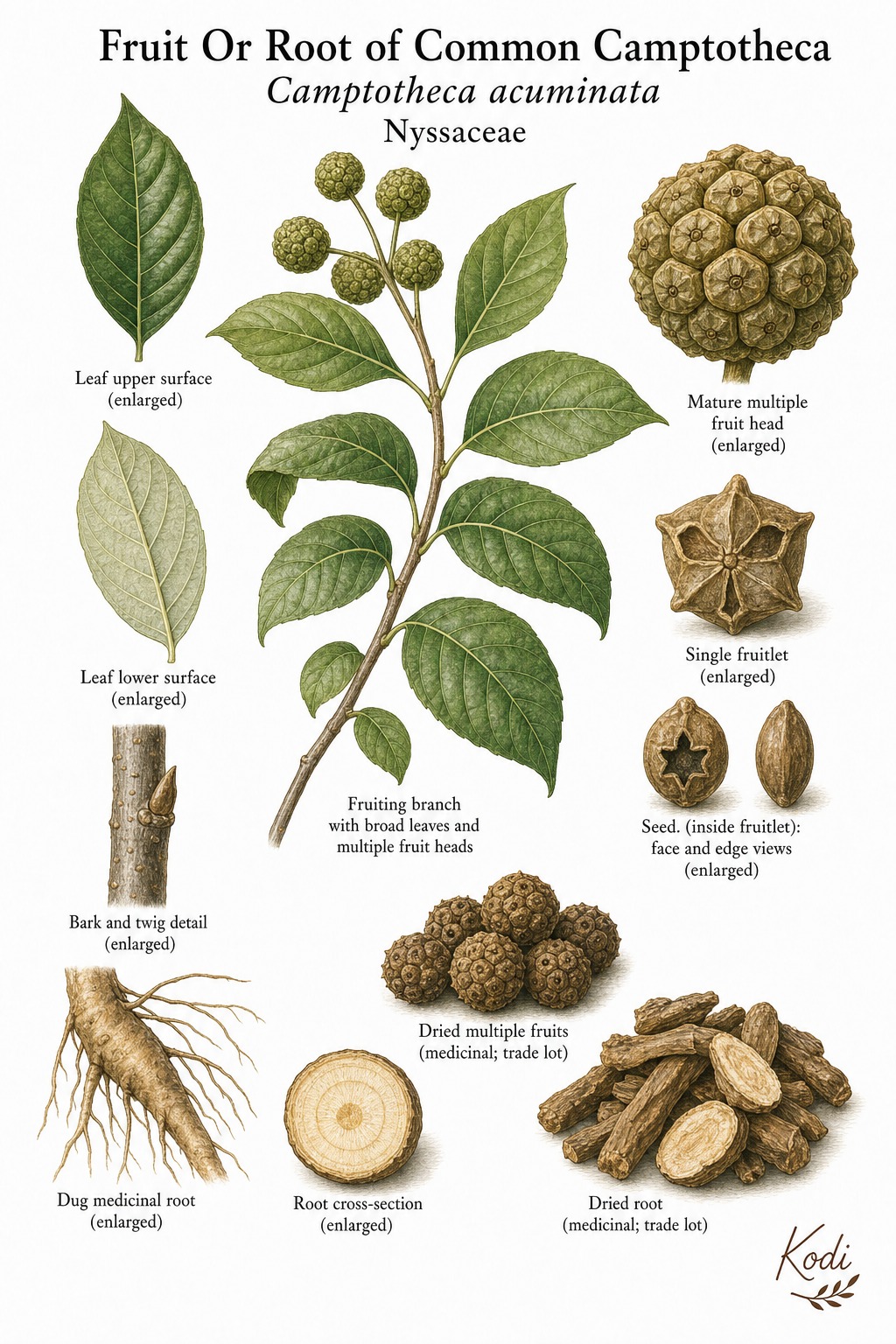
Known in TCM as Xi Shu (喜树), this pungent and bitter, cold herb enters the Spleen, Stomach, and Liver. Traditionally, it clears heat and resolves toxin - Xi Shu is a cold toxic medicinal used for severe heat-toxin patterns rather than for ordinary deficiency complaints, most often applied for cancer, phlegm accumulation, and thyroid nodule. Modern research has identified Camptothecin among its active constituents.
Part used: Fruit
Also Known As
Latin: Fructus et Radix Camptothecae | Pinyin: Xi Shu | Chinese: 喜树
TCM Properties
- Taste
- pungent, bitter
- Temperature
- cold
- Channels
- Spleen, Stomach, Liver
Traditional Use
Primary Actions
- Clears heat and resolves toxin - Xi Shu is a cold toxic medicinal used for severe heat-toxin patterns rather than for ordinary deficiency complaints.
- Disperses masses and accumulations - the fruit and root/root-bark record is best known in later Chinese practice for stubborn fixed masses, especially in oncology-oriented folk and hospital settings.
- Addresses refractory phlegm-toxin and obstruction patterns - traditional use focuses on difficult, serious presentations in which heat, toxin, and accumulation have become entrenched.
Secondary Actions
- This inherited record intentionally preserves both the fruit and root identity because historical usage and modern research both reference more than one medicinal part of Camptotheca acuminata.
- Xi Shu belongs to the toxic-herb category; it is not a general wellness tree remedy and should not be conflated with purified prescription camptothecin derivatives.
Classic Formulas
- Later antitumor decoction strategies pair Xi Shu with Bai Hua She She Cao, Ban Zhi Lian, or E Zhu when the treatment logic emphasizes toxin, fixed masses, and difficult obstruction.
- Mass-dispersing combinations with San Leng or other blood-moving herbs are used when pain, obstruction, and palpable accumulation dominate the presentation.
Classical References
- Modern Chinese herb references describe Xi Shu as pungent, bitter, cold, and toxic, using the fruit or root for heat-toxin and mass disorders.
- Folk and later clinical usage center less on broad classical formula fame and more on its role as a potent specialized medicinal for difficult toxic accumulations.
Modern Research
Active Compounds
- Camptothecin - the signature antitumor alkaloid isolated from Camptotheca acuminata
- 10-Hydroxycamptothecin - a major related alkaloid relevant to later drug development
- 11-Methoxycamptothecin and related camptothecin analogues - supportive constituents in fruit and other plant-part analyses
Studied Effects
- A 2014 study found that aqueous extract of Camptotheca acuminata fruit suppressed proliferation and promoted apoptosis-related effects in human endometrial carcinoma cell lines, directly linking the fruit record to modern antitumor laboratory work (PMID 24963324).
- A 1997 RP-HPLC study measured camptothecin in Camptotheca acuminata fruit, reinforcing that the medicinal fruit identity is tightly bound to quantifiable topoisomerase-inhibiting alkaloids (PMID 10743218).
- A 2012 review of anticancer drugs from toxic Chinese medicines places Camptotheca among the best-known examples of a traditional toxic herb that became important to modern oncology drug discovery (PMID 22389143).
PubMed References
- Antitumor Effects and Biological Mechanism of Action of the Aqueous Extract of the Camptotheca acuminata Fruit in Human Endometrial Carcinoma Cells. (2014)
- [Determination of camptothecine in the fruit of Camptotheca acuminata Decne. by RP-HPLC]. (1997)
- Anticancer drugs from traditional toxic Chinese medicines. (2012)
Safety & Interactions
Contraindications
- Pregnancy
- Breastfeeding
- Self-treatment of suspected cancer or other serious mass lesions
- Use alongside active cancer therapy without oncology supervision
Cautions
- Xi Shu is a toxic medicinal tied to camptothecin alkaloids, so crude-herb use should be treated with the same seriousness one would give other pharmacologically potent antitumor materials.
- Laboratory antitumor findings do not mean the crude herb is a safe substitute for standardized oncology drugs or specialist care.
- Gastrointestinal irritation, cytotoxicity risk, and general toxicity concerns warrant conservative dosing and high-quality sourcing only.
Conditions
- Cancer Research ★★★☆☆ JSON
- Phlegm Accumulation Traditional ★★☆☆☆ JSON
- Thyroid Nodule Traditional ★★☆☆☆ JSON
Frequently Asked Questions
What is Common Camptotheca Fruit or Root used for?
Common Camptotheca Fruit or Root is traditionally used to Clears heat and resolves toxin - Xi Shu is a cold toxic medicinal used for severe heat-toxin patterns rather than for ordinary deficiency complaints., Disperses masses and accumulations - the fruit and root/root-bark record is best known in later Chinese practice for stubborn fixed masses, especially in oncology-oriented folk and hospital settings., Addresses refractory phlegm-toxin and obstruction patterns - traditional use focuses on difficult, serious presentations in which heat, toxin, and accumulation have become entrenched.. Research has investigated its effects on: A 2014 study found that aqueous extract of Camptotheca acuminata fruit suppressed proliferation and promoted apoptosis-related effects in human endometrial carcinoma cell lines, directly linking the fruit record to modern antitumor laboratory work (PMID 24963324).; A 1997 RP-HPLC study measured camptothecin in Camptotheca acuminata fruit, reinforcing that the medicinal fruit identity is tightly bound to quantifiable topoisomerase-inhibiting alkaloids (PMID 10743218)..
What are other names for Common Camptotheca Fruit or Root?
Common Camptotheca Fruit or Root is also known as Camptotheca, Happy Tree. In TCM: 喜树 (Xi Shu); Fructus et Radix Camptothecae.
Is Common Camptotheca Fruit or Root safe during pregnancy?
Common Camptotheca Fruit or Root is not recommended during pregnancy.
What are the contraindications for Common Camptotheca Fruit or Root?
Common Camptotheca Fruit or Root should not be used in: Pregnancy; Breastfeeding; Self-treatment of suspected cancer or other serious mass lesions; Use alongside active cancer therapy without oncology supervision. Consult a qualified practitioner before use.