Galangal Fruit
- Chinese
- 红豆蔛
- Pinyin
- Hong Dou Kou
- Latin
- Fructus Galangae
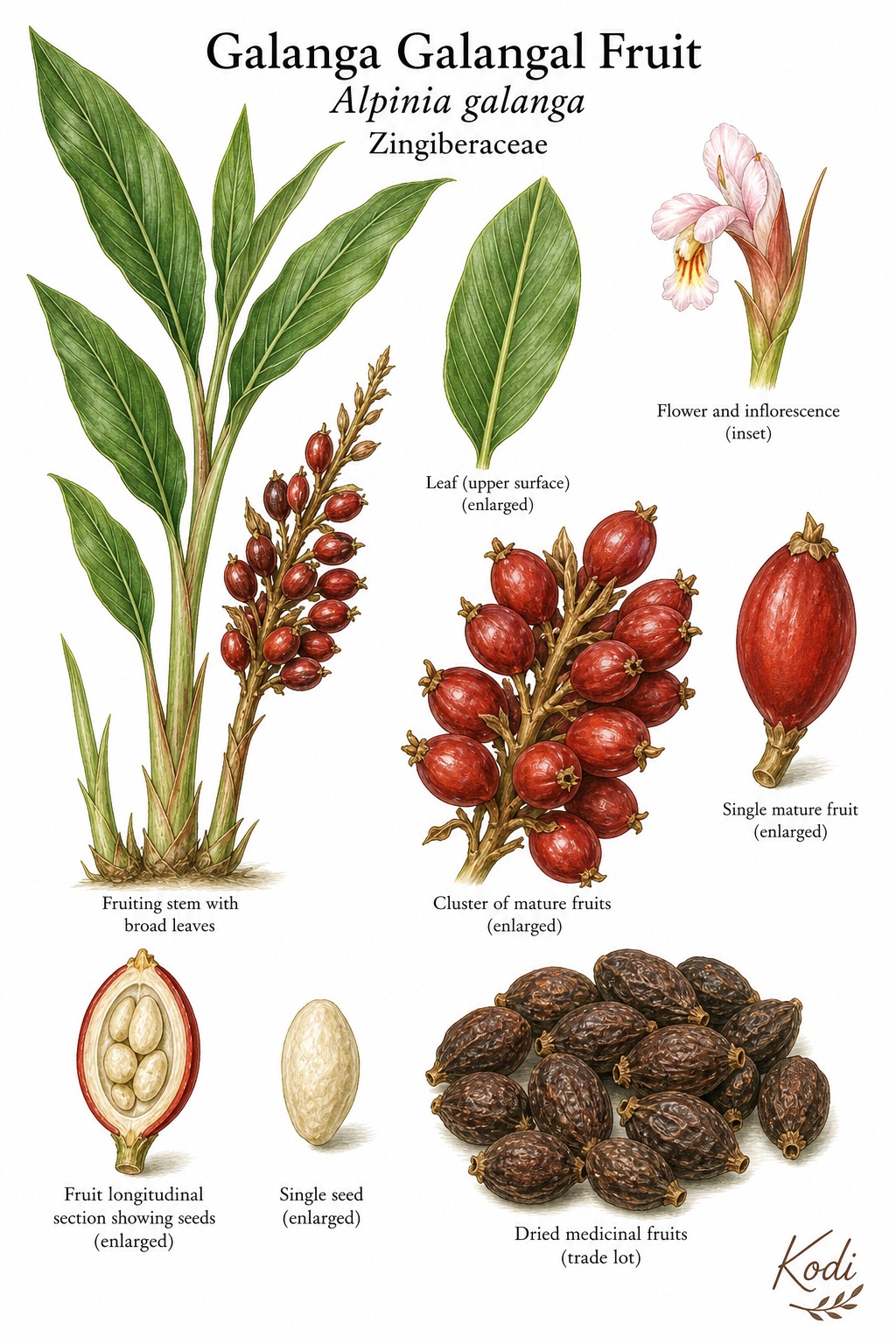
Known in TCM as Hong Dou Kou (红豆蔛), this pungent, warm herb enters the Spleen, Stomach, and Lung. Traditionally, it warms the middle and dispels cold - Hong Dou Kou is used for cold abdominal pain, weak digestion, and damp-cold obstruction affecting the middle burner, most often applied for abdominal pain, nausea, and diarrhea. Modern research has identified Volatile among its active constituents.
Part used: Fruit
Also Known As
Latin: Fructus Galangae | Pinyin: Hong Dou Kou | Chinese: 红豆蔛
TCM Properties
- Taste
- pungent
- Temperature
- warm
- Channels
- Spleen, Stomach, Lung
Traditional Use
Primary Actions
- Warms the middle and dispels cold - Hong Dou Kou is used for cold abdominal pain, weak digestion, and damp-cold obstruction affecting the middle burner.
- Dries dampness and promotes digestion - it is chosen when food stagnation, fullness, foul taste, or heavy dampness complicate an already cold digestive pattern.
- Stops nausea, vomiting, and diarrhea from cold-damp disorder - traditional indications include rebellious stomach qi with nausea as well as cold-type loose stool.
Secondary Actions
- Although the name overlaps with other cardamom and galangal lines, Hong Dou Kou is kept distinct from Bai Dou Kou, Yi Zhi Ren, and Katsumada galangal because its medicinal part and warming-digestive emphasis are not identical.
- The herb is aromatic and moving rather than deeply tonifying, so it is usually paired with qi-regulating or middle-warming companions.
Classic Formulas
- Middle-warming digestive combinations with Gan Jiang, Chen Pi, or Mu Xiang - used when nausea, cold fullness, and food stagnation appear together.
- Cold-damp diarrhea pairings with Gao Liang Jiang or Sha Ren - traditional strategy when vomiting and loose stool reflect middle-burner cold rather than heat.
Classical References
- TCM Wiki describes Hong Dou Kou as pungent and warm, entering the Spleen and Lung channels to dispel cold, dry dampness, and promote digestion.
- Later herb summaries emphasize that Hong Dou Kou is especially useful when cold and dampness suppress appetite and drive vomiting or abdominal pain.
Modern Research
Active Compounds
- Volatile oils - the major modern chemical focus in Alpinia galanga fruit and dried-fruit work
- 1,8-Cineole - a frequently reported aromatic constituent in galangal essential-oil studies
- Methyl cinnamate and related phenylpropanoid aroma compounds - supportive constituents tied to flavor and biologic activity
Studied Effects
- A 2022 study found that drying method substantially altered the essential-oil composition and antioxidant activity of Alpinia galanga material, underscoring how processing can change the chemistry of Hong Dou Kou preparations (PMID 35636195).
- A 2001 molecular-authentication study examined the ITS-region sequences of Alpinia galanga fruits and adulterants, highlighting the practical importance of correct identification in a medicinal group prone to substitution (PMID 11458466).
- Overall, the indexed literature supports aromatic bioactivity and authentication work more clearly than it supports large human trials for the classical digestive-fruit indication.
PubMed References
Safety & Interactions
Contraindications
- Yin deficiency with heat
- Heat-pattern vomiting or diarrhea
Cautions
- Hong Dou Kou is distinctly warming and aromatic, so it can aggravate dryness or internal heat if misapplied.
- Most modern studies are species-level or chemistry-focused and should not be overread as proof for every traditional digestive claim.
- Concentrated essential-oil products are not interchangeable with ordinary decoction-level medicinal fruit.
Conditions
- Abdominal Pain Traditional ★★★★☆ JSON
- Nausea Traditional ★★★★☆ JSON
- Diarrhea Traditional ★★★☆☆ JSON
- Indigestion Traditional ★★★☆☆ JSON
Frequently Asked Questions
What is Galangal Fruit used for?
Galangal Fruit is traditionally used to Warms the middle and dispels cold - Hong Dou Kou is used for cold abdominal pain, weak digestion, and damp-cold obstruction affecting the middle burner., Dries dampness and promotes digestion - it is chosen when food stagnation, fullness, foul taste, or heavy dampness complicate an already cold digestive pattern., Stops nausea, vomiting, and diarrhea from cold-damp disorder - traditional indications include rebellious stomach qi with nausea as well as cold-type loose stool.. Research has investigated its effects on: A 2022 study found that drying method substantially altered the essential-oil composition and antioxidant activity of Alpinia galanga material, underscoring how processing can change the chemistry of Hong Dou Kou preparations (PMID 35636195).; A 2001 molecular-authentication study examined the ITS-region sequences of Alpinia galanga fruits and adulterants, highlighting the practical importance of correct identification in a medicinal group prone to substitution (PMID 11458466)..
What are other names for Galangal Fruit?
Galangal Fruit is also known as Alpinia galanga Fruit, Red Cardamom. In TCM: 红豆蔛 (Hong Dou Kou); Fructus Galangae.
Is Galangal Fruit safe during pregnancy?
The safety of Galangal Fruit during pregnancy has not been established. Consult a qualified healthcare provider before use.
What are the contraindications for Galangal Fruit?
Galangal Fruit should not be used in: Yin deficiency with heat; Heat-pattern vomiting or diarrhea. Consult a qualified practitioner before use.