Uncaria Stem with Hooks
- Chinese
- 钩藤
- Pinyin
- Gou Teng
- Latin
- Ramulus Uncariae Cum Uncis
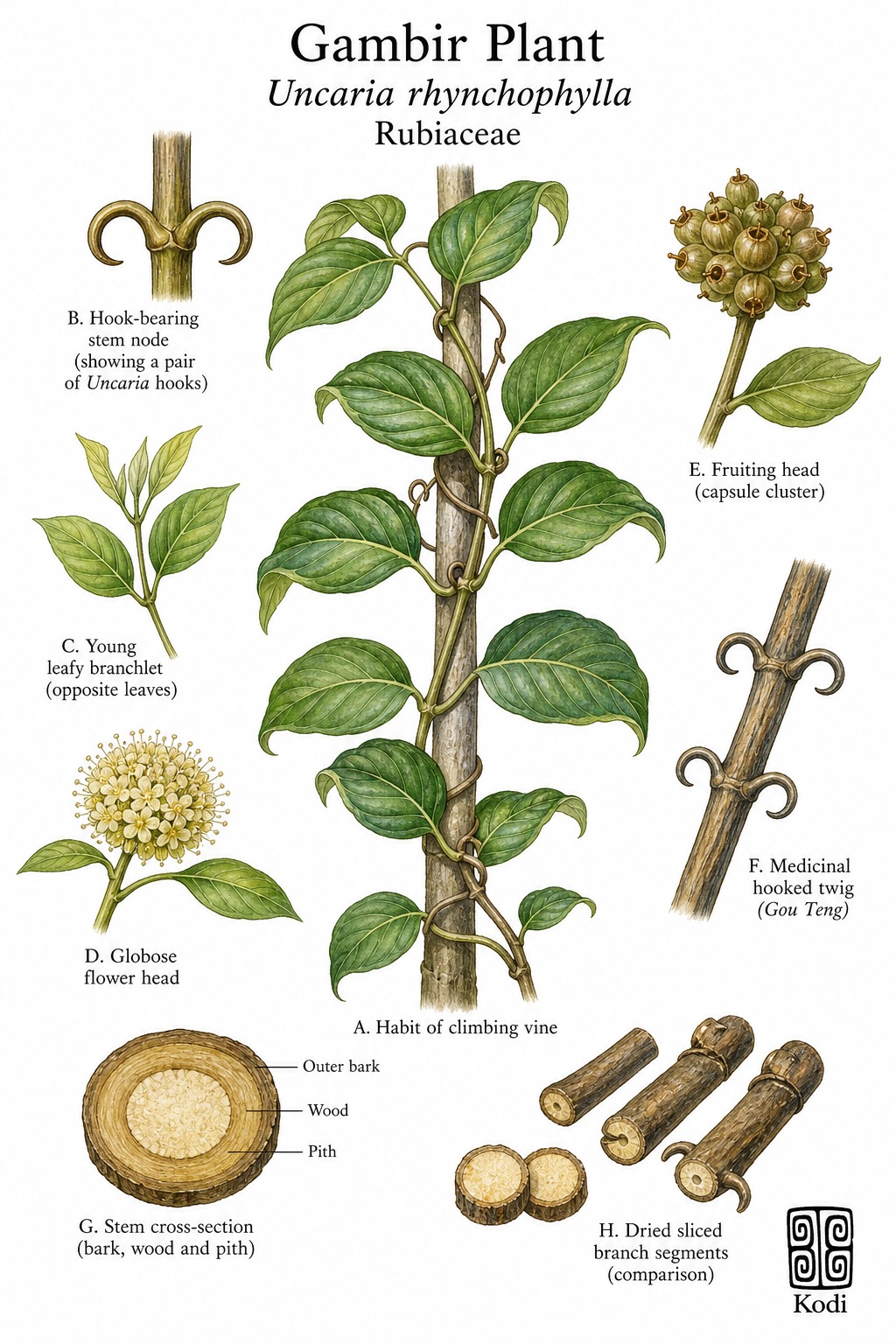
Known in TCM as Gou Teng (钩藤), this sweet, slightly cold herb enters the Liver and Pericardium. Traditionally, it extinguishes internal wind and stops spasms - Gou Teng is a standard herb for tremor, convulsion, pediatric febrile spasm, and other wind-stirring presentations, most often applied for headache, dizziness, and liver yang rising. Modern research has identified Rhynchophylline among its active constituents.
Part used: Twig
Also Known As
Latin: Ramulus Uncariae Cum Uncis | Pinyin: Gou Teng | Chinese: 钩藤
TCM Properties
- Taste
- sweet
- Temperature
- slightly cold
- Channels
- Liver, Pericardium
Traditional Use
Primary Actions
- Extinguishes internal wind and stops spasms - Gou Teng is a standard herb for tremor, convulsion, pediatric febrile spasm, and other wind-stirring presentations.
- Clears Liver heat and pacifies rising Yang - it is widely used for headache, dizziness, irritability, and red-eye patterns associated with upward Liver disturbance.
- Relieves hypertension-style presentations within TCM pattern logic - later practice especially values Gou Teng when dizziness and headache reflect vascular tension or rising Liver Yang.
Secondary Actions
- The crude drug is the hooked twig, not a catechu block or an acacia-derived gambier resin, which is why this inherited slug needed normalization to the Gou Teng identity.
- Traditional decoction practice often adds Gou Teng later in the boil to better preserve active constituents in the hook-bearing twigs.
Classic Formulas
- Ling Jiao Gou Teng Tang - classic warm-disease formula for heat-generated Liver Wind with high fever, spasms, and agitation.
- Tian Ma Gou Teng Yin - later formula for Liver-Yang rising with headache, dizziness, and hypertension-style symptoms.
- Gou Teng Yin - convulsion-oriented formula lineage using Gou Teng when internal wind and heat disturb the child or adult nervous system.
Classical References
- TCM Wiki describes Gou Teng as sweet and slightly cold, entering the Liver and Pericardium to extinguish wind, stop spasm, clear Liver heat, and pacify the Liver.
- Traditional herbology also preserves the practical rule that Gou Teng should usually be added near the end of decoction.
Modern Research
Active Compounds
- Rhynchophylline - the best-known Gou Teng oxindole alkaloid
- Isorhynchophylline - a closely related alkaloid prominent in CNS and vascular research
- Hirsutine and hirsuteine - supportive indole alkaloids discussed in cardiovascular and neurologic studies
Studied Effects
- A 2020 review summarized the central-nervous-system pharmacology of Uncaria rhynchophylla and its major constituents, reinforcing why Gou Teng remains a major modern research herb for seizures, neuroprotection, and vascular tension (PMID 31272356).
- A 2017 study investigated vasodilatory mechanisms of Uncaria rhynchophylla ethanolic extract, providing a plausible bridge between traditional Yang-pacifying use and modern cardiovascular interest (PMID 28771084).
- A 2014 experimental study found that Uncaria rhynchophylla and rhynchophylline improved kainic-acid-induced epileptic seizures, supporting the herb's classical spasm-stopping reputation in preclinical form (PMID 24636743).
PubMed References
- Uncaria rhynchophylla and its Major Constituents on Central Nervous System: A Review on Their Pharmacological Actions. (2020)
- Mechanisms of Action of Uncaria rhynchophylla Ethanolic Extract for Its Vasodilatory Effects. (2017)
- Uncaria rhynchophylla and rhynchophylline improved kainic acid-induced epileptic seizures via IL-1beta and brain-derived neurotrophic factor. (2014)
Safety & Interactions
Contraindications
- Deficiency-cold presentations without wind or rising Yang
- Symptomatic hypotension
Cautions
- Gou Teng is relatively gentle within the wind-extinguishing category, but concentrated extracts may have stronger neurologic and vascular effects than ordinary decoction twigs.
- Because modern data point toward hypotensive and CNS activity, concurrent use with antihypertensive or sedative therapies deserves practitioner review.
- Species identity matters because several Uncaria sources are accepted in trade, even though this record is standardized to representative accepted Uncaria rhynchophylla.
Drug Interactions
- Antihypertensive medications - possible additive blood-pressure-lowering effect.
- Sedatives or anticonvulsants - possible additive central nervous system effects.
Conditions
- Headache Traditional ★★★★☆ JSON
- Dizziness Traditional ★★★★☆ JSON
- Liver Yang Rising Traditional ★★★★☆ JSON
- Hypertension Research ★★★☆☆ JSON
- Epilepsy Traditional ★★★☆☆ JSON
Frequently Asked Questions
What is Uncaria Stem with Hooks used for?
Uncaria Stem with Hooks is traditionally used to Extinguishes internal wind and stops spasms - Gou Teng is a standard herb for tremor, convulsion, pediatric febrile spasm, and other wind-stirring presentations., Clears Liver heat and pacifies rising Yang - it is widely used for headache, dizziness, irritability, and red-eye patterns associated with upward Liver disturbance., Relieves hypertension-style presentations within TCM pattern logic - later practice especially values Gou Teng when dizziness and headache reflect vascular tension or rising Liver Yang.. Research has investigated its effects on: A 2020 review summarized the central-nervous-system pharmacology of Uncaria rhynchophylla and its major constituents, reinforcing why Gou Teng remains a major modern research herb for seizures, neuroprotection, and vascular tension (PMID 31272356).; A 2017 study investigated vasodilatory mechanisms of Uncaria rhynchophylla ethanolic extract, providing a plausible bridge between traditional Yang-pacifying use and modern cardiovascular interest (PMID 28771084)..
What are other names for Uncaria Stem with Hooks?
Uncaria Stem with Hooks is also known as Uncaria, Gambir Plant. In TCM: 钩藤 (Gou Teng); Ramulus Uncariae Cum Uncis.
Is Uncaria Stem with Hooks safe during pregnancy?
The safety of Uncaria Stem with Hooks during pregnancy has not been established. Consult a qualified healthcare provider before use.
What are the contraindications for Uncaria Stem with Hooks?
Uncaria Stem with Hooks should not be used in: Deficiency-cold presentations without wind or rising Yang; Symptomatic hypotension. Consult a qualified practitioner before use.
Does Uncaria Stem with Hooks interact with any medications?
Uncaria Stem with Hooks may interact with: Antihypertensive medications - possible additive blood-pressure-lowering effect.; Sedatives or anticonvulsants - possible additive central nervous system effects.. Always inform your healthcare provider of any herbal supplements you are taking.