Germinated Barley
- Chinese
- 麦芽
- Pinyin
- Mai Ya
- Latin
- Fructus Hordei Germinatus
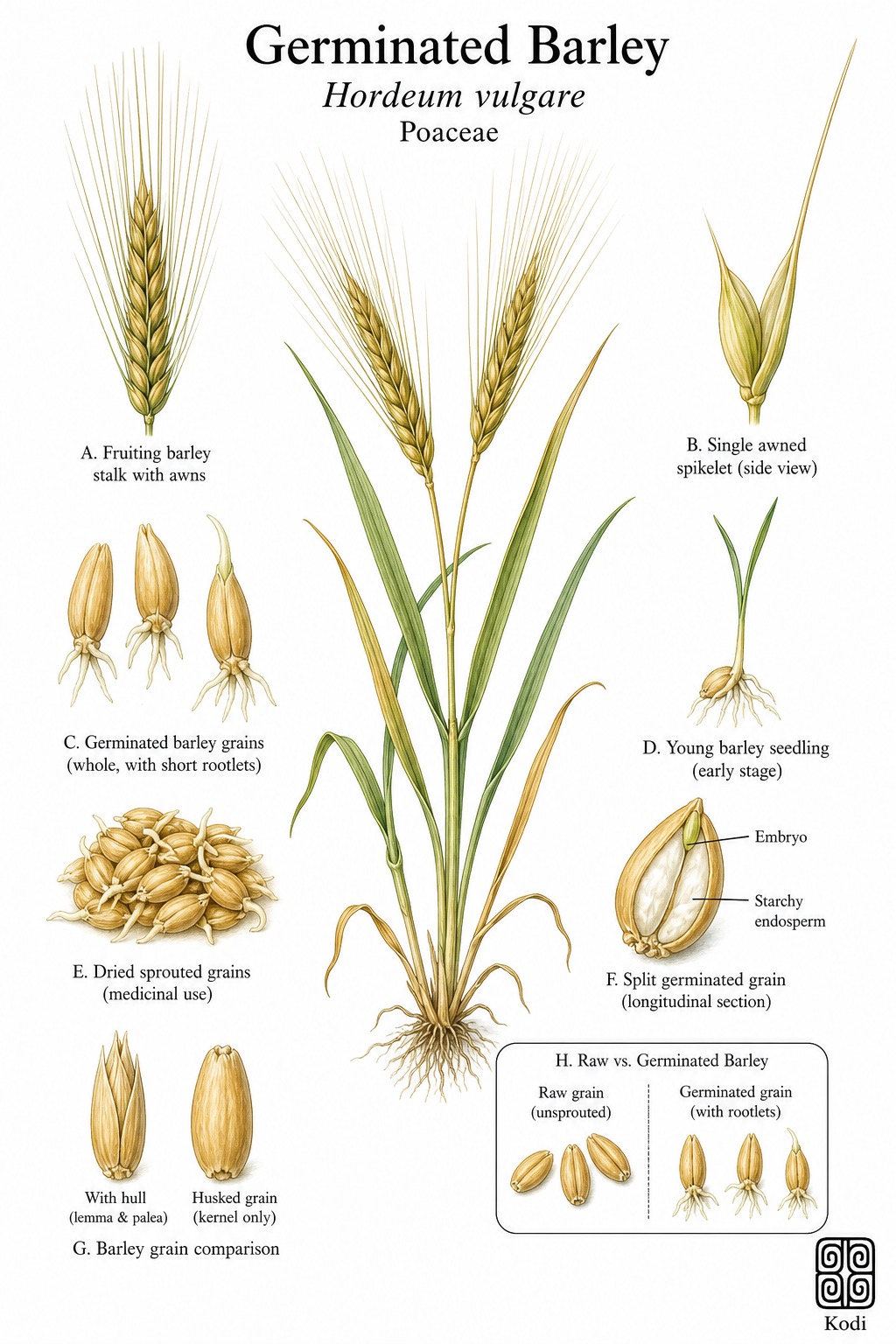
Known in TCM as Mai Ya (麦芽), this sweet, neutral herb enters the Spleen, Stomach, and Liver. Traditionally, it promotes digestion and reduces food stagnation - Mai Ya is especially used for retained grains, starches, milk, and childhood food accumulation with fullness and sourness, most often applied for indigestion, poor appetite, and abdominal distension. Modern research has identified Hordenine among its active constituents.
Part used: Fruit
Also Known As
Latin: Fructus Hordei Germinatus | Pinyin: Mai Ya | Chinese: 麦芽
TCM Properties
- Taste
- sweet
- Temperature
- neutral
- Channels
- Spleen, Stomach, Liver
Traditional Use
Primary Actions
- Promotes digestion and reduces food stagnation - Mai Ya is especially used for retained grains, starches, milk, and childhood food accumulation with fullness and sourness.
- Soothes the Liver and relieves constraint - traditional use extends to distention or breast and hypochondriac discomfort when food stagnation and qi constraint overlap.
- Reduces lactation - larger or targeted use is classically associated with suppressing breast-milk production during weaning or when overfull lactation must be checked.
Secondary Actions
- Compared with Jiao Mai Ya, the raw germinated herb is gentler, less drying, and more suitable when the goal is to aid digestion without the stronger astringing effect of charring.
- Mai Ya belongs to the broader malt-and-leaven digestive lineage but remains the cleanest single-herb choice when grain and starch retention dominate.
Classic Formulas
- Bao He Wan modifications with Mai Ya - food-stagnation strategy when retained grains and poor appetite are central.
- Jian Pi Wan-style digestive support - later practice uses Mai Ya when weak transformation and lingering food retention occur together.
- Jiao San Xian lineage comparison - Mai Ya is the raw-malt baseline from which the stronger charred digestants are derived.
Classical References
- Traditional herbology describes Mai Ya as sweet and neutral, entering the Spleen, Stomach, and Liver to promote digestion, soothe the Liver, and reduce lactation.
- Classical cautions repeatedly note that the same quality that helps disperse milk accumulation can undesirably suppress lactation when milk supply should be maintained.
Modern Research
Active Compounds
- Hordenine - the best-known barley-sprout alkaloid linked to prolactin regulation
- Hordatines - barley-specific phenolamides prominent in seedling metabolomics
- Amylase and other digestive-enzyme fractions - central to the traditional food-reducing rationale
- Phenolic acids and flavonoids - supportive antioxidant constituents in germinated barley
Studied Effects
- A 2014 study found that water extract of Fructus Hordei Germinatus showed antihyperprolactinemia activity via dopamine D2-receptor signaling, giving a plausible modern explanation for Mai Ya's classic lactation-suppressing use (PMID 25254056).
- A 2020 study reported that Maillard reaction products from stir-fried Hordei Fructus Germinatus were important to efficacy in functional dyspepsia, which helps clarify how processing changes the digestive profile within the Mai Ya lineage (PMID 31971858).
- A 2022 metabolomics study showed that hordatines and associated precursors dominate barley seedling metabolite profiles, reinforcing that germinated barley is chemically distinct from ordinary grain (PMID 35448497).
PubMed References
- Water Extract of Fructus Hordei Germinatus Shows Antihyperprolactinemia Activity via Dopamine D2 Receptor. (2014)
- Maillard Reaction Products of Stir Fried Hordei Fructus Germinatus Are Important for Its Efficacy in Treating Functional Dyspepsia. (2020)
- Hordatines and Associated Precursors Dominate Metabolite Profiles of Barley (Hordeum vulgare L.) Seedlings: A Metabolomics Study of Five Cultivars. (2022)
Safety & Interactions
Contraindications
- Pregnancy
- Breastfeeding when continued milk supply is desired
- Spleen and Stomach deficiency without actual food retention
Cautions
- Mai Ya can suppress lactation, which is helpful for weaning but inappropriate during active breastfeeding when milk production should continue.
- The herb is food-like but not neutral for everyone; overuse can weaken already deficient digestion if true stagnation is absent.
- Modern prolactin and processing studies support pharmacologic activity, so it should not be treated as just ordinary dietary barley.
Conditions
- Indigestion Traditional ★★★★☆ JSON
- Poor Appetite Traditional ★★★☆☆ JSON
- Abdominal Distension Traditional ★★★☆☆ JSON
- Hypochondriac Pain Traditional ★★☆☆☆ JSON
Frequently Asked Questions
What is Germinated Barley used for?
Germinated Barley is traditionally used to Promotes digestion and reduces food stagnation - Mai Ya is especially used for retained grains, starches, milk, and childhood food accumulation with fullness and sourness., Soothes the Liver and relieves constraint - traditional use extends to distention or breast and hypochondriac discomfort when food stagnation and qi constraint overlap., Reduces lactation - larger or targeted use is classically associated with suppressing breast-milk production during weaning or when overfull lactation must be checked.. Research has investigated its effects on: A 2014 study found that water extract of Fructus Hordei Germinatus showed antihyperprolactinemia activity via dopamine D2-receptor signaling, giving a plausible modern explanation for Mai Ya's classic lactation-suppressing use (PMID 25254056).; A 2020 study reported that Maillard reaction products from stir-fried Hordei Fructus Germinatus were important to efficacy in functional dyspepsia, which helps clarify how processing changes the digestive profile within the Mai Ya lineage (PMID 31971858)..
What are other names for Germinated Barley?
Germinated Barley is also known as Hordei, Malt Sprout. In TCM: 麦芽 (Mai Ya); Fructus Hordei Germinatus.
Is Germinated Barley safe during pregnancy?
Germinated Barley is not recommended during pregnancy.
What are the contraindications for Germinated Barley?
Germinated Barley should not be used in: Pregnancy; Breastfeeding when continued milk supply is desired; Spleen and Stomach deficiency without actual food retention. Consult a qualified practitioner before use.