Ginger Peel
- Chinese
- 姜皮
- Pinyin
- Jiang Pi
- Latin
- Cortex Zingiberis
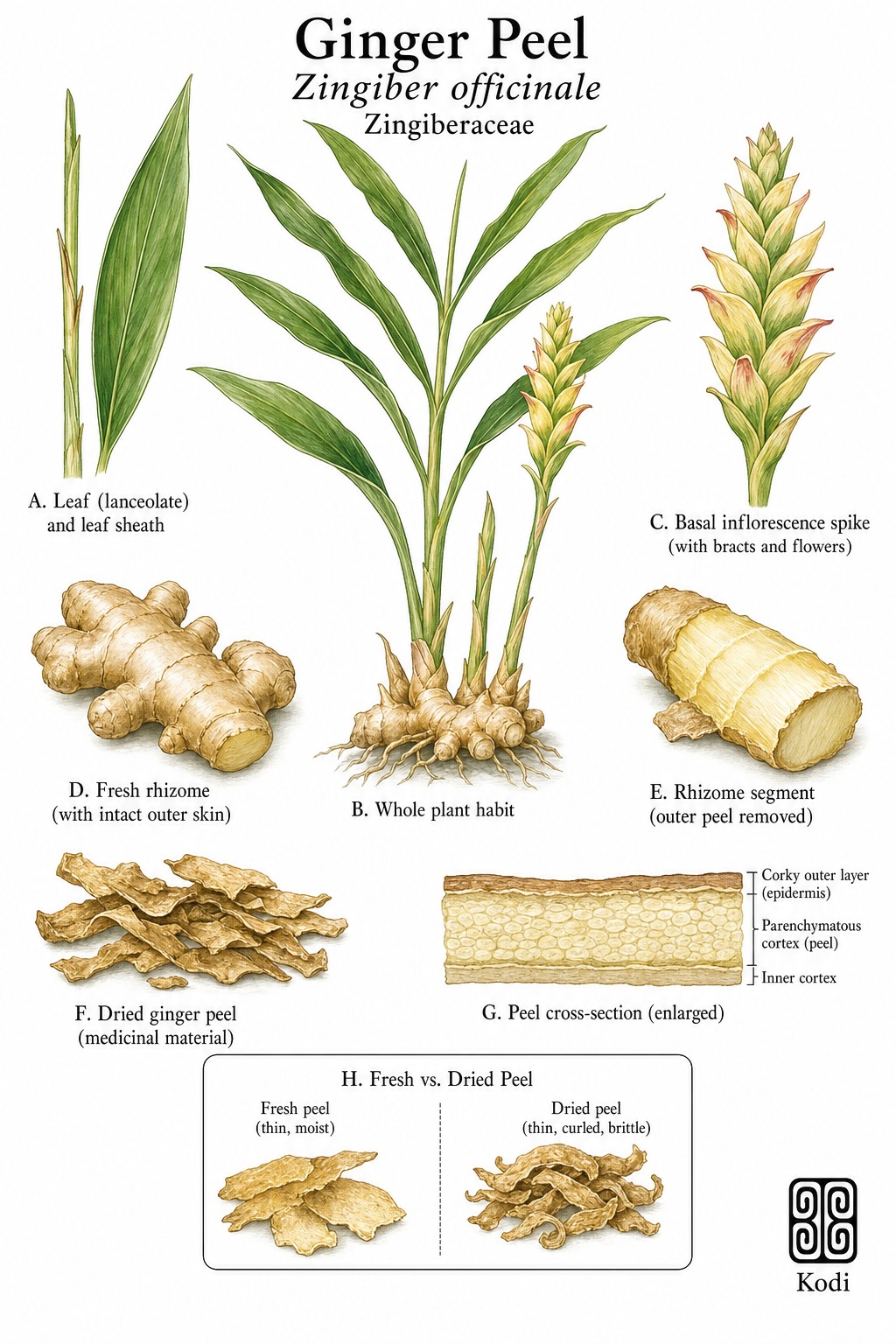
Known in TCM as Jiang Pi (姜皮), this pungent, cool herb enters the Lung and Spleen. Traditionally, it promotes urination and reduces edema - Jiang Pi is used when swelling is superficial, relatively early, or associated with mild dysfunction of the exterior and fluids, most often applied for edema, abdominal distension, and wind cold. Modern research has identified Gingerols among its active constituents.
Part used: Bark
Also Known As
Latin: Cortex Zingiberis | Pinyin: Jiang Pi | Chinese: 姜皮
TCM Properties
- Taste
- pungent
- Temperature
- cool
- Channels
- Lung, Spleen
Traditional Use
Primary Actions
- Promotes urination and reduces edema - Jiang Pi is used when swelling is superficial, relatively early, or associated with mild dysfunction of the exterior and fluids.
- Mildly releases the exterior - the peel retains some of ginger's dispersing nature but is gentler and cooler than the inner rhizome.
- Relieves distention from fluid stagnation - traditional use includes abdominal or body-surface puffiness when dampness and constrained qi are both present.
Secondary Actions
- Classical ginger teaching contrasts the peel and the flesh: the peel moves outward and drains swelling, while the inner rhizome warms the middle and stops vomiting.
- Jiang Pi is therefore not interchangeable with Sheng Jiang or Gan Jiang even though all come from Zingiber officinale.
Classic Formulas
- Wu Pi Yin - classic edema formula in which Sheng Jiang Pi or Jiang Pi joins other peels to move qi and drain superficial swelling.
- Exterior-fluid formulas using qi-moving peels - traditional strategy when mild edema and surface obstruction appear together.
Classical References
- Me and Qi describes Sheng Jiang Pi as pungent and cool, entering the Spleen and Lung to cause diuresis and alleviate edema.
- Traditional teaching repeatedly emphasizes the peel-versus-flesh distinction, making Jiang Pi one of the clearest examples of part-specific medicinal action within a common food plant.
Modern Research
Active Compounds
- Gingerols - major pungent phenolics found across ginger peel and pulp
- Shogaols - dehydration products relevant to anti-inflammatory and antioxidant discussion
- Volatile-oil fractions - aromatic constituents contributing to the peel's dispersing profile
- Peel-enriched phenolic fractions - highlighted in peel-versus-pulp comparison studies
Studied Effects
- A 2021 UPLC-QTOF analysis compared different polarity fractions from ginger pulp and peel, showing that the peel has a distinct chemical profile rather than simply being a throwaway outer layer (PMID 33326132).
- A 2024 review summarized the preparation, pungency, and bioactivity of gingerols, which remain central to understanding both peel and rhizome pharmacology in modern terms (PMID 36135317).
- A 2023 study of hydro-ethanolic ginger extract in postoperative peritoneal-adhesion models reported anti-inflammatory and antioxidative effects, supporting species-level ginger pharmacology even though it was not a peel-only clinical trial (PMID 36865747).
PubMed References
- Qualitative analysis on chemical constituents from different polarity extracted fractions of the pulp and peel of ginger rhizomes by ultra-high-performance liquid chromatography coupled with electrospray ionization quadrupole time-of-flight tandem mass spectrometry. (2021)
- Preparation, pungency and bioactivity of gingerols from ginger (Zingiber officinale Roscoe): a review. (2024)
- Oral Administration Evaluation of the Hydro-Ethanolic Extract of Ginger (Rhizome of Zingiber officinale) against Postoperative-Induced Peritoneal Adhesion: Investigating the Role of Anti-Inflammatory and Antioxidative Effects. (2023)
Safety & Interactions
Contraindications
- Cold deficiency without edema or fluid stagnation
- Perioperative use of concentrated ginger supplements
Cautions
- Jiang Pi is milder than whole-rhizome ginger for warming the middle, so using it as if it were Sheng Jiang can miss the clinical target.
- Species-level ginger interaction cautions still matter when concentrated extracts are used, especially around bleeding risk and glucose-lowering therapies.
- Most indexed modern research is on ginger as a whole plant or on peel-vs-pulp chemistry, not on Jiang Pi as a stand-alone clinical crude drug.
Drug Interactions
- Anticoagulants or antiplatelet drugs - possible increased bleeding risk with concentrated ginger products.
- Hypoglycemics or insulin - possible additive glucose-lowering effect with concentrated extracts.
Conditions
Frequently Asked Questions
What is Ginger Peel used for?
Ginger Peel is traditionally used to Promotes urination and reduces edema - Jiang Pi is used when swelling is superficial, relatively early, or associated with mild dysfunction of the exterior and fluids., Mildly releases the exterior - the peel retains some of ginger's dispersing nature but is gentler and cooler than the inner rhizome., Relieves distention from fluid stagnation - traditional use includes abdominal or body-surface puffiness when dampness and constrained qi are both present.. Research has investigated its effects on: A 2021 UPLC-QTOF analysis compared different polarity fractions from ginger pulp and peel, showing that the peel has a distinct chemical profile rather than simply being a throwaway outer layer (PMID 33326132).; A 2024 review summarized the preparation, pungency, and bioactivity of gingerols, which remain central to understanding both peel and rhizome pharmacology in modern terms (PMID 36135317)..
What are other names for Ginger Peel?
Ginger Peel is also known as Sheng Jiang Pi, Zingiberis Peel. In TCM: 姜皮 (Jiang Pi); Cortex Zingiberis.
Is Ginger Peel safe during pregnancy?
The safety of Ginger Peel during pregnancy has not been established. Consult a qualified healthcare provider before use.
What are the contraindications for Ginger Peel?
Ginger Peel should not be used in: Cold deficiency without edema or fluid stagnation; Perioperative use of concentrated ginger supplements. Consult a qualified practitioner before use.
Does Ginger Peel interact with any medications?
Ginger Peel may interact with: Anticoagulants or antiplatelet drugs - possible increased bleeding risk with concentrated ginger products.; Hypoglycemics or insulin - possible additive glucose-lowering effect with concentrated extracts.. Always inform your healthcare provider of any herbal supplements you are taking.