Ginseng
- Chinese
- 人参
- Pinyin
- Ren Shen
- Latin
- Radix Ginseng
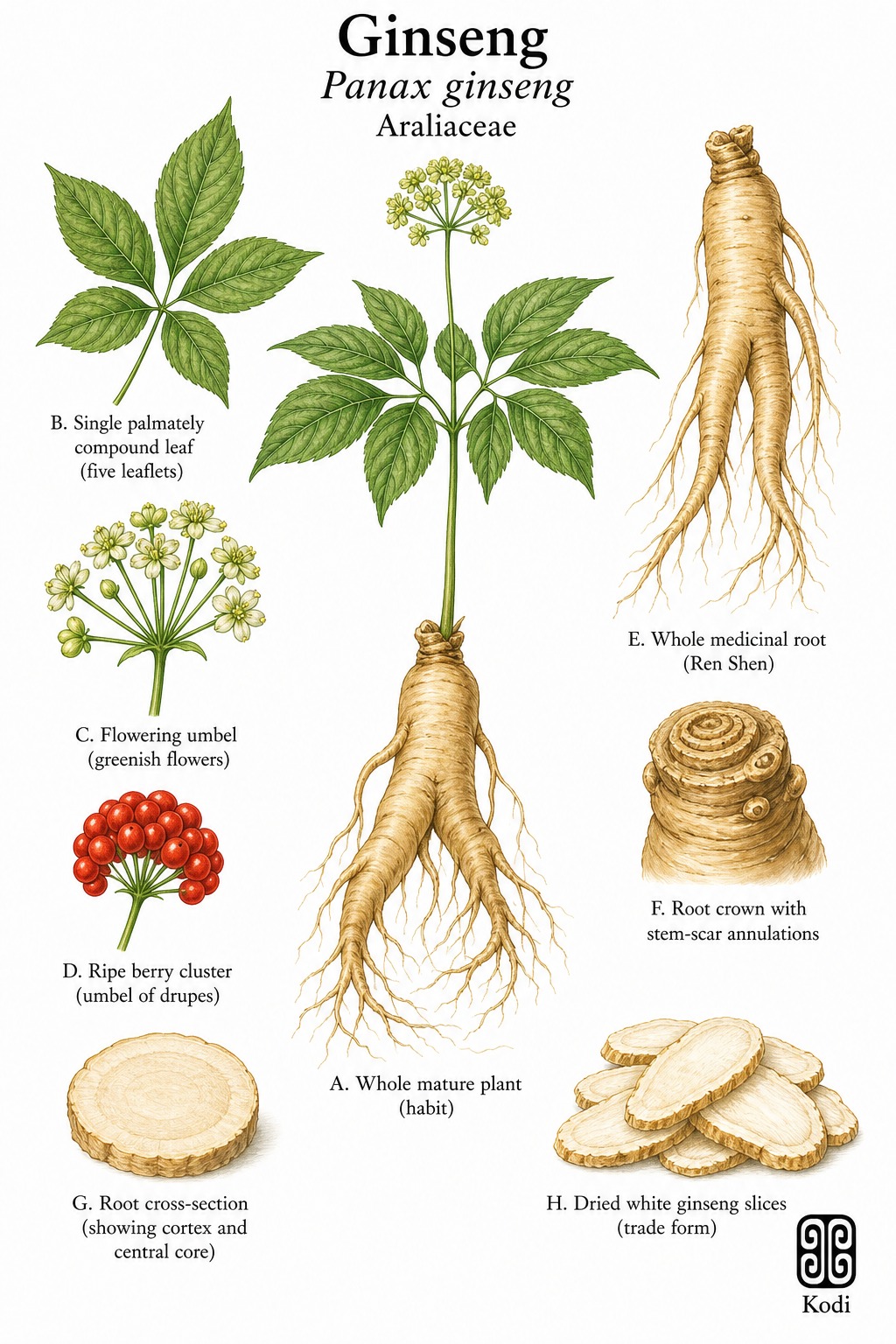
Known in TCM as Ren Shen (人参), this sweet and slightly bitter, slightly warm herb enters the Spleen, Lung, and Heart. Traditionally, it powerfully tonifies source qi - Ren Shen is the flagship qi tonic for collapse, profound fatigue, weak pulse, and severe constitutional depletion, most often applied for fatigue, digestive weakness, and cough. Modern research has identified Ginsenosides among its active constituents.
Part used: Root
Also Known As
Latin: Radix Ginseng | Pinyin: Ren Shen | Chinese: 人参
TCM Properties
- Taste
- sweet, slightly bitter
- Temperature
- slightly warm
- Channels
- Spleen, Lung, Heart
Traditional Use
Primary Actions
- Powerfully tonifies source qi - Ren Shen is the flagship qi tonic for collapse, profound fatigue, weak pulse, and severe constitutional depletion.
- Strengthens the Spleen and Lung - traditional use includes shortness of breath, poor appetite, weak digestion, and chronic cough from deficiency rather than excess.
- Generates fluids and stops thirst - it is used when deficiency damages fluids, producing dry mouth, wasting-thirst presentations, or post-illness depletion.
- Calms the spirit - later use extends to palpitations, insomnia, and emotional depletion when qi and fluids no longer anchor the Heart well.
Secondary Actions
- Ren Shen is warmer and more forcefully tonifying than American ginseng, so it is better for cold-depleted qi states and less suitable for deficiency heat.
- Because it is strong, Ren Shen often becomes the decision herb in a formula: whether to use it, substitute it, or omit it can shift the whole treatment strategy.
Classic Formulas
- Si Jun Zi Tang - the foundational Spleen-Qi tonic formula built around Ren Shen.
- Sheng Mai San - classic formula in which Ren Shen restores qi while Mai Men Dong and Wu Wei Zi preserve fluids and leakage.
- Du Shen Tang and Shen Fu Tang lineages - collapse-rescue formulas that show Ren Shen at its strongest traditional end.
Classical References
- Traditional materia medica describe Ren Shen as sweet, slightly bitter, and slightly warm, entering the Spleen, Lung, and Heart to strongly tonify primal qi and generate fluids.
- Classical teaching also preserves the well-known incompatibility caution with Li Lu and the antagonist relationship with Wu Ling Zhi.
Modern Research
Active Compounds
- Ginsenosides such as Rg1, Rb1, Rc, Rd, and Re - the core Panax ginseng marker compounds
- Ginseng polysaccharides - major constituents in metabolic and immune research
- Polyacetylenes such as panaxynol and panaxydol - supportive constituents discussed in anti-inflammatory literature
Studied Effects
- A 2022 systematic review and meta-analysis found that Panax ginseng has been studied for hyperglycemia, hypertension, and hyperlipidemia, supporting ongoing cardiometabolic interest while still leaving effect sizes mixed and context dependent (PMID 35509826).
- A 2019 meta-analysis of randomized trials reported favorable effects of Panax ginseng supplementation on blood-lipid profiles, reinforcing the herb's modern metabolic research relevance (PMID 31315027).
- A 2022 systematic review surveyed Panax ginseng across aging-related disorders, showing why Ren Shen remains one of the most heavily researched traditional tonics in modern biomedicine (PMID 35143871).
PubMed References
- Effects of Panax ginseng on hyperglycemia, hypertension, and hyperlipidemia: A systematic review and meta-analysis. (2022)
- Efficacy of Panax ginseng supplementation on blood lipid profile. A meta-analysis and systematic review of clinical randomized trials. (2019)
- Panax ginseng and aging related disorders: A systematic review. (2022)
Safety & Interactions
Contraindications
- Acute excess heat or agitation without deficiency
- Uncontrolled stimulant-type insomnia or marked upward-yang excess
- Concurrent warfarin therapy without close monitoring
Cautions
- MSK and broader clinical literature note interaction concerns with warfarin, glucose-lowering drugs, and stimulant-type responses such as insomnia or palpitations.
- Different ginseng species and processed forms are not interchangeable, so Ren Shen should not be assumed equivalent to American ginseng, red ginseng, or leaf products.
- High-dose or inappropriate use may cause agitation, insomnia, headache, or blood-pressure changes.
Drug Interactions
- Warfarin - possible reduction of anticoagulant effect.
- Insulin or hypoglycemic drugs - possible additive glucose-lowering effect.
- MAOIs or stimulants - possible overstimulation, headache, or insomnia.
Conditions
- Fatigue Traditional ★★★★☆ JSON
- Digestive Weakness Traditional ★★★★☆ JSON
- Cough Traditional ★★★☆☆ JSON
- Palpitations Traditional ★★★☆☆ JSON
- Type 2 Diabetes Research ★★☆☆☆ JSON
Frequently Asked Questions
What is Ginseng used for?
Ginseng is traditionally used to Powerfully tonifies source qi - Ren Shen is the flagship qi tonic for collapse, profound fatigue, weak pulse, and severe constitutional depletion., Strengthens the Spleen and Lung - traditional use includes shortness of breath, poor appetite, weak digestion, and chronic cough from deficiency rather than excess., Generates fluids and stops thirst - it is used when deficiency damages fluids, producing dry mouth, wasting-thirst presentations, or post-illness depletion., Calms the spirit - later use extends to palpitations, insomnia, and emotional depletion when qi and fluids no longer anchor the Heart well.. Research has investigated its effects on: A 2022 systematic review and meta-analysis found that Panax ginseng has been studied for hyperglycemia, hypertension, and hyperlipidemia, supporting ongoing cardiometabolic interest while still leaving effect sizes mixed and context dependent (PMID 35509826).; A 2019 meta-analysis of randomized trials reported favorable effects of Panax ginseng supplementation on blood-lipid profiles, reinforcing the herb's modern metabolic research relevance (PMID 31315027)..
What are other names for Ginseng?
Ginseng is also known as Panax ginseng, Asian Ginseng. In TCM: 人参 (Ren Shen); Radix Ginseng.
Is Ginseng safe during pregnancy?
The safety of Ginseng during pregnancy has not been established. Consult a qualified healthcare provider before use.
What are the contraindications for Ginseng?
Ginseng should not be used in: Acute excess heat or agitation without deficiency; Uncontrolled stimulant-type insomnia or marked upward-yang excess; Concurrent warfarin therapy without close monitoring. Consult a qualified practitioner before use.
Does Ginseng interact with any medications?
Ginseng may interact with: Warfarin - possible reduction of anticoagulant effect.; Insulin or hypoglycemic drugs - possible additive glucose-lowering effect.; MAOIs or stimulants - possible overstimulation, headache, or insomnia.. Always inform your healthcare provider of any herbal supplements you are taking.