Glabrous Greenbrier Rhizome
- Chinese
- 土茯苓
- Pinyin
- Tu Fu Ling
- Latin
- Rhizoma Smilacis Glabrae
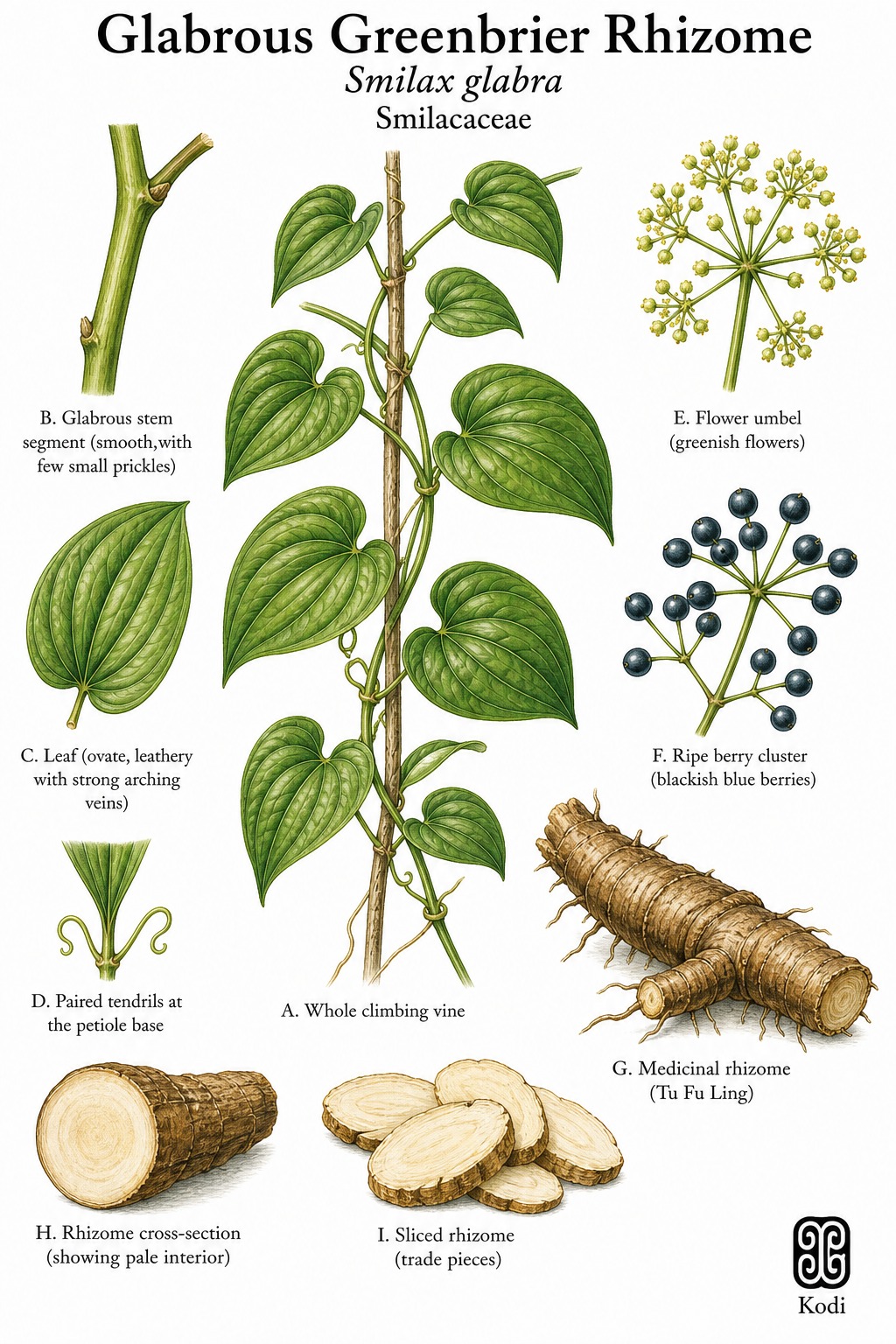
Known in TCM as Tu Fu Ling (土茯苓), this sweet and bland, neutral herb enters the Liver and Stomach. Traditionally, it eliminates toxic heat and resolves damp-toxin - Tu Fu Ling is classically used for syphilitic lesions, damp-hot sores, carbuncles, genital itching, and chronic skin disorders in which heat and dampness linger together, most often applied for eczema, joint pain, and syphilis. Modern research has identified Flavonoids among its active constituents.
Part used: Rhizome
Also Known As
Latin: Rhizoma Smilacis Glabrae | Pinyin: Tu Fu Ling | Chinese: 土茯苓
TCM Properties
- Taste
- sweet, bland
- Temperature
- neutral
- Channels
- Liver, Stomach
Traditional Use
Primary Actions
- Eliminates toxic heat and resolves damp-toxin - Tu Fu Ling is classically used for syphilitic lesions, damp-hot sores, carbuncles, genital itching, and chronic skin disorders in which heat and dampness linger together.
- Promotes urination and drains damp turbidity - it is chosen when damp-heat causes cloudy urine, leukorrhea, painful dribbling, or lingering lower-burner congestion.
- Unblocks the channels and relieves painful obstruction - traditional use extends to mercury-related toxicity patterns, gout-like painful joints, swollen limbs, and chronic damp obstruction affecting the sinews and bones.
Secondary Actions
- Tu Fu Ling is unusually gentle for a detoxifying herb and often appears in relatively large doses when long-standing damp-toxic skin or joint patterns need steady clearing without excessive coldness.
- It should not be collapsed into either Ba Qia or Fu Ling: the name overlap confuses trade material, but the TCM job and botanical source are distinct.
Classic Formulas
- Tu Fu Ling with Bi Xie and Yi Yi Ren - a common pairing approach for cloudy urine, damp-heat, leukorrhea, and gout-like painful obstruction.
- Tu Fu Ling with Jin Yin Hua and Lian Qiao - used when toxic heat produces carbuncles, swollen sores, or damp-hot skin eruptions.
- Tu Fu Ling with Ku Shen and Bai Xian Pi - a damp-toxic skin pairing for chronic itching, eczema, discharge, or lower-body heat.
Classical References
- Me & Qi describes Tu Fu Ling as sweet, bland, and neutral, entering the Liver and Stomach to detoxify, eliminate dampness, and benefit the joints.
- Materia medica summaries tracing back to Ben Cao Gang Mu repeatedly emphasize sores, mercury-related toxicity, painful joints, and damp-heat in the lower body as signature indications.
- SOURCE NOTE: this record follows the accepted Smilax glabra identity used elsewhere in the repo and keeps it separate from Ba Qia and other Smilax rhizomes.
Modern Research
Active Compounds
- Flavonoids such as astilbin, neoastilbin, neoisoastilbin, and isoastilbin - the best-studied signature compounds of Smilax glabra rhizome
- Engeletin and related flavanonol derivatives - anti-inflammatory constituents investigated in gut and immune models
- Phenylpropanoid glycosides and broader polyphenolic fractions - supportive antioxidant and anti-inflammatory constituents
- Polysaccharide-rich fractions - macromolecular components explored for immunomodulatory and detoxification-related effects
Studied Effects
- A 2022 study found that fresh Smilax glabra outperformed processed material in suppressing phosphodiesterase-4 and inflammatory cytokine signaling, supporting the herb's traditional damp-toxic and heat-clearing use while also showing that preparation matters pharmacologically (PMID 36211720).
- A 2019 animal study reported that a flavonoid-rich Smilax glabra extract promoted uric-acid excretion and reduced oxidative and inflammatory injury in hyperuricemic nephropathy, offering a modern correlate for classical painful-damp and gout-like use (PMID 30579255).
- A 2024 study identified engeletin from Smilax glabra as protective in experimental colitis through modulation of TLR4-NF-kB signaling, adding mechanistic support to the herb's long association with toxic-heat and inflammatory bowel patterns (PMID 39181281).
PubMed References
- Comparative anti-inflammatory effects of fresh and processed Smilax glabra based on regulation of PDE4. (2022)
- Flavonoid-rich extract from Smilax glabra Roxb. inhibits hyperuricemic nephropathy by attenuating NLRP3 inflammasome activation and promoting renal urate excretion. (2019)
- Smilax glabra Roxb.-derived engeletin attenuates inflammatory response and intestinal mucosal damage in Crohn's disease-like colitis by targeting the TLR4/NF-kB signaling pathway. (2024)
Safety & Interactions
Contraindications
- Marked deficiency-cold without dampness, toxicity, or joint obstruction
- Use as an assumed substitute for Ba Qia or other Smilax rhizomes without authentication
Cautions
- Species confusion is common in Smilax trade material, so authenticated Tu Fu Ling should not be assumed interchangeable with Ba Qia or unrelated sarsaparilla products.
- Memorial Sloan Kettering notes preclinical findings suggesting possible CYP2D6 and CYP3A4 effects, so concentrated extract use deserves caution with narrow-therapeutic-index medicines.
- Human clinical evidence remains limited; most modern literature is preclinical and should not be overextended into stand-alone treatment claims.
Drug Interactions
- Possible interaction with CYP2D6- or CYP3A4-metabolized drugs based on preclinical data
Conditions
- Eczema Traditional ★★★★☆ JSON
- Joint Pain Traditional ★★★☆☆ JSON
- Syphilis Traditional ★★★☆☆ JSON
- Urinary Tract Infection Traditional ★★☆☆☆ JSON
Frequently Asked Questions
What is Glabrous Greenbrier Rhizome used for?
Glabrous Greenbrier Rhizome is traditionally used to Eliminates toxic heat and resolves damp-toxin - Tu Fu Ling is classically used for syphilitic lesions, damp-hot sores, carbuncles, genital itching, and chronic skin disorders in which heat and dampness linger together., Promotes urination and drains damp turbidity - it is chosen when damp-heat causes cloudy urine, leukorrhea, painful dribbling, or lingering lower-burner congestion., Unblocks the channels and relieves painful obstruction - traditional use extends to mercury-related toxicity patterns, gout-like painful joints, swollen limbs, and chronic damp obstruction affecting the sinews and bones.. Research has investigated its effects on: A 2022 study found that fresh Smilax glabra outperformed processed material in suppressing phosphodiesterase-4 and inflammatory cytokine signaling, supporting the herb's traditional damp-toxic and heat-clearing use while also showing that preparation matters pharmacologically (PMID 36211720).; A 2019 animal study reported that a flavonoid-rich Smilax glabra extract promoted uric-acid excretion and reduced oxidative and inflammatory injury in hyperuricemic nephropathy, offering a modern correlate for classical painful-damp and gout-like use (PMID 30579255)..
What are other names for Glabrous Greenbrier Rhizome?
Glabrous Greenbrier Rhizome is also known as Smilacis. In TCM: 土茯苓 (Tu Fu Ling); Rhizoma Smilacis Glabrae.
Is Glabrous Greenbrier Rhizome safe during pregnancy?
The safety of Glabrous Greenbrier Rhizome during pregnancy has not been established. Consult a qualified healthcare provider before use.
What are the contraindications for Glabrous Greenbrier Rhizome?
Glabrous Greenbrier Rhizome should not be used in: Marked deficiency-cold without dampness, toxicity, or joint obstruction; Use as an assumed substitute for Ba Qia or other Smilax rhizomes without authentication. Consult a qualified practitioner before use.
Does Glabrous Greenbrier Rhizome interact with any medications?
Glabrous Greenbrier Rhizome may interact with: Possible interaction with CYP2D6- or CYP3A4-metabolized drugs based on preclinical data. Always inform your healthcare provider of any herbal supplements you are taking.