Glehnia Root
- Chinese
- 北沙参
- Pinyin
- Bei Sha Shen
- Latin
- Radix Glehniae
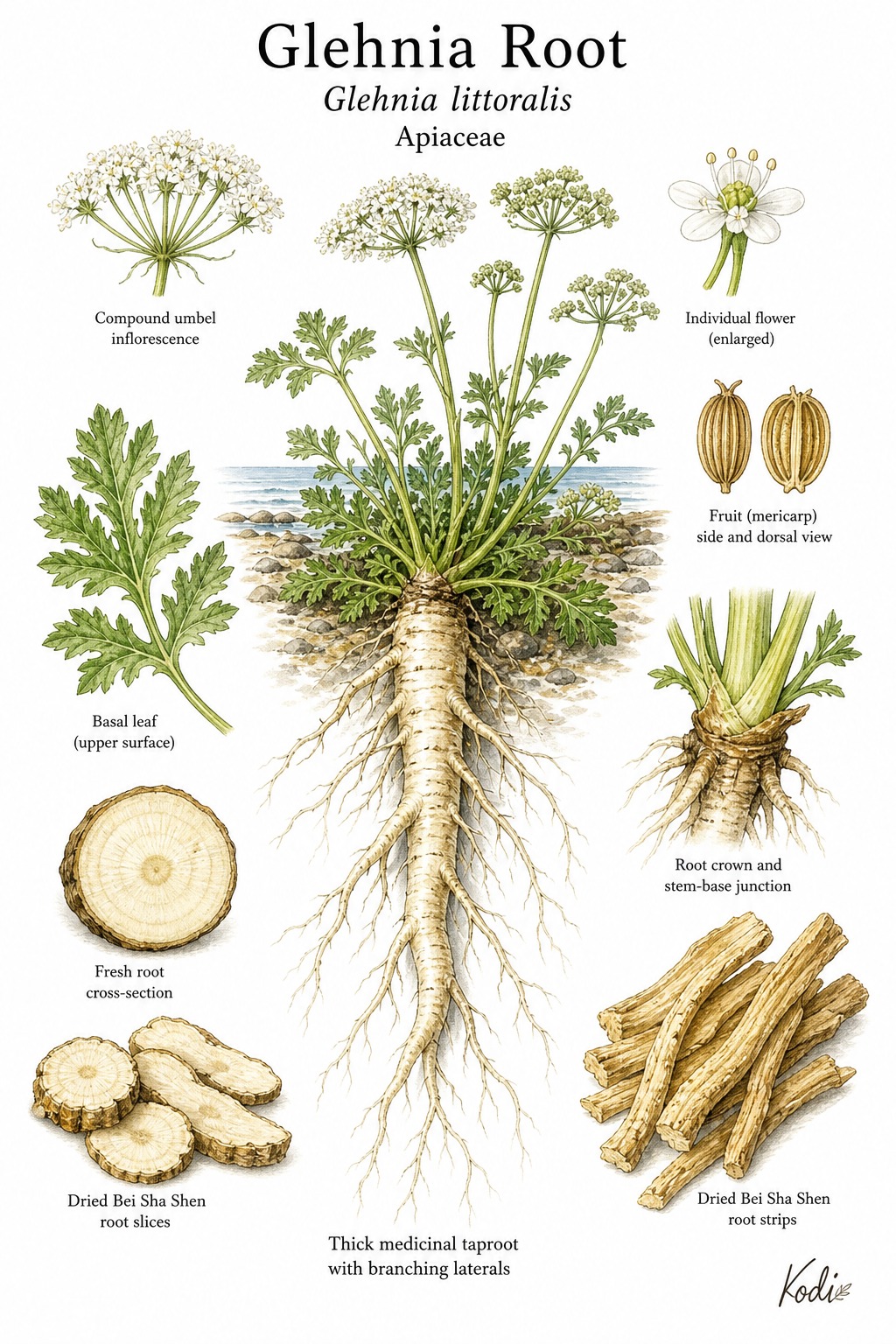
Known in TCM as Bei Sha Shen (北沙参), this sweet and slightly bitter, slightly cold herb enters the Lung and Stomach. Traditionally, it nourishes Lung Yin and moistens dryness - Bei Sha Shen is classically used for dry cough, throat irritation, scant sputum, hoarseness, and lingering dryness after warm disease, most often applied for dry cough, yin deficiency, and pharyngitis. Modern research has identified Furanocoumarins among its active constituents.
Part used: Root
Also Known As
Latin: Radix Glehniae | Pinyin: Bei Sha Shen | Chinese: 北沙参
TCM Properties
- Taste
- sweet, slightly bitter
- Temperature
- slightly cold
- Channels
- Lung, Stomach
Traditional Use
Primary Actions
- Nourishes Lung Yin and moistens dryness - Bei Sha Shen is classically used for dry cough, throat irritation, scant sputum, hoarseness, and lingering dryness after warm disease.
- Nourishes Stomach Yin and generates fluids - it is chosen for dry mouth, thirst, hunger without appetite, and fluid depletion after febrile illness or chronic heat damage.
- Clears residual heat from the Lung and Stomach without being harsh - it is especially useful when deficiency and dryness coexist rather than full excess heat.
Secondary Actions
- Compared with Nan Sha Shen, Bei Sha Shen is usually considered denser, cooler, and somewhat stronger at generating fluids and enriching Stomach Yin, while Nan Sha Shen is gentler on weak digestion and a little better at transforming lingering phlegm.
- Because the herb is also used in food-style soups and convalescent preparations, it often bridges the line between classical tonic herb and medicinal diet therapy.
Classic Formulas
- Sha Shen Mai Dong Tang - classic Lung-Stomach dryness formula in which Sha Shen restores fluids and moistens the upper burner.
- Yi Wei Tang - Stomach-Yin formula that commonly uses Sha Shen with Mai Men Dong, Sheng Di Huang, and Yu Zhu for thirst and dry mouth after heat damage.
- Yi Guan Jian - a Liver-Stomach Yin deficiency formula in which Sha Shen is often paired with Sheng Di Huang and Mai Men Dong to enrich fluids and soften dryness.
Classical References
- Me & Qi and TCM Wiki both describe Bei Sha Shen as sweet and slightly cold, entering the Lung and Stomach to nourish yin, moisten dryness, and generate fluids.
- Traditional differentiation between Bei Sha Shen and Nan Sha Shen is clinically important; older materia medica commentary treats them as related but not interchangeable in all dryness patterns.
- This record follows the accepted Glehnia littoralis identity rather than leaving the broader Sha Shen name ambiguous.
Modern Research
Active Compounds
- Furanocoumarins such as imperatorin and isoimperatorin - repeatedly studied anti-inflammatory constituents of Glehnia littoralis
- Water-soluble polysaccharides - major macromolecular fractions linked to antioxidant and immunomodulatory investigation
- Polyacetylenes including falcarindiol-type compounds - characteristic Apiaceae metabolites with bioactivity interest
- Phenolic and flavonoid fractions - supportive antioxidant constituents identified in profiling studies
Studied Effects
- A 2010 study found that Glehnia littoralis extract reduced nitric oxide, prostaglandin E2, TNF-alpha, IL-1beta, and IL-6 production in activated macrophages through suppression of NF-kB and MAPK signaling, giving a modern mechanistic correlate for its heat-dryness indications (PMID 20093788).
- Imperatorin isolated from Glehnia littoralis suppressed inflammatory mediators in vitro and reduced carrageenan-induced paw edema in vivo, supporting the anti-inflammatory relevance of one major coumarin constituent (PMID 22188242).
- A 2021 study characterized a novel Glehnia littoralis polysaccharide with antioxidant and antibacterial activity, while a 2024 paper described an arabinan fraction with immunomodulatory and antitumor effects, suggesting that the herb's nonvolatile macromolecules may be pharmacologically important alongside its coumarins (PMIDs 33933541, 38368974).
PubMed References
- Anti-inflammatory effect of Glehnia littoralis extract in acute and chronic cutaneous inflammation. (2010)
- Anti-inflammatory effects of imperatorin from Glehnia littoralis on lipopolysaccharide-induced production of nitric oxide and prostaglandin E2 and induced paw edema. (2012)
- Extraction, characterization, antioxidant and antibacterial activities of a novel polysaccharide from Glehnia littoralis. (2021)
- GLP90-2, a novel arabinan from Glehnia littoralis, exerts antitumor effects by activating anti-cancer immunity and inhibiting tumor angiogenesis. (2024)
Safety & Interactions
Contraindications
- Cold-damp cough with copious thin sputum and loose stool from Spleen deficiency
- Traditional incompatibility with Li Lu
- Use during radiation therapy because furanocoumarin-containing herbs may increase photosensitivity
Cautions
- The broad name Sha Shen covers more than one crude drug in practice, so authenticated Glehnia littoralis remains important when the cooler, fluid-generating Bei Sha Shen profile is intended.
- Most modern pharmacology is preclinical and does not by itself justify using the herb as a stand-alone treatment for chronic pulmonary or gastrointestinal disease.
- Memorial Sloan Kettering notes a theoretical interaction with CYP3A4 substrate drugs and cautions that furanocoumarin-containing herbs may raise photosensitivity risk during radiation therapy.
- Human interaction data remain limited, so medication reviews should stay conservative when concentrated extracts are used.
Drug Interactions
- Theoretical CYP3A4 inhibition may increase exposure to CYP3A4 substrate drugs
Conditions
- Dry Cough Traditional ★★★★☆ JSON
- Yin Deficiency Traditional ★★★★☆ JSON
- Pharyngitis Traditional ★★☆☆☆ JSON
- Poor Appetite Traditional ★★☆☆☆ JSON
Frequently Asked Questions
What is Glehnia Root used for?
Glehnia Root is traditionally used to Nourishes Lung Yin and moistens dryness - Bei Sha Shen is classically used for dry cough, throat irritation, scant sputum, hoarseness, and lingering dryness after warm disease., Nourishes Stomach Yin and generates fluids - it is chosen for dry mouth, thirst, hunger without appetite, and fluid depletion after febrile illness or chronic heat damage., Clears residual heat from the Lung and Stomach without being harsh - it is especially useful when deficiency and dryness coexist rather than full excess heat.. Research has investigated its effects on: A 2010 study found that Glehnia littoralis extract reduced nitric oxide, prostaglandin E2, TNF-alpha, IL-1beta, and IL-6 production in activated macrophages through suppression of NF-kB and MAPK signaling, giving a modern mechanistic correlate for its heat-dryness indications (PMID 20093788).; Imperatorin isolated from Glehnia littoralis suppressed inflammatory mediators in vitro and reduced carrageenan-induced paw edema in vivo, supporting the anti-inflammatory relevance of one major coumarin constituent (PMID 22188242)..
What are other names for Glehnia Root?
Glehnia Root is also known as Glehnia. In TCM: 北沙参 (Bei Sha Shen); Radix Glehniae.
Is Glehnia Root safe during pregnancy?
The safety of Glehnia Root during pregnancy has not been established. Consult a qualified healthcare provider before use.
What are the contraindications for Glehnia Root?
Glehnia Root should not be used in: Cold-damp cough with copious thin sputum and loose stool from Spleen deficiency; Traditional incompatibility with Li Lu; Use during radiation therapy because furanocoumarin-containing herbs may increase photosensitivity. Consult a qualified practitioner before use.
Does Glehnia Root interact with any medications?
Glehnia Root may interact with: Theoretical CYP3A4 inhibition may increase exposure to CYP3A4 substrate drugs. Always inform your healthcare provider of any herbal supplements you are taking.