Globethistle Root
- Chinese
- 禹州漏芦
- Pinyin
- Yu Zhou Lou Lu
- Latin
- Echinopsis Radix
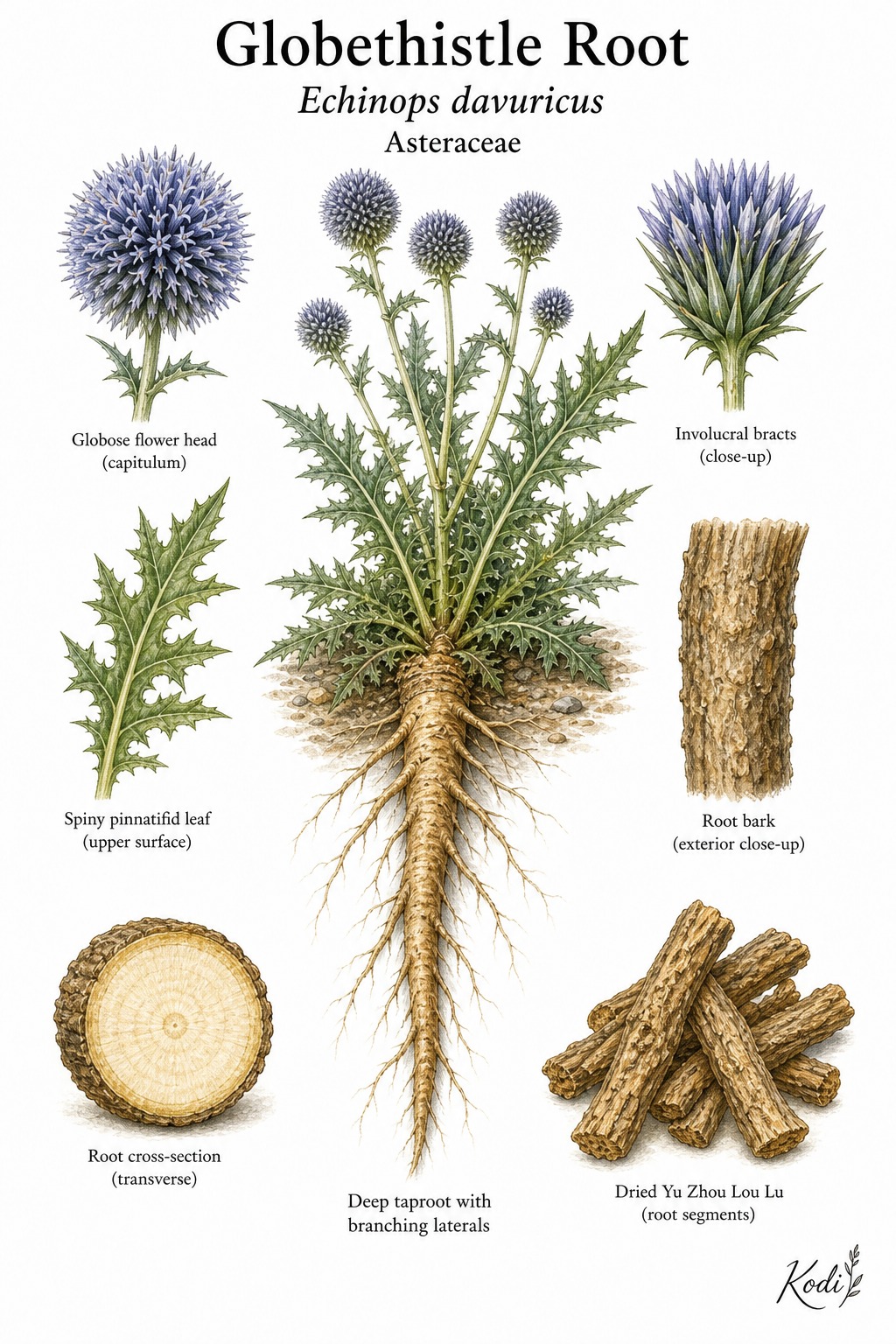
Known in TCM as Yu Zhou Lou Lu (禹州漏芦), this bitter, cold herb enters the Stomach. Traditionally, it clears heat toxin and reduces swelling - Yu Zhou Lou Lu is classically used for carbuncles, breast abscess, scrofulous swellings, and toxic-heat lesions with hardness or redness, most often applied for insufficient lactation, mastitis, and breast abscess. Modern research has identified Thiophenes among its active constituents.
Part used: Root
Also Known As
Latin: Echinopsis Radix | Pinyin: Yu Zhou Lou Lu | Chinese: 禹州漏芦
TCM Properties
- Taste
- bitter
- Temperature
- cold
- Channels
- Stomach
Traditional Use
Primary Actions
- Clears heat toxin and reduces swelling - Yu Zhou Lou Lu is classically used for carbuncles, breast abscess, scrofulous swellings, and toxic-heat lesions with hardness or redness.
- Promotes lactation and unblocks the breasts - it is chosen when heat, swelling, or obstruction prevents milk flow or causes painful postpartum breast distension.
- Relaxes the sinews and opens the channels - traditional use also includes painful obstruction, contracture, and stiffness when heat and blockage affect the collaterals.
Secondary Actions
- Modern Chinese pharmacopoeial use distinguishes Yu Zhou Lou Lu from the older Lou Lu source based on different plant origin and chemistry, so the identity should not be blurred in sourcing.
- Its cold, bitter profile makes it more appropriate for swollen hot breast or toxin patterns than for purely deficient low milk supply.
Classic Formulas
- Yu Zhou Lou Lu with Wang Bu Liu Xing and Tong Cao - a classic pairing style for blocked lactation, breast swelling, and painful poor milk flow.
- Yu Zhou Lou Lu with Jin Yin Hua and Lian Qiao - used when carbuncles, breast abscess, or toxic nodules need simultaneous heat-clearing and swelling reduction.
- Yu Zhou Lou Lu with Fang Feng and Qin Jiao - a channel-unblocking pairing used for painful obstruction with stiffness and limited movement.
Classical References
- Chinese pharmacopoeia summaries describe Yu Zhou Lou Lu as bitter and cold, entering the Stomach to clear heat, detoxify, reduce breast swelling, promote lactation, and relieve channel tightness.
- TCM literature specifically notes that Yu Zhou Lou Lu was separated from older Lou Lu records because the accepted source is Echinops rather than Rhaponticum.
- SOURCE NOTE: the Latin drug name Echinopsis Radix is pharmacopoeial usage for an Echinops-derived root and should not be confused with the cactus genus Echinopsis.
Modern Research
Active Compounds
- Thiophenes - the dominant specialized metabolites repeatedly highlighted in modern Echinops chemical reviews
- Caffeic-acid derivatives and phenolic acids - antioxidant and anti-inflammatory constituents reported from medicinal Echinops roots
- Sesquiterpenoids - structurally diverse compounds isolated from Yu Zhou Lou Lu source plants
- Triterpenes and flavonoid-related fractions - supportive constituents in broader activity profiling
Studied Effects
- A 2024 review summarized 85 compounds from Echinops latifolius and emphasized thiophenes, caffeic-acid derivatives, and sesquiterpenes as the main pharmacologically relevant groups, with reported antitumor, antifungal, and anti-inflammatory activity across the literature (PMID 38792128).
- A 2016 phytochemistry paper isolated thiophenes and a sesquiterpenoid from Echinops latifolius roots that inhibited LPS-induced nitric oxide production in macrophages, supporting the herb's traditional swelling and toxic-heat indications (PMID 27865705).
- Older animal research found anti-inflammatory activity in Echinops latifolius and Echinops grijsii crude drugs and also reported hepatoprotective effects in experimental liver injury, but these studies remain preclinical and not disease-specific enough for strong clinical claims (PMIDs 1519553, 2270845).
PubMed References
- A review of medicinal uses, phytochemistry and pharmacology of Echinops latifolius Tausch and quality marker prediction. (2024)
- Thiophenes and sesquiterpenoids from Echinops latifolius and their anti-inflammatory activities. (2016)
- Anti-inflammatory effects of Chinese medicinal crude drugs on carrageenan-induced edema and granuloma pouch induced by Freund's complete adjuvant. (1992)
- Hepatoprotective effects of Echinops latifolius and Echinops grijsii in experimental liver injury induced by carbon tetrachloride. (1990)
Safety & Interactions
Contraindications
- Pregnancy unless specifically supervised
- Cold deficiency or weak digestion without heat, toxin, or obstructed lactation
Cautions
- Because the herb strongly promotes movement through the breasts and channels, pregnancy use is traditionally approached cautiously.
- Trade and translation confusion still occurs between Yu Zhou Lou Lu, older Lou Lu records, and the misleading pharmacopoeial Latin name Echinopsis Radix.
- Modern evidence remains preclinical and should not replace standard evaluation of breast infection, abscess, or lactation failure.
Conditions
- Insufficient Lactation Traditional ★★★★☆ JSON
- Mastitis Traditional ★★★★☆ JSON
- Breast Abscess Traditional ★★★☆☆ JSON
- Joint Pain Traditional ★★☆☆☆ JSON
Frequently Asked Questions
What is Globethistle Root used for?
Globethistle Root is traditionally used to Clears heat toxin and reduces swelling - Yu Zhou Lou Lu is classically used for carbuncles, breast abscess, scrofulous swellings, and toxic-heat lesions with hardness or redness., Promotes lactation and unblocks the breasts - it is chosen when heat, swelling, or obstruction prevents milk flow or causes painful postpartum breast distension., Relaxes the sinews and opens the channels - traditional use also includes painful obstruction, contracture, and stiffness when heat and blockage affect the collaterals.. Research has investigated its effects on: A 2024 review summarized 85 compounds from Echinops latifolius and emphasized thiophenes, caffeic-acid derivatives, and sesquiterpenes as the main pharmacologically relevant groups, with reported antitumor, antifungal, and anti-inflammatory activity across the literature (PMID 38792128).; A 2016 phytochemistry paper isolated thiophenes and a sesquiterpenoid from Echinops latifolius roots that inhibited LPS-induced nitric oxide production in macrophages, supporting the herb's traditional swelling and toxic-heat indications (PMID 27865705)..
What are other names for Globethistle Root?
Globethistle Root is also known as Echinopsis. In TCM: 禹州漏芦 (Yu Zhou Lou Lu); Echinopsis Radix.
Is Globethistle Root safe during pregnancy?
The safety of Globethistle Root during pregnancy has not been established. Consult a qualified healthcare provider before use.
What are the contraindications for Globethistle Root?
Globethistle Root should not be used in: Pregnancy unless specifically supervised; Cold deficiency or weak digestion without heat, toxin, or obstructed lactation. Consult a qualified practitioner before use.