Glorybower Leaf, Clerodendron Leaf
- Chinese
- 臭梧桐
- Pinyin
- Chou Wu Tong
- Latin
- Folium Clerodendri Trichotomi
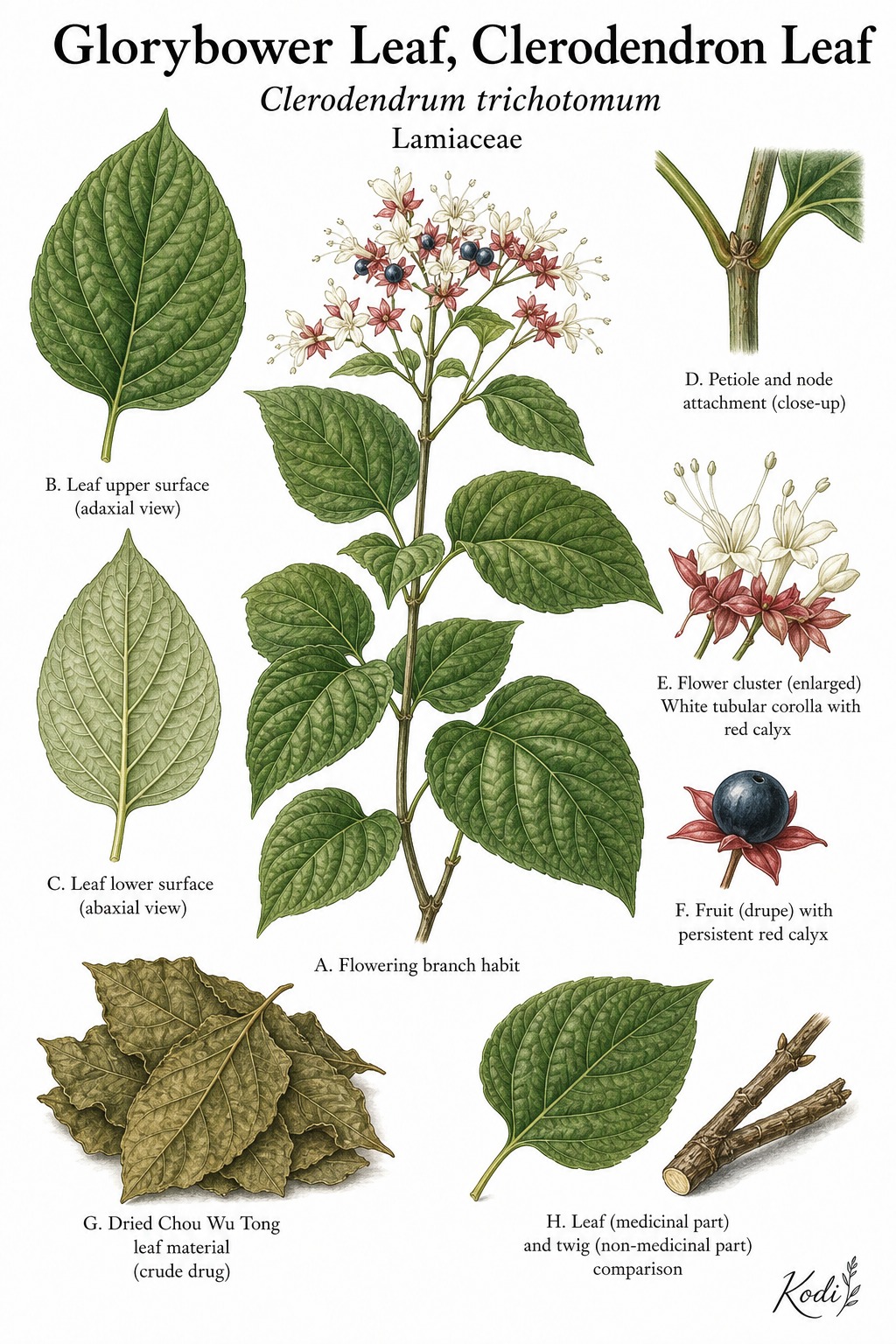
Known in TCM as Chou Wu Tong (臭梧桐), this sweet and bitter, slightly cold herb enters the Liver. Traditionally, it dispels wind-damp and unblocks the channels - Chou Wu Tong is classically used for rheumatic pain, heavy numb limbs, contracture, and difficulty moving when dampness lodges in the collaterals, most often applied for joint pain, rheumatism, and hypertension. Modern research has identified Abietane among its active constituents.
Part used: Leaf
Also Known As
Latin: Folium Clerodendri Trichotomi | Pinyin: Chou Wu Tong | Chinese: 臭梧桐
TCM Properties
- Taste
- sweet, bitter
- Temperature
- slightly cold
- Channels
- Liver
Traditional Use
Primary Actions
- Dispels wind-damp and unblocks the channels - Chou Wu Tong is classically used for rheumatic pain, heavy numb limbs, contracture, and difficulty moving when dampness lodges in the collaterals.
- Pacifies the Liver and helps lower rising pressure - traditional and modern Chinese use both include dizziness, headache, and hypertension-type patterns associated with Liver Yang agitation.
- Reduces swelling and relieves itching - the leaf is also used in external practice for itchy skin, toxic swelling, or hot painful lesions.
Secondary Actions
- This herb is often harvested before flowering and appears in both internal and external practice, which helps explain why folk use spans joints, blood pressure, and skin complaints.
- SOURCE NOTE: regional standards differ between slightly cold and neutral classification depending on whether the leaf alone or the broader leaf-and-twig crude drug is being referenced; this entry keeps the more common slightly cold Liver-channel profile while noting the variation.
Classic Formulas
- Chou Wu Tong with Xi Xian Cao and Sang Zhi - a classic pairing style for chronic wind-damp painful obstruction and numb limbs.
- Chou Wu Tong with Niu Xi and Xia Ku Cao - used in Liver-Yang or pressure-rising patterns with dizziness, headache, and irritability.
- Chou Wu Tong with Ku Shen or Bai Xian Pi - an external wash style for itching, damp-heat skin irritation, or swollen lesions.
Classical References
- TCM herb references commonly place Chou Wu Tong in the Liver channel, emphasizing wind-damp painful obstruction, hypertension, dizziness, and collaterals that need opening.
- Chinese local processing standards for the leaf alone describe a sweet-bitter, more neutral profile, which likely reflects medicinal-part differences rather than a direct contradiction of the broader folk record.
- The herb's long use before flowering for both arthralgia and high blood pressure helps explain why it sits at the overlap of dispelling wind-damp and calming Liver ascent.
Modern Research
Active Compounds
- Abietane diterpenoids and related terpenoid metabolites - prominent bioactive constituents discussed in modern reviews of Clerodendrum trichotomum
- Flavonoids and phenylpropanoid-related compounds - antioxidant and anti-inflammatory fractions identified from aerial parts
- Lipophilic triterpenes and sterols such as lupeol, betulinic acid, taraxerol, beta-sitosterol, and daucosterol - compounds isolated from the leaves
- Polyketone-type constituents from leaves and twigs - newly reported compounds with antioxidant and antibacterial activity
Studied Effects
- A 2025 review summarized antihypertensive, anti-inflammatory, analgesic, sedative, antioxidant, and antibacterial findings across Clerodendrum trichotomum literature, reinforcing why the herb remains relevant for both joint pain and pressure-rising patterns (PMID 39834825).
- A 2022 animal study reported that Clerodendrum trichotomum leaf extract improved high-fructose metabolic derangements and related oxidative stress markers, offering a modern correlate for its traditional use in pressure and Liver-Yang patterns (PMID 35059139).
- Leaf-focused chemistry studies identified novel polyketones with antioxidant and antibacterial activity as well as multiple triterpenes and sterols from the leaves, showing that the medicinal leaf has a chemically credible profile distinct from simple folk usage (PMIDs 33871298, 25857158).
PubMed References
- Progress in studies on the pharmacological activity and mechanism of action of Clerodendrum trichotomum Thunb. and its active constituents. (2025)
- Protective effect of Clerodendrum trichotomum leaves extract against fructose-induced metabolic syndrome in rats. (2022)
- New polyketones from leaves and twigs of Clerodendrum trichotomum and their antioxidant and antibacterial activities. (2021)
- Lipophilic constituents from the leaves of Clerodendrum trichotomum. (2015)
Safety & Interactions
Contraindications
- Marked deficiency-cold or severe weakness without wind-damp, heat, or rising Liver patterns
Cautions
- Because Chou Wu Tong is often used in blood-pressure-lowering contexts, it should not replace evaluation or monitoring in patients with established hypertension.
- Additive pressure-lowering effects are plausible with antihypertensive medication, although good human interaction data are lacking.
- MSK page not found - drug interaction data not available from Memorial Sloan Kettering integrative medicine database
Conditions
- Joint Pain Traditional ★★★★☆ JSON
- Rheumatism Traditional ★★★★☆ JSON
- Hypertension Traditional ★★★☆☆ JSON
- Facial Paralysis Traditional ★★☆☆☆ JSON
Frequently Asked Questions
What is Glorybower Leaf, Clerodendron Leaf used for?
Glorybower Leaf, Clerodendron Leaf is traditionally used to Dispels wind-damp and unblocks the channels - Chou Wu Tong is classically used for rheumatic pain, heavy numb limbs, contracture, and difficulty moving when dampness lodges in the collaterals., Pacifies the Liver and helps lower rising pressure - traditional and modern Chinese use both include dizziness, headache, and hypertension-type patterns associated with Liver Yang agitation., Reduces swelling and relieves itching - the leaf is also used in external practice for itchy skin, toxic swelling, or hot painful lesions.. Research has investigated its effects on: A 2025 review summarized antihypertensive, anti-inflammatory, analgesic, sedative, antioxidant, and antibacterial findings across Clerodendrum trichotomum literature, reinforcing why the herb remains relevant for both joint pain and pressure-rising patterns (PMID 39834825).; A 2022 animal study reported that Clerodendrum trichotomum leaf extract improved high-fructose metabolic derangements and related oxidative stress markers, offering a modern correlate for its traditional use in pressure and Liver-Yang patterns (PMID 35059139)..
What are other names for Glorybower Leaf, Clerodendron Leaf?
Glorybower Leaf, Clerodendron Leaf is also known as Clerodendri. In TCM: 臭梧桐 (Chou Wu Tong); Folium Clerodendri Trichotomi.
Is Glorybower Leaf, Clerodendron Leaf safe during pregnancy?
The safety of Glorybower Leaf, Clerodendron Leaf during pregnancy has not been established. Consult a qualified healthcare provider before use.
What are the contraindications for Glorybower Leaf, Clerodendron Leaf?
Glorybower Leaf, Clerodendron Leaf should not be used in: Marked deficiency-cold or severe weakness without wind-damp, heat, or rising Liver patterns. Consult a qualified practitioner before use.