Gold
- Chinese
- 黄金
- Pinyin
- Huang Jin
- Latin
- Aurum Nativum
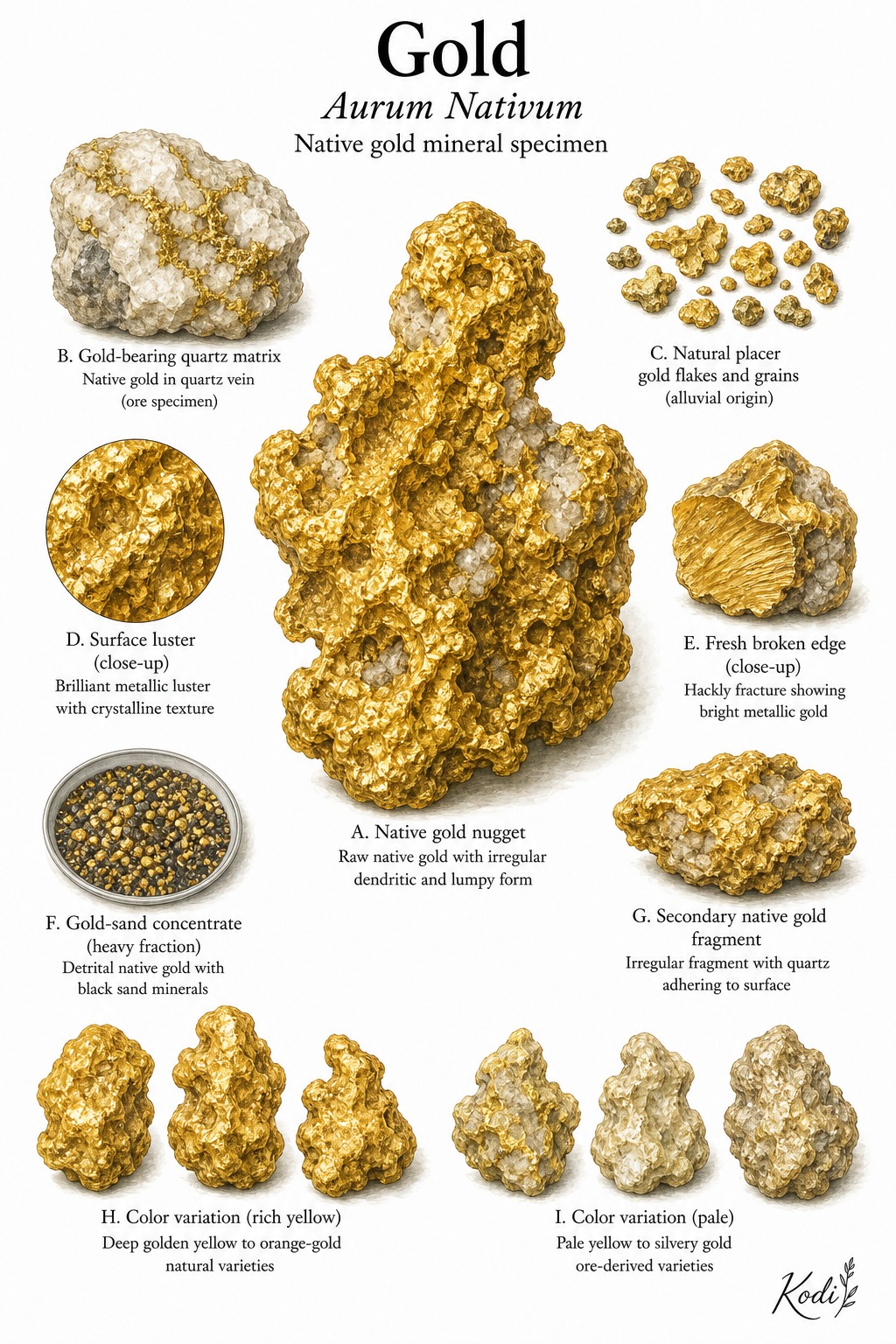
Known in TCM as Huang Jin (黄金), this acrid and bitter, neutral herb enters the Heart and Liver. Traditionally, it weighs down and settles the Spirit - Huang Jin appears in older emergency-style formula tradition as a heavy mineral intended to anchor severe agitation, delirium, convulsions, or phlegm-fire disturbing the Heart. Modern research has identified Elemental among its active constituents.
Part used: Gold
Also Known As
Latin: Aurum Nativum | Pinyin: Huang Jin | Chinese: 黄金
TCM Properties
- Taste
- acrid, bitter
- Temperature
- neutral
- Channels
- Heart, Liver
Traditional Use
Primary Actions
- Weighs down and settles the Spirit - Huang Jin appears in older emergency-style formula tradition as a heavy mineral intended to anchor severe agitation, delirium, convulsions, or phlegm-fire disturbing the Heart.
- Subdues rising Yang and descends phlegm-fire in acute heat patterns - historical use overlaps with severe febrile conditions in which internal wind, seizures, or loss of consciousness need forceful downward settling.
- Resolves toxicity in historical external or emergency contexts - classical writing also associates gold with sores or toxic accumulations, although direct modern clinical use is now rare.
Secondary Actions
- Raw gold belongs more to historical materia medica than to ordinary modern dispensing practice, and in later tradition it is usually refined into Jin Bo or omitted entirely.
- This record is intentionally kept separate from Jin Bo because the processing into gold leaf is the main classical step used to reduce heaviness, contamination, and middle-burner injury.
Classic Formulas
- Zi Xue Dan - older formula tradition records Huang Jin boiled in the decoction liquid to help weigh down the Heart spirit and control heat-generated agitation and convulsions.
- Huang Jin with Ci Shi and Zhu Sha - heavy-mineral pairing logic for severe fright, delirium, or convulsive heat patterns.
- Refined into Jin Bo for pill coating or powder use - a classical processing pathway rather than a separate indication set.
Classical References
- Me & Qi's Zi Xue Dan commentary notes that gold was present in the original formula as a heavy spirit-settling and toxin-resolving adjunct, but is often omitted in modern preparations.
- Classical processing notes in Song-dynasty materia medica emphasize that refinement into thin gold leaf was the key step for making medicinal use safer and more workable.
- SOURCE NOTE: this file covers raw native gold as a historical medicinal substance, not the more commonly dispensed processed gold leaf Jin Bo.
Modern Research
Active Compounds
- Elemental gold - the principal metallic substance
- Trace silver, copper, lead, or other ore-derived impurities - the main reason raw sourcing and refining matter clinically
- Dense mineral matrix - the physical form that helps explain both the classical settling concept and the practical safety limitations
Studied Effects
- Modern biomedical literature on gold mostly concerns toxicology, occupational exposure, pharmaceutical gold compounds, or engineered nanomaterials rather than raw native gold as a TCM medicine.
- A 2018 toxicology review emphasized that gold is not a nutrient and that health risk depends strongly on form, dose, route, and impurity burden, which supports the classical insistence on careful refining before medicinal use (PMID 31851875).
- A classic pharmacokinetic review of oral and parenteral gold drugs showed that absorption, retention, and excretion vary dramatically by formulation, reinforcing that modern chrysotherapy data cannot be casually mapped back onto native gold ingestion in TCM (PMID 6813498).
PubMed References
Safety & Interactions
Contraindications
- Direct internal self-use of raw or unrefined gold
- Yang deficiency with sinking Qi, loose stool, or cold weakness of the middle burner
- Use of non-medicinal or contaminated gold sources
Cautions
- Raw gold was classically considered unsafe until refined, and modern medicinal use of the unprocessed metal is extremely limited.
- Contamination with other metals is a more realistic safety issue than pure elemental gold alone, so authentication and refining matter greatly.
- This record should not be interpreted as support for ingesting decorative, industrial, jewelry, or mining-derived gold products.
Frequently Asked Questions
What is Gold used for?
Gold is traditionally used to Weighs down and settles the Spirit - Huang Jin appears in older emergency-style formula tradition as a heavy mineral intended to anchor severe agitation, delirium, convulsions, or phlegm-fire disturbing the Heart., Subdues rising Yang and descends phlegm-fire in acute heat patterns - historical use overlaps with severe febrile conditions in which internal wind, seizures, or loss of consciousness need forceful downward settling., Resolves toxicity in historical external or emergency contexts - classical writing also associates gold with sores or toxic accumulations, although direct modern clinical use is now rare.. Research has investigated its effects on: Modern biomedical literature on gold mostly concerns toxicology, occupational exposure, pharmaceutical gold compounds, or engineered nanomaterials rather than raw native gold as a TCM medicine.; A 2018 toxicology review emphasized that gold is not a nutrient and that health risk depends strongly on form, dose, route, and impurity burden, which supports the classical insistence on careful refining before medicinal use (PMID 31851875)..
What are other names for Gold?
Gold is also known as Aurum. In TCM: 黄金 (Huang Jin); Aurum Nativum.
Is Gold safe during pregnancy?
The safety of Gold during pregnancy has not been established. Consult a qualified healthcare provider before use.
What are the contraindications for Gold?
Gold should not be used in: Direct internal self-use of raw or unrefined gold; Yang deficiency with sinking Qi, loose stool, or cold weakness of the middle burner; Use of non-medicinal or contaminated gold sources. Consult a qualified practitioner before use.