Granulated Sugar
- Chinese
- 白砂糖
- Pinyin
- Sha Tang
- Latin
- Saccharum Granulatum
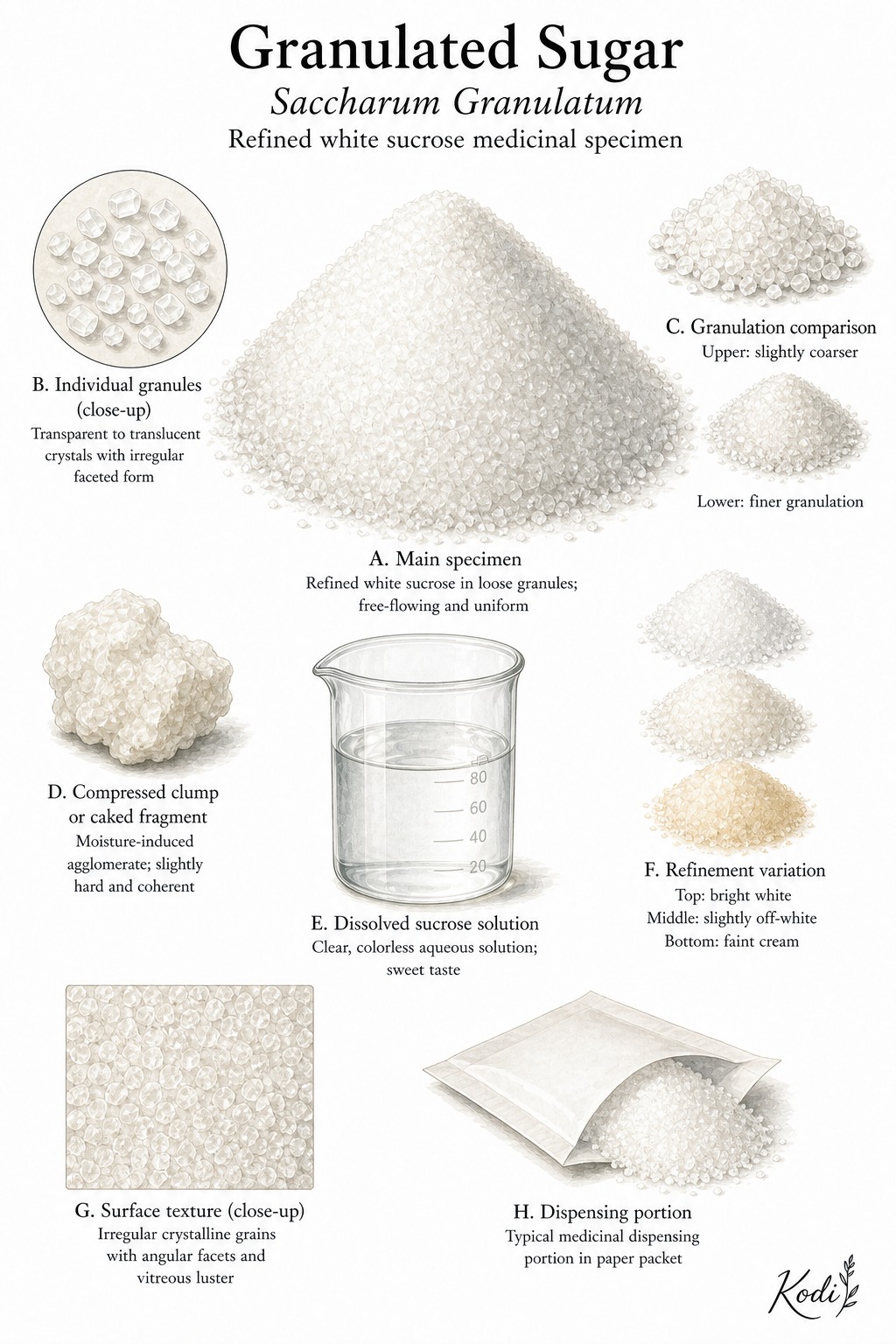
Known in TCM as Sha Tang (白砂糖), this sweet, neutral herb enters the Lung and Spleen. Traditionally, it harmonizes the Spleen and Stomach - white granulated sugar appears in mild medicinal food use for abdominal discomfort, poor appetite, and weakness when a simple sweet support is appropriate, most often applied for abdominal pain, dry cough, and cough. Modern research has identified Sucrose among its active constituents.
Part used: Sugar
Also Known As
Latin: Saccharum Granulatum | Pinyin: Sha Tang | Chinese: 白砂糖
TCM Properties
- Taste
- sweet
- Temperature
- neutral
- Channels
- Lung, Spleen
Traditional Use
Primary Actions
- Harmonizes the Spleen and Stomach - white granulated sugar appears in mild medicinal food use for abdominal discomfort, poor appetite, and weakness when a simple sweet support is appropriate.
- Moistens the Lung and relieves dryness-type cough - it is used in household remedies for dry throat, dry cough, and scanty fluids.
- Generates fluids and alleviates thirst - simple sugar water preparations are used when dryness, heat, or convalescent fatigue have depleted body fluids.
Secondary Actions
- Sha Tang is more a food-medicine support ingredient than a forceful crude herb, and its therapeutic role is usually gentle, adjunctive, and short term.
- This record follows the white granulated sugar tradition rather than rock sugar; the actions overlap, but granulated sugar is the more ordinary everyday kitchen form.
Classic Formulas
- White sugar water - a simple convalescent preparation for thirst, dry mouth, and light depletion.
- Sha Tang with pear or other moistening foods - household use for dry cough and throat discomfort.
- White sugar mixed with water for topical application - minor folk external use for simple irritated lesions.
Classical References
- TCM Wiki describes white granulated sugar as sweet and neutral, entering the Spleen and Lung to harmonize the middle, moisten the Lung, and promote body fluids.
- The same traditional summary highlights abdominal pain, dry mouth, and Lung-dryness cough as the main indications.
- Like other refined sugars, its medicinal role is supportive and dietetic rather than strongly herbal.
Modern Research
Active Compounds
- Sucrose - the dominant carbohydrate and main functional constituent
- Trace minerals - minor residual constituents that depend on source and processing
- Simple water-soluble sugar matrix - the processed form that makes this a nutritive support ingredient rather than a phytochemical-rich herb
Studied Effects
- Modern literature on granulated sugar itself is limited because the substance is a common refined food ingredient rather than a distinct medicinal phytochemical source.
- Its present-day relevance in Chinese medicine remains mostly dietetic: quick calories, improved palatability, and a gentle fluid-support role in traditional food remedies.
- From a safety perspective, the main issues are glycemic load and overuse, not hidden herb-drug pharmacology.
Safety & Interactions
Contraindications
- Poorly controlled diabetes
- Pronounced phlegm-damp accumulation with heaviness and sluggish digestion
Cautions
- Repeated medicinal use still adds meaningful sugar load and may be inappropriate in hyperglycemia, metabolic syndrome, or severe dental decay.
- This is a supportive food-medicine ingredient and should not be used to self-treat persistent cough, severe abdominal pain, or ongoing dehydration without evaluation.
- MSK page not found - drug interaction data not available from Memorial Sloan Kettering integrative medicine database
Conditions
- Abdominal Pain Traditional ★★☆☆☆ JSON
- Dry Cough Traditional ★★☆☆☆ JSON
- Cough Traditional ★☆☆☆☆ JSON
- Poor Appetite Traditional ★☆☆☆☆ JSON
Frequently Asked Questions
What is Granulated Sugar used for?
Granulated Sugar is traditionally used to Harmonizes the Spleen and Stomach - white granulated sugar appears in mild medicinal food use for abdominal discomfort, poor appetite, and weakness when a simple sweet support is appropriate., Moistens the Lung and relieves dryness-type cough - it is used in household remedies for dry throat, dry cough, and scanty fluids., Generates fluids and alleviates thirst - simple sugar water preparations are used when dryness, heat, or convalescent fatigue have depleted body fluids.. Research has investigated its effects on: Modern literature on granulated sugar itself is limited because the substance is a common refined food ingredient rather than a distinct medicinal phytochemical source.; Its present-day relevance in Chinese medicine remains mostly dietetic: quick calories, improved palatability, and a gentle fluid-support role in traditional food remedies..
What are other names for Granulated Sugar?
Granulated Sugar is also known as Bai Sha Tang. In TCM: 白砂糖 (Sha Tang); Saccharum Granulatum.
Is Granulated Sugar safe during pregnancy?
The safety of Granulated Sugar during pregnancy has not been established. Consult a qualified healthcare provider before use.
What are the contraindications for Granulated Sugar?
Granulated Sugar should not be used in: Poorly controlled diabetes; Pronounced phlegm-damp accumulation with heaviness and sluggish digestion. Consult a qualified practitioner before use.