Grassleaf Sweetflag Rhizome
- Chinese
- 石菖蒲
- Pinyin
- Shi Chang Pu
- Latin
- Rhizoma Acori Tatarinowii
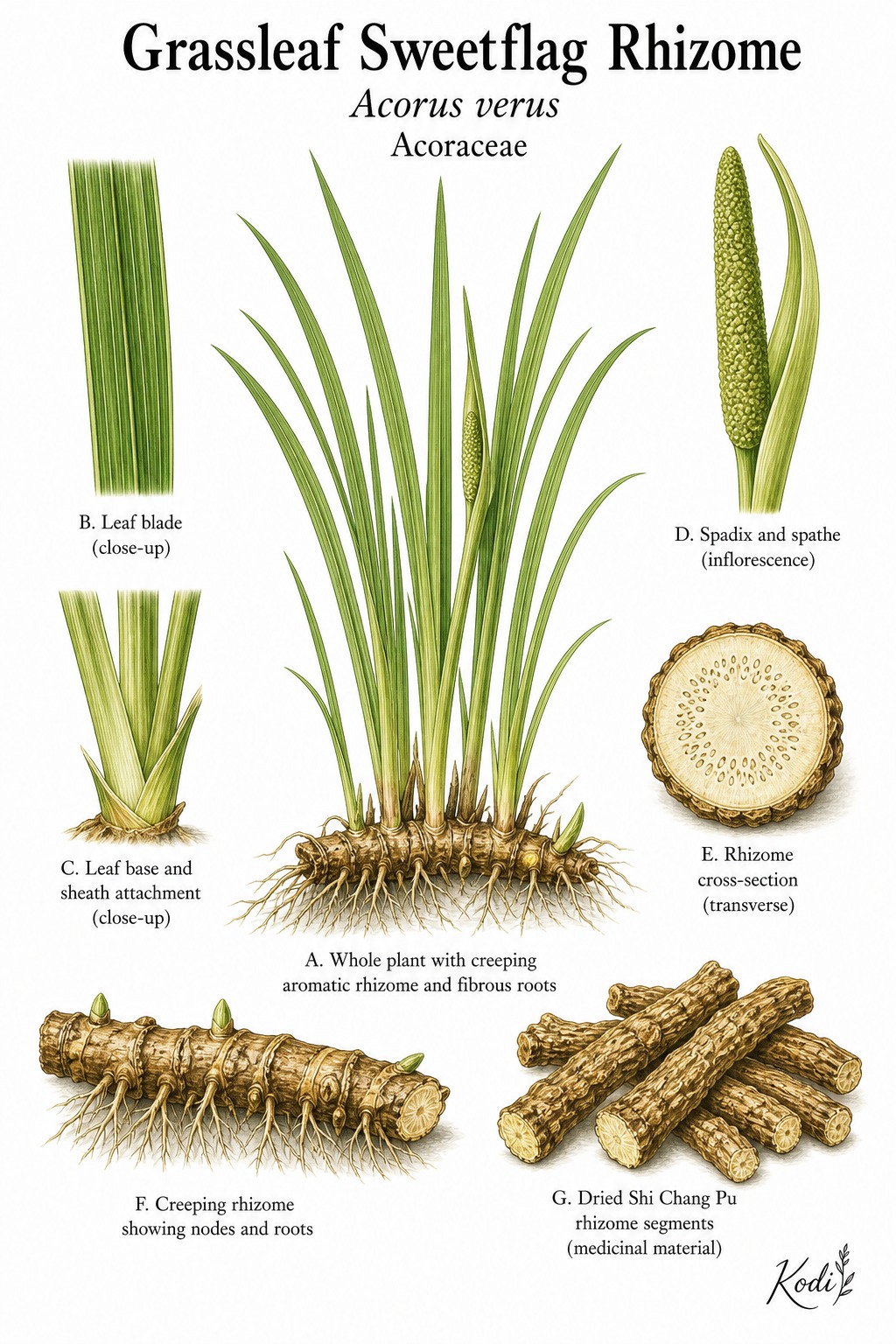
Known in TCM as Shi Chang Pu (石菖蒲), this acrid and bitter, warm herb enters the Heart, Spleen, and Stomach. Traditionally, it opens the orifices and transforms phlegm-turbidity - Shi Chang Pu is classically used for clouded consciousness, epilepsy, dizziness, deafness, or foggy thinking when phlegm blocks the clear Yang, most often applied for epilepsy, insomnia, and cognitive decline. Modern research has identified Alpha-asarone among its active constituents.
Part used: Rhizome
Also Known As
Latin: Rhizoma Acori Tatarinowii | Pinyin: Shi Chang Pu | Chinese: 石菖蒲
TCM Properties
- Taste
- acrid, bitter
- Temperature
- warm
- Channels
- Heart, Spleen, Stomach
Traditional Use
Primary Actions
- Opens the orifices and transforms phlegm-turbidity - Shi Chang Pu is classically used for clouded consciousness, epilepsy, dizziness, deafness, or foggy thinking when phlegm blocks the clear Yang.
- Calms the Spirit and benefits cognition - it is applied in forgetfulness, poor concentration, insomnia with turbidity, and emotional disturbance when the Heart is not communicating clearly.
- Aromatically transforms dampness and harmonizes the middle - traditional use includes nausea, poor appetite, abdominal fullness, and foul turbidity affecting digestion.
Secondary Actions
- Shi Chang Pu is often chosen when mental clouding and digestive dampness appear together, which is why it bridges the orifice-opening and aromatic-transforming categories.
- SOURCE NOTE: this record follows the accepted Acorus tatarinowii identity and keeps it distinct from Shui Chang Pu, Jiu Jie Chang Pu, and other Chang Pu materials.
Classic Formulas
- Ding Zhi Wan - classical combination with Ren Shen, Fu Ling, and Yuan Zhi for phlegm clouding, forgetfulness, fright, and disturbed sleep.
- Chang Pu Yu Jin Tang - warm-disease style pairing for phlegm-heat obstructing the Heart orifices with confusion, agitation, or muttering.
- Di Tan Tang - formula logic for epilepsy, stroke, or dizziness in which phlegm blocks the orifices and clear Yang cannot rise.
Classical References
- TCM Wiki describes Shi Chang Pu as acrid, bitter, and warm, entering the Heart, Spleen, and Stomach to open the orifices, vaporize phlegm, and harmonize the middle.
- Me & Qi similarly emphasizes the Acorus tatarinowii rhizome as a bridge between phlegm-turbidity obstructing the Heart and damp obstruction affecting digestion.
- The herb's reputation for benefiting hearing, cognition, and memory depends on its ability to clear turbidity rather than on a purely tonic action.
Modern Research
Active Compounds
- Alpha-asarone and beta-asarone - the best-known volatile phenylpropanoids from Shi Chang Pu rhizome
- Broader volatile oil fractions - aromatic constituents central to the herb's pharmacology and toxicity discussion
- Water-soluble polysaccharides - macromolecular fractions studied for anti-neuroinflammatory and neuroprotective effects
- Sesquiterpenes and lignan-like compounds - supportive constituents in chemical profiling studies
Studied Effects
- A 2025 review summarized alpha-asarone and beta-asarone pharmacology across anti-Alzheimer, antiepileptic, anti-Parkinson, and neuroprotective models, reinforcing how modern research still centers on the rhizome's volatile constituents (PMID 40461186).
- A 2020 study purified an Acorus tatarinowii polysaccharide that reduced neuroinflammatory signaling and protected neurons through TLR4-MyD88-NF-kB and PI3K-Akt pathway modulation, offering a mechanistic correlate for the herb's traditional mind-clearing use (PMID 32621930).
- Beta-asarone reduced ischemic injury in a rat middle cerebral artery occlusion model, adding preclinical support to Shi Chang Pu's long association with stroke, collapse, and obstruction of the clear orifices (PMID 24066702).
- A 2024 safety study of a water extract found no major acute or subacute oral toxicity at the tested doses, but this does not remove separate concerns about concentrated volatile-oil or beta-asarone-rich products (PMID 38567357).
PubMed References
- [Research progress on pharmacological effects and mechanism of alpha-asarone and beta-asarone in Acori Tatarinowii Rhizoma]. (2025)
- A novel polysaccharide from Acorus tatarinowii protects against LPS-induced neuroinflammation and neurotoxicity by inhibiting TLR4-mediated MyD88/NF-kB and PI3K/Akt signaling pathways. (2020)
- Beta-asarone, a major component of Acorus tatarinowii Schott, attenuates focal cerebral ischemia induced by middle cerebral artery occlusion in rats. (2013)
- Safety assessment of Acori Tatarinowii Rhizoma: acute and subacute oral toxicity. (2024)
Safety & Interactions
Contraindications
- Yin deficiency with heat, dryness, or irritability without phlegm-turbidity
- Use of concentrated volatile-oil products in place of standard crude-herb dosing
Cautions
- Most modern efficacy data are preclinical, and the volatile oil profile that drives interest also drives safety concern.
- Beta-asarone-rich products deserve extra caution because concentrated extracts are not equivalent to ordinary decoction pieces.
- Source confusion persists among Acorus species and Chang Pu substitutes, so authenticated material matters.
Conditions
Frequently Asked Questions
What is Grassleaf Sweetflag Rhizome used for?
Grassleaf Sweetflag Rhizome is traditionally used to Opens the orifices and transforms phlegm-turbidity - Shi Chang Pu is classically used for clouded consciousness, epilepsy, dizziness, deafness, or foggy thinking when phlegm blocks the clear Yang., Calms the Spirit and benefits cognition - it is applied in forgetfulness, poor concentration, insomnia with turbidity, and emotional disturbance when the Heart is not communicating clearly., Aromatically transforms dampness and harmonizes the middle - traditional use includes nausea, poor appetite, abdominal fullness, and foul turbidity affecting digestion.. Research has investigated its effects on: A 2025 review summarized alpha-asarone and beta-asarone pharmacology across anti-Alzheimer, antiepileptic, anti-Parkinson, and neuroprotective models, reinforcing how modern research still centers on the rhizome's volatile constituents (PMID 40461186).; A 2020 study purified an Acorus tatarinowii polysaccharide that reduced neuroinflammatory signaling and protected neurons through TLR4-MyD88-NF-kB and PI3K-Akt pathway modulation, offering a mechanistic correlate for the herb's traditional mind-clearing use (PMID 32621930)..
What are other names for Grassleaf Sweetflag Rhizome?
Grassleaf Sweetflag Rhizome is also known as Acori. In TCM: 石菖蒲 (Shi Chang Pu); Rhizoma Acori Tatarinowii.
Is Grassleaf Sweetflag Rhizome safe during pregnancy?
The safety of Grassleaf Sweetflag Rhizome during pregnancy has not been established. Consult a qualified healthcare provider before use.
What are the contraindications for Grassleaf Sweetflag Rhizome?
Grassleaf Sweetflag Rhizome should not be used in: Yin deficiency with heat, dryness, or irritability without phlegm-turbidity; Use of concentrated volatile-oil products in place of standard crude-herb dosing. Consult a qualified practitioner before use.