Green Tangerine Peel
- Chinese
- 青皮
- Pinyin
- Qing Pi
- Latin
- Pericarpium Citri Reticulatae Viride
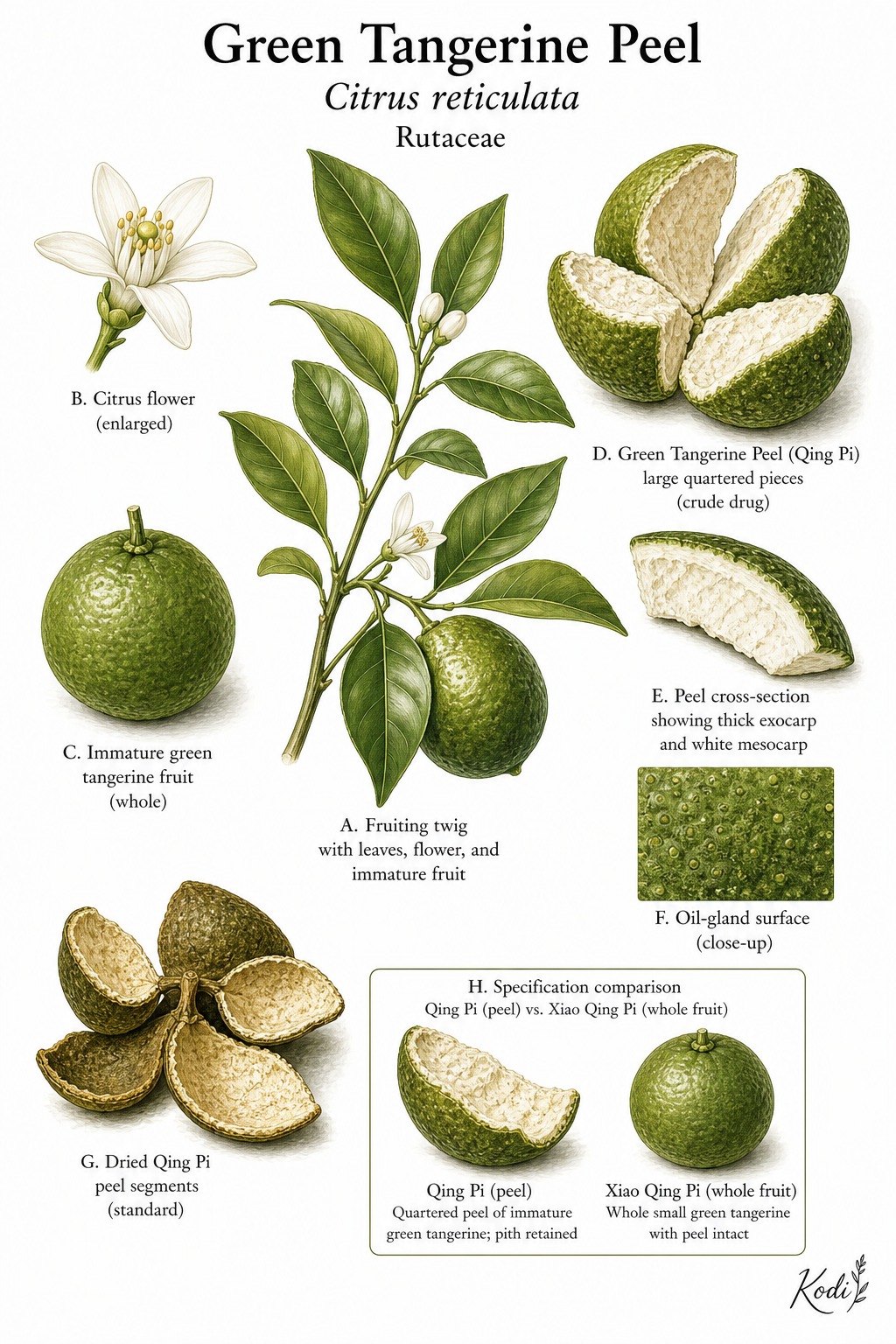
Known in TCM as Qing Pi (青皮), this bitter and acrid, warm herb enters the Liver, Gallbladder, and Stomach. Traditionally, it spreads Liver Qi and breaks stagnant Qi - Qing Pi is classically used for pronounced Liver constraint with distending hypochondriac pain, breast tenderness, mood frustration, or wiry excess patterns, most often applied for liver qi stagnation, hypochondriac pain, and indigestion. Modern research has identified Flavanones among its active constituents.
Part used: Peel
Also Known As
Latin: Pericarpium Citri Reticulatae Viride | Pinyin: Qing Pi | Chinese: 青皮
TCM Properties
- Taste
- bitter, acrid
- Temperature
- warm
- Channels
- Liver, Gallbladder, Stomach
Traditional Use
Primary Actions
- Spreads Liver Qi and breaks stagnant Qi - Qing Pi is classically used for pronounced Liver constraint with distending hypochondriac pain, breast tenderness, mood frustration, or wiry excess patterns.
- Dissipates clumps and reduces focal distention - traditional indications include breast lumps, hernia-type pain, epigastric masses, and fixed distention caused by constrained or knotted Qi.
- Transforms food stagnation and relieves abdominal fullness - it is stronger and more dispersing than Chen Pi and is chosen when food retention and Qi blockage are more stubborn.
Secondary Actions
- Qing Pi and Chen Pi come from the same Citrus source but are harvested at different stages; Qing Pi is sharper, more forceful, and more Liver-Gallbladder directed because it comes from the immature peel.
- SOURCE NOTE: this record covers the standard Qing Pi medicine and keeps the smaller related Xiao Qing Pi record separate rather than collapsing the two immature-peel entries together.
Classic Formulas
- Tian Tai Wu Yao San - Qing Pi helps move Liver Qi and relieve severe lower-abdominal or hernia-type pain.
- Qing Pi San - a classic naming formula that highlights the herb's role in dispersing constrained Qi and reducing distending pain.
- Mu Xiang Bing Lang Wan - Qing Pi contributes to stronger movement of intestinal and middle-burner stagnation when fullness and obstruction are prominent.
Classical References
- Me & Qi and standard herb references describe Qing Pi as bitter, acrid, and warm, entering the Liver, Gallbladder, and Stomach to spread Liver Qi, break stagnant Qi, and dissipate clumps.
- Traditional processing notes distinguish Ge Qing Pi and Si Hua Qing Pi by harvest form, reflecting that immature-peel specifications are not perfectly interchangeable.
- Compared with Chen Pi, Qing Pi is harsher and more dispersing, so it is favored in excess Qi stagnation rather than in simple damp-phlegm or gentle digestive support.
Modern Research
Active Compounds
- Flavanones such as hesperidin and narirutin - major citrus glycosides quantified in Qing Pi
- Polymethoxylated flavones such as nobiletin and tangeretin - signature bioactive citrus peel constituents
- Synephrine, N-methyltyramine, choline, and stachydrine-related amines - small molecules relevant to quality and bioactivity discussion
- Volatile oils dominated by limonene and related terpenes - aromatic constituents linked to digestive and mood-related investigation
Studied Effects
- A 2022 review summarized the chemistry and analytical methods of Citri Reticulatae Pericarpium Viride and Chen Pi, emphasizing flavonoids, terpenes, and volatile oils while noting that truly systematic differentiation of the two medicines is still evolving (PMID 35718507).
- A 2022 comparison of Geqingpi and Sihuaqingpi showed meaningful differences in physical traits and chemical composition, supporting the traditional insistence that immature-peel specifications should not be treated as identical (PMID 35630762).
- A 2007 phytochemical study identified polymethoxylated flavones in green tangerine peel, helping explain why Qing Pi continues to attract antioxidant and anti-inflammatory research interest (PMID 17367982).
- A 2024 animal study found that Qing Pi essential oil improved anxiety-like behavior through Glu-NMDAR regulation in the olfactory bulb, which is intriguing but still far from clinical proof (PMID 38735421).
PubMed References
- [Research advances of chemical constituents and analytical methods of Citri Reticulatae Pericarpium Viride and Citri Reticulatae Pericarpium]. (2022)
- Analyses of Physical and Chemical Compositions of Different Medicinal Specifications of CRPV by Use of Multiple Instrumental Techniques Combined with Multivariate Statistical Analysis. (2022)
- Identification of polymethoxylated flavones from green tangerine peel (Pericarpium Citri Reticulatae Viride) by chromatographic and spectroscopic techniques. (2007)
- Neuro-stimulating effect of Citri Reticulata Pericarpium Viride essential oil through regulating Glu/NMDAR on olfactory bulb to improve anxiety-like behavior. (2024)
Safety & Interactions
Contraindications
- Qi deficiency without excess stagnation or clumping
- Yin deficiency with marked dryness and depleted fluids
Cautions
- Qing Pi is stronger and more dispersing than Chen Pi and may be too harsh for frail or depleted patients.
- Concentrated citrus extracts are not equivalent to traditional decoction pieces; some analyses identify synephrine-related compounds that warrant extra caution in stimulant-sensitive patients.
- Long-term self-use for breast lumps, persistent hypochondriac pain, or mass-like abdominal symptoms is not appropriate without evaluation.
Conditions
- Liver Qi Stagnation Traditional ★★★★☆ JSON
- Hypochondriac Pain Traditional ★★★★☆ JSON
- Indigestion Traditional ★★★☆☆ JSON
- Mastitis Traditional ★★☆☆☆ JSON
Frequently Asked Questions
What is Green Tangerine Peel used for?
Green Tangerine Peel is traditionally used to Spreads Liver Qi and breaks stagnant Qi - Qing Pi is classically used for pronounced Liver constraint with distending hypochondriac pain, breast tenderness, mood frustration, or wiry excess patterns., Dissipates clumps and reduces focal distention - traditional indications include breast lumps, hernia-type pain, epigastric masses, and fixed distention caused by constrained or knotted Qi., Transforms food stagnation and relieves abdominal fullness - it is stronger and more dispersing than Chen Pi and is chosen when food retention and Qi blockage are more stubborn.. Research has investigated its effects on: A 2022 review summarized the chemistry and analytical methods of Citri Reticulatae Pericarpium Viride and Chen Pi, emphasizing flavonoids, terpenes, and volatile oils while noting that truly systematic differentiation of the two medicines is still evolving (PMID 35718507).; A 2022 comparison of Geqingpi and Sihuaqingpi showed meaningful differences in physical traits and chemical composition, supporting the traditional insistence that immature-peel specifications should not be treated as identical (PMID 35630762)..
What are other names for Green Tangerine Peel?
Green Tangerine Peel is also known as Citri. In TCM: 青皮 (Qing Pi); Pericarpium Citri Reticulatae Viride.
Is Green Tangerine Peel safe during pregnancy?
The safety of Green Tangerine Peel during pregnancy has not been established. Consult a qualified healthcare provider before use.
What are the contraindications for Green Tangerine Peel?
Green Tangerine Peel should not be used in: Qi deficiency without excess stagnation or clumping; Yin deficiency with marked dryness and depleted fluids. Consult a qualified practitioner before use.