Green Tangerine Peel
- Chinese
- 小青皮
- Pinyin
- Xiao Qing Pi
- Latin
- Pericarpium Citri Reticulatae Viride
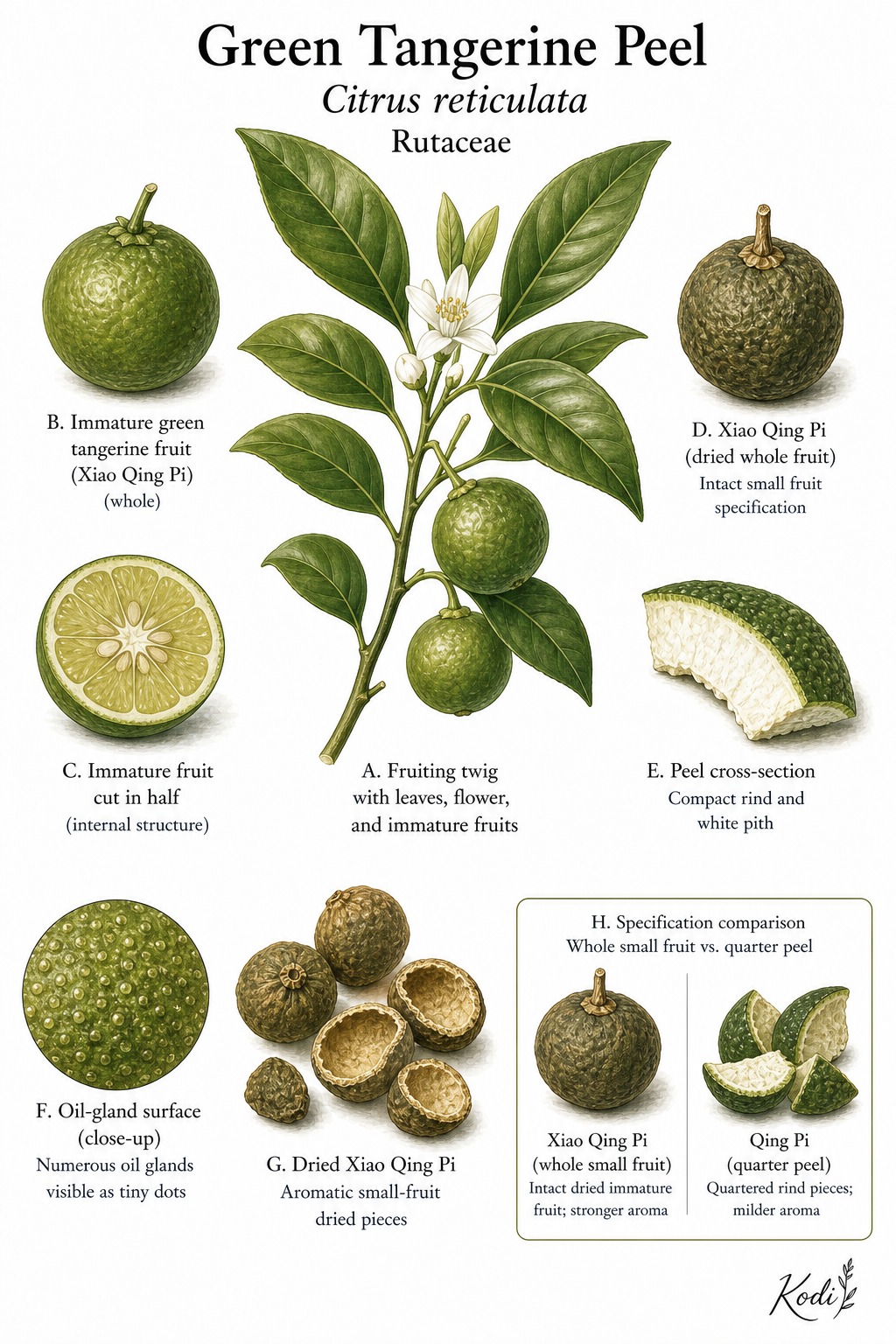
Known in TCM as Xiao Qing Pi (小青皮), this bitter and acrid, warm herb enters the Liver, Spleen, and Stomach. Traditionally, it soothes the Liver and harmonizes the Stomach - Xiao Qing Pi is used for distending discomfort, belching, nausea, poor appetite, or epigastric constraint when constrained Liver Qi disrupts digestion, most often applied for abdominal distension, nausea, and poor appetite. Modern research has identified Flavanones among its active constituents.
Part used: Peel
Also Known As
Latin: Pericarpium Citri Reticulatae Viride | Pinyin: Xiao Qing Pi | Chinese: 小青皮
TCM Properties
- Taste
- bitter, acrid
- Temperature
- warm
- Channels
- Liver, Spleen, Stomach
Traditional Use
Primary Actions
- Soothes the Liver and harmonizes the Stomach - Xiao Qing Pi is used for distending discomfort, belching, nausea, poor appetite, or epigastric constraint when constrained Liver Qi disrupts digestion.
- Reduces food stagnation and focal distention - compared with ordinary culinary citrus peel, it more forcefully breaks up lingering middle-burner blockage and relieves fullness after rich food.
- Stops pain from constrained Qi - it is used in smaller, more aromatic formulations for flank, epigastric, or lower-abdominal discomfort when Qi is bound but not yet severely knotted.
Secondary Actions
- Xiao Qing Pi is the smaller whole-fruit specification within the broader Qing Pi category, so it overlaps with standard Qing Pi but is often experienced as slightly more aromatic and more middle-burner focused.
- SOURCE NOTE: this entry intentionally stays separate from the standard Qing Pi record because specification-level differences in morphology and chemistry are part of the current literature.
Classic Formulas
- Xiao Qing Pi with Xiang Fu and Fo Shou - a common pairing style for Liver-Stomach disharmony with belching, nausea, and distention.
- Xiao Qing Pi with Chen Pi and Shan Zha - used when Qi stagnation and food retention combine to cause fullness and poor appetite.
- Xiao Qing Pi with Xiao Hui Xiang and Wu Yao - a constrained-Qi pain pairing for lower-abdominal cold-stagnation patterns.
Classical References
- Current Chinese materia medica summaries describe Xiao Qing Pi as a warm, bitter-acrid immature citrus specification used to soothe the Liver, harmonize the Stomach, and relieve distention.
- The smaller whole-fruit form is closely related to Ge Qing Pi and is not simply a duplicate of the larger quarter-peel Qing Pi preparation.
- Compared with the standard Qing Pi record in this repo, Xiao Qing Pi is written with a slightly more digestive and stomach-harmonizing emphasis.
Modern Research
Active Compounds
- Flavanones such as hesperidin and narirutin - major quantified constituents shared with the broader Qing Pi category
- Polymethoxylated flavones such as nobiletin and tangeretin - notable immature-peel bioactive compounds
- Synephrine and related small amines - compounds of interest in citrus specification and safety discussions
- Volatile oils dominated by limonene and other terpenes - aromatic constituents relevant to digestive and sensory effects
Studied Effects
- A 2022 comparison of Geqingpi and Sihuaqingpi found meaningful physical and chemical differences between immature-peel specifications, supporting the decision to keep Xiao Qing Pi separate from the broader Qing Pi monograph (PMID 35630762).
- A 2022 review of Citri Reticulatae Pericarpium Viride and Chen Pi summarized the major flavonoid, terpene, and volatile-oil constituents while noting that full specification-level differentiation is still evolving (PMID 35718507).
- A 2007 phytochemical study identified polymethoxylated flavones in green tangerine peel, helping explain the continued antioxidant and anti-inflammatory research interest in immature citrus peel medicines (PMID 17367982).
PubMed References
- Analyses of Physical and Chemical Compositions of Different Medicinal Specifications of CRPV by Use of Multiple Instrumental Techniques Combined with Multivariate Statistical Analysis. (2022)
- [Research advances of chemical constituents and analytical methods of Citri Reticulatae Pericarpium Viride and Citri Reticulatae Pericarpium]. (2022)
- Identification of polymethoxylated flavones from green tangerine peel (Pericarpium Citri Reticulatae Viride) by chromatographic and spectroscopic techniques. (2007)
Safety & Interactions
Contraindications
- Qi deficiency or weak digestion without clear stagnation
- Yin deficiency with dryness and depleted fluids
Cautions
- Even though Xiao Qing Pi is often used more gently than standard Qing Pi, it still moves Qi strongly enough to aggravate depleted or frail patients when used carelessly.
- Concentrated citrus extracts are not equivalent to traditional decoction pieces and may overrepresent stimulant-like amine exposure compared with ordinary herbal use.
- Long-term self-use for persistent abdominal pain, nausea, or palpable fullness is not appropriate without evaluation.
Conditions
- Abdominal Distension Traditional ★★★☆☆ JSON
- Nausea Traditional ★★★☆☆ JSON
- Poor Appetite Traditional ★★☆☆☆ JSON
- Liver Qi Stagnation Traditional ★★★☆☆ JSON
Frequently Asked Questions
What is Green Tangerine Peel used for?
Green Tangerine Peel is traditionally used to Soothes the Liver and harmonizes the Stomach - Xiao Qing Pi is used for distending discomfort, belching, nausea, poor appetite, or epigastric constraint when constrained Liver Qi disrupts digestion., Reduces food stagnation and focal distention - compared with ordinary culinary citrus peel, it more forcefully breaks up lingering middle-burner blockage and relieves fullness after rich food., Stops pain from constrained Qi - it is used in smaller, more aromatic formulations for flank, epigastric, or lower-abdominal discomfort when Qi is bound but not yet severely knotted.. Research has investigated its effects on: A 2022 comparison of Geqingpi and Sihuaqingpi found meaningful physical and chemical differences between immature-peel specifications, supporting the decision to keep Xiao Qing Pi separate from the broader Qing Pi monograph (PMID 35630762).; A 2022 review of Citri Reticulatae Pericarpium Viride and Chen Pi summarized the major flavonoid, terpene, and volatile-oil constituents while noting that full specification-level differentiation is still evolving (PMID 35718507)..
What are other names for Green Tangerine Peel?
Green Tangerine Peel is also known as Citri, Ge Qing Pi. In TCM: 小青皮 (Xiao Qing Pi); Pericarpium Citri Reticulatae Viride.
Is Green Tangerine Peel safe during pregnancy?
The safety of Green Tangerine Peel during pregnancy has not been established. Consult a qualified healthcare provider before use.
What are the contraindications for Green Tangerine Peel?
Green Tangerine Peel should not be used in: Qi deficiency or weak digestion without clear stagnation; Yin deficiency with dryness and depleted fluids. Consult a qualified practitioner before use.