Green Tea
- Chinese
- 绿茶
- Pinyin
- Lv Cha
- Latin
- Folium Camelliae Sinensis
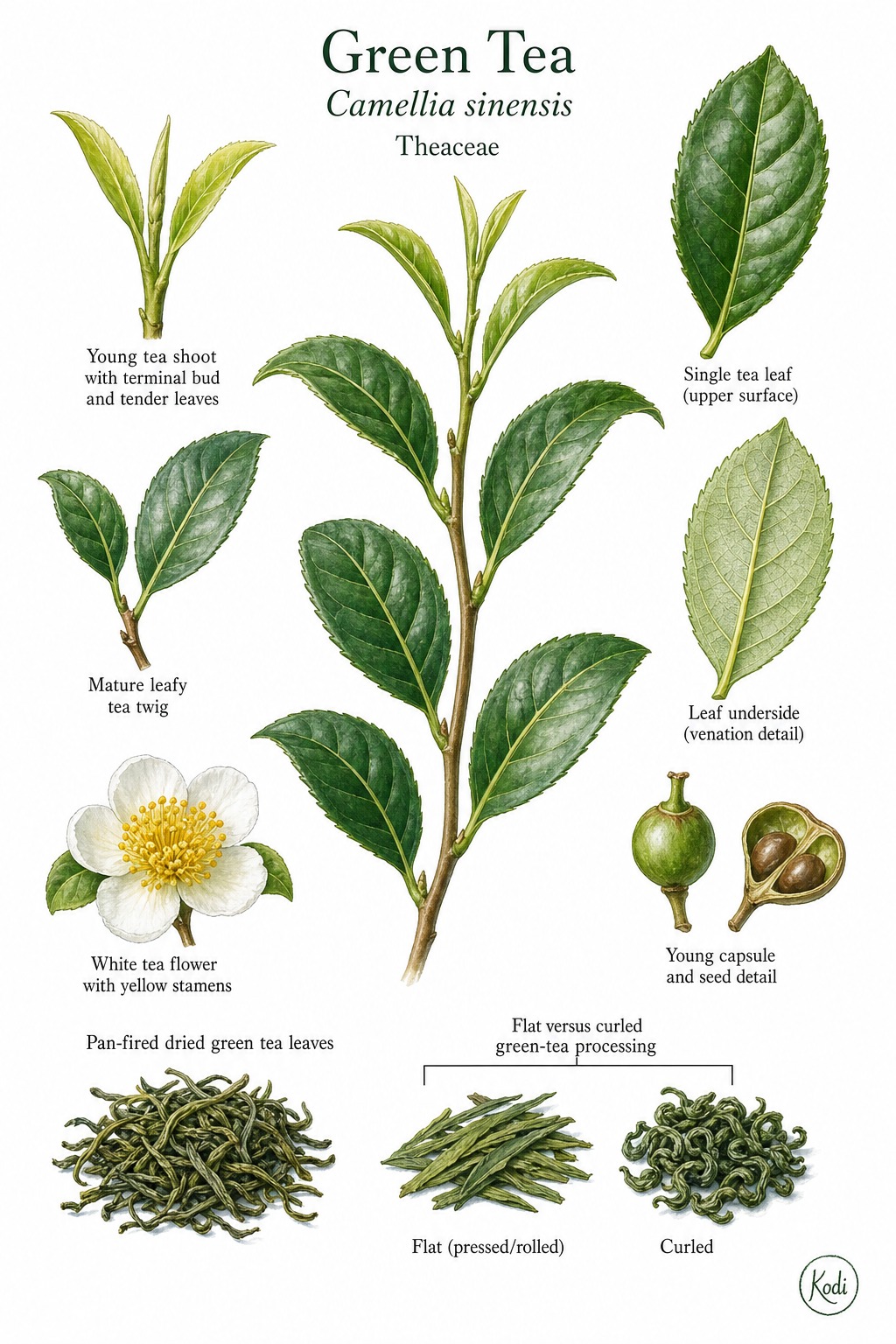
Known in TCM as Lv Cha (绿茶), this sweet and bitter, cool herb enters the Heart, Lung, and Stomach. Traditionally, it clears heat and relieves toxicity - Lv Cha is classically used for sore throat, red eyes, headache, mouth discomfort, and summer heat when excess warmth and irritability predominate, most often applied for fatigue, headache, and phlegm accumulation. Modern research has identified Catechins among its active constituents.
Part used: Leaf
Also Known As
Latin: Folium Camelliae Sinensis | Pinyin: Lv Cha | Chinese: 绿茶
TCM Properties
- Taste
- sweet, bitter
- Temperature
- cool
- Channels
- Heart, Lung, Stomach
Traditional Use
Primary Actions
- Clears heat and relieves toxicity - Lv Cha is classically used for sore throat, red eyes, headache, mouth discomfort, and summer heat when excess warmth and irritability predominate.
- Transforms phlegm and aids digestion - it is used after greasy meals or damp-turbid heaviness when mental dullness, nausea, or chest oppression improve with a light bitter-cooling aromatic.
- Promotes urination and brightens the mind - traditional tea therapy uses it for heat-related drowsiness, sluggishness, and mild fluid congestion rather than for deficiency fatigue.
Secondary Actions
- Lv Cha sits at the border of daily beverage and medicinal herb, so tea therapy depends as much on preparation strength and constitution as on the tea itself.
- Compared with more oxidized teas, green tea is the cooler, more clearing expression of Camellia sinensis and is less suitable for cold digestion or weak Yang constitutions.
Classic Formulas
- Lv Cha with Ju Hua - tea-therapy style pairing for head and eye heat with mild irritability.
- Lv Cha with He Ye - a household-style summer-heat preparation for thirst, heaviness, and warm-weather fatigue.
- Lv Cha with Chen Pi - used after greasy food when dampness, phlegm, or digestive stagnation cloud the middle and the mind.
Classical References
- Me & Qi places Lv Cha in the Heart, Lung, and Stomach channels and emphasizes heat-clearing, phlegm-resolving, urination-promoting, digestive, and mental-alerting actions.
- Chinese tea therapy developed a distinct practice of yi cha dai yao, or using tea as medicine, which explains why green tea appears in both food culture and medicinal writing.
- Lv Cha is most appropriate for heat, turbidity, and mild excess patterns rather than for pure deficiency or cold.
Modern Research
Active Compounds
- Catechins led by epigallocatechin gallate (EGCG), epigallocatechin, epicatechin gallate, and epicatechin - the signature polyphenols of green tea
- Caffeine - the stimulant alkaloid responsible for much of tea's alerting effect
- L-theanine - an amino acid associated with the beverage's calming-attentive profile
- Flavonols and broader polyphenolic fractions - supportive antioxidant constituents
Studied Effects
- A 2022 review summarized green tea phytochemistry, pharmacology, and toxicology, reinforcing that its best-studied modern relevance lies in cardiometabolic, antioxidant, and neurocognitive support rather than one single disease claim (PMID 35745040).
- A 2025 dose-response meta-analysis of randomized trials found that green tea supplementation modestly improved blood pressure outcomes in adults, supporting ongoing cardiovascular interest in the beverage and its extracts (PMID 40497293).
- A 2020 meta-analysis reported favorable effects of green tea consumption on blood lipids, especially total and LDL cholesterol, which helps explain why it remains prominent in preventive-health research (PMID 32434539).
- Safety review work from EFSA concluded that ordinary green tea infusions are generally safe in customary amounts, while concentrated catechin supplements at or above about 800 mg EGCG per day carry a clearer signal for liver enzyme elevation (PMID 32625874).
PubMed References
- Green Tea (Camellia sinensis): A Review of Its Phytochemistry, Pharmacology, and Toxicology. (2022)
- Effect of green tea supplementation on blood pressure in adults: a GRADE-assessed systematic review and dose-response meta-analysis of randomised controlled trials. (2025)
- Effect of green tea consumption on blood lipids: a systematic review and meta-analysis of randomized controlled trials. (2020)
- Scientific opinion on the safety of green tea catechins. (2018)
Safety & Interactions
Contraindications
- Cold weak digestion with loose stools and no heat signs
- Use of concentrated catechin supplements in people with active liver injury unless specifically supervised
Cautions
- Brewed green tea and concentrated green tea extract are not interchangeable; most serious liver-safety concerns involve high-dose supplements rather than ordinary tea.
- Caffeine sensitivity may produce insomnia, palpitations, anxiety, reflux, or tremor in some users.
- Heavy tea intake around meals may reduce nonheme iron absorption in susceptible people.
Drug Interactions
- Possible additive stimulant effects with caffeine-containing drugs or supplements
- Very high intake may complicate warfarin management because tea leaves contain vitamin K, although ordinary beverage use is usually less problematic
Conditions
- Fatigue Traditional ★★☆☆☆ JSON
- Headache Traditional ★★☆☆☆ JSON
- Phlegm Accumulation Traditional ★★☆☆☆ JSON
- Sore Throat Traditional ★★☆☆☆ JSON
Frequently Asked Questions
What is Green Tea used for?
Green Tea is traditionally used to Clears heat and relieves toxicity - Lv Cha is classically used for sore throat, red eyes, headache, mouth discomfort, and summer heat when excess warmth and irritability predominate., Transforms phlegm and aids digestion - it is used after greasy meals or damp-turbid heaviness when mental dullness, nausea, or chest oppression improve with a light bitter-cooling aromatic., Promotes urination and brightens the mind - traditional tea therapy uses it for heat-related drowsiness, sluggishness, and mild fluid congestion rather than for deficiency fatigue.. Research has investigated its effects on: A 2022 review summarized green tea phytochemistry, pharmacology, and toxicology, reinforcing that its best-studied modern relevance lies in cardiometabolic, antioxidant, and neurocognitive support rather than one single disease claim (PMID 35745040).; A 2025 dose-response meta-analysis of randomized trials found that green tea supplementation modestly improved blood pressure outcomes in adults, supporting ongoing cardiovascular interest in the beverage and its extracts (PMID 40497293)..
What are other names for Green Tea?
Green Tea is also known as Camellia. In TCM: 绿茶 (Lv Cha); Folium Camelliae Sinensis.
Is Green Tea safe during pregnancy?
The safety of Green Tea during pregnancy has not been established. Consult a qualified healthcare provider before use.
What are the contraindications for Green Tea?
Green Tea should not be used in: Cold weak digestion with loose stools and no heat signs; Use of concentrated catechin supplements in people with active liver injury unless specifically supervised. Consult a qualified practitioner before use.
Does Green Tea interact with any medications?
Green Tea may interact with: Possible additive stimulant effects with caffeine-containing drugs or supplements; Very high intake may complicate warfarin management because tea leaves contain vitamin K, although ordinary beverage use is usually less problematic. Always inform your healthcare provider of any herbal supplements you are taking.