Hairy Deer-Horn (Hairy Antler)
- Chinese
- 鹿茸
- Pinyin
- Lu Rong
- Latin
- Cornu Cervi Pantotrichum
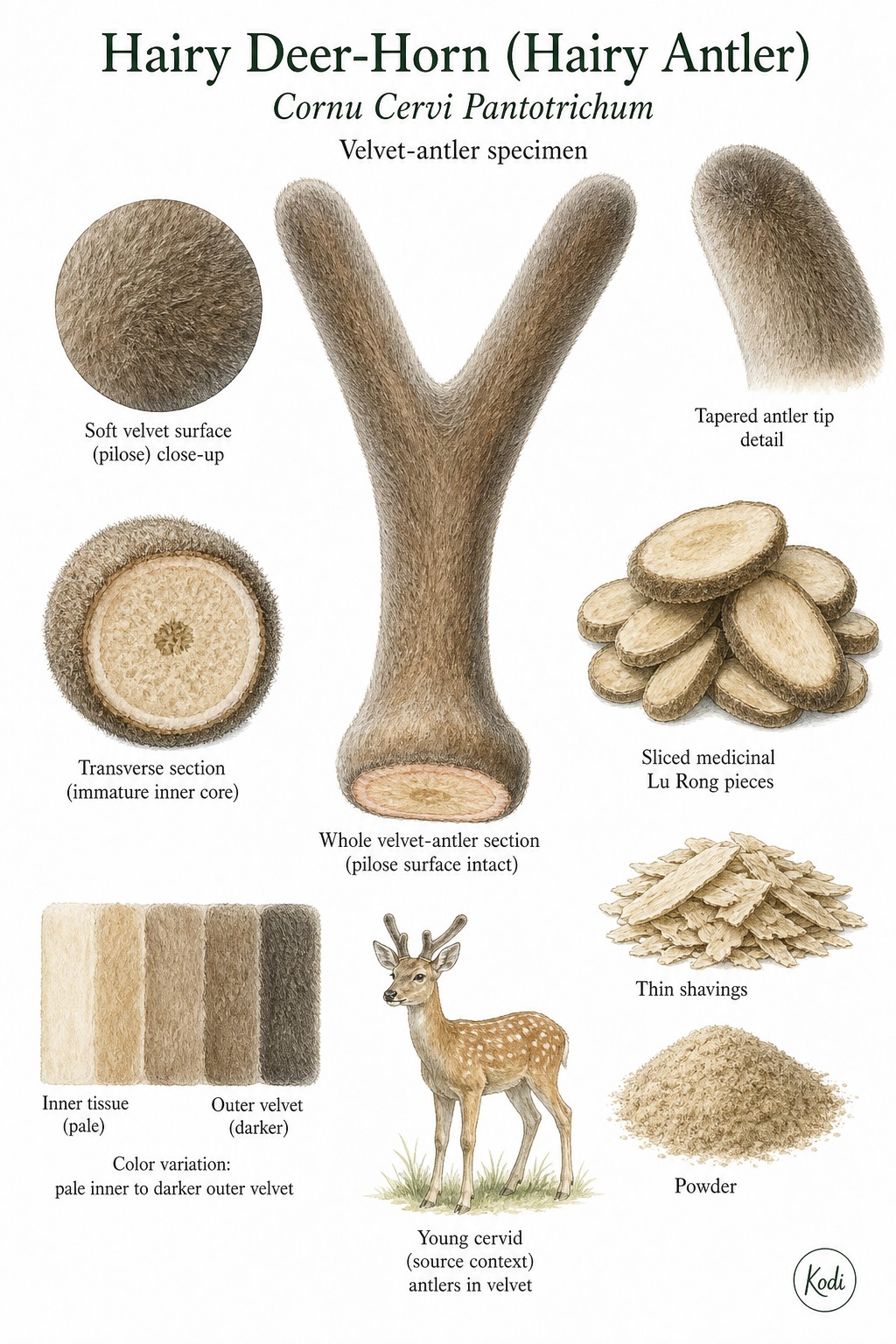
Known in TCM as Lu Rong (鹿茸), this sweet and salty, warm herb enters the Liver and Kidney. Traditionally, it powerfully tonifies Kidney Yang and replenishes essence and blood - Lu Rong is one of the strongest traditional animal tonics for cold depletion, infertility, impotence, developmental weakness, and marked constitutional exhaustion, most often applied for kidney yang deficiency, low back pain, and infertility. Modern research has identified Collagen-rich among its active constituents.
Part used: Horn
Also Known As
Latin: Cornu Cervi Pantotrichum | Pinyin: Lu Rong | Chinese: 鹿茸
TCM Properties
- Taste
- sweet, salty
- Temperature
- warm
- Channels
- Liver, Kidney
Traditional Use
Primary Actions
- Powerfully tonifies Kidney Yang and replenishes essence and blood - Lu Rong is one of the strongest traditional animal tonics for cold depletion, infertility, impotence, developmental weakness, and marked constitutional exhaustion.
- Strengthens sinews and bones - it is chosen when soreness, weakness, delayed recovery, or poor structural resilience suggest deep Liver-Kidney deficiency.
- Regulates the Chong and Ren vessels - traditional gynecologic use includes cold infertility, uterine weakness, and chronic deficiency patterns involving blood and essence insufficiency.
- Supports healing of chronic sores and non-healing lesions - the classical phrase 'tuo chuang du' reflects its use when profound deficiency prevents tissue repair.
Secondary Actions
- Compared with Lu Jiao, Lu Rong is richer, more luxuriantly supplementing, and less blood-moving, which is why the two deer records should not be flattened into one profile.
- Traditional sources repeatedly warn to start with small doses because an overly rapid or excessive use can stir Yang upward and aggravate heat, dizziness, or bleeding.
Classic Formulas
- Shen Rong Dan and related deer-ginseng restorative formulas - classic strategy for severe Yang, essence, and blood depletion.
- You Gui Wan-style Kidney-Yang and fertility tonics - Lu Rong is added when the formula needs a deeper jing-restoring push.
- Post-illness or developmental weakness combinations with Shu Di Huang, Dang Gui, and Gou Qi Zi - traditional rebuilding approach for blood, marrow, and constitutional weakness.
Classical References
- Official modern TCM reference material describes Lu Rong as sweet, salty, and warm, entering the Liver and Kidney to tonify Kidney Yang, boost essence and blood, strengthen sinews and bones, regulate Chong and Ren, and support chronic sore healing.
- Classical use consistently places Lu Rong at the richer and stronger end of the deer-tonic spectrum, above mature horn products such as Lu Jiao.
Modern Research
Active Compounds
- Collagen-rich proteins and bioactive peptides - major structural and signaling-related fractions discussed in velvet-antler literature
- Growth-factor-like and cartilage-associated fractions - candidate correlates for regenerative and musculoskeletal research
- Phospholipids, glycosaminoglycans, and mineral components - supportive constituents relevant to bone and connective-tissue interpretation
- Sterol and hormone-related compounds - minor but clinically important constituents behind some of the endocrine caution around deer antler products
Studied Effects
- A 2013 ovariectomized-rat study found that total velvet antler polypeptides improved bone-related parameters, offering a preclinical correlate for the traditional use of Lu Rong in weakness of bone and structure (PMID 23993908).
- A 2019 study identified ACE-inhibitory peptides in standard and fermented deer velvet, showing how modern peptide-focused research is expanding the cardiometabolic discussion around velvet antler materials beyond purely tonic language (PMID 31806003).
- A 2022 arthritis-model study reported anti-inflammatory and anti-arthritic effects of deer velvet antler extracts in synoviocytes and mice, but the findings remain preclinical and do not establish broad clinical efficacy for crude Lu Rong use (PMID 35850642).
PubMed References
- The anti-osteoporotic effect of velvet antler polypeptides from Cervus elaphus Linnaeus in ovariectomized rats. (2013)
- ACE inhibitory peptides in standard and fermented deer velvet: an in silico and in vitro investigation. (2019)
- Deer Velvet Antler Extracts Exert Anti-Inflammatory and Anti-Arthritic Effects on Human Rheumatoid Arthritis Fibroblast-Like Synoviocytes and Distinct Mouse Arthritis. (2022)
Safety & Interactions
Contraindications
- Yin deficiency with heat or rising Yang
- Active febrile, inflammatory, or phlegm-heat conditions
- Unverified or illegally sourced deer material
Cautions
- Because Lu Rong is a strong warming tonic, dosing is traditionally introduced gradually rather than used casually in large amounts.
- Hormone-active and sterol-related fractions are one reason to use extra caution in patients with hormone-sensitive conditions or unexplained endocrine symptoms.
- Most modern evidence concerns deer velvet broadly rather than the exact crude-drug form used in a TCM dispensary.
Conditions
- Kidney Yang Deficiency Traditional ★★★★☆ JSON
- Low Back Pain Traditional ★★★☆☆ JSON
- Infertility Traditional ★★★☆☆ JSON
- Fatigue Traditional ★★★☆☆ JSON
- Osteoporosis Research ★★☆☆☆ JSON
Frequently Asked Questions
What is Hairy Deer-Horn (Hairy Antler) used for?
Hairy Deer-Horn (Hairy Antler) is traditionally used to Powerfully tonifies Kidney Yang and replenishes essence and blood - Lu Rong is one of the strongest traditional animal tonics for cold depletion, infertility, impotence, developmental weakness, and marked constitutional exhaustion., Strengthens sinews and bones - it is chosen when soreness, weakness, delayed recovery, or poor structural resilience suggest deep Liver-Kidney deficiency., Regulates the Chong and Ren vessels - traditional gynecologic use includes cold infertility, uterine weakness, and chronic deficiency patterns involving blood and essence insufficiency., Supports healing of chronic sores and non-healing lesions - the classical phrase 'tuo chuang du' reflects its use when profound deficiency prevents tissue repair.. Research has investigated its effects on: A 2013 ovariectomized-rat study found that total velvet antler polypeptides improved bone-related parameters, offering a preclinical correlate for the traditional use of Lu Rong in weakness of bone and structure (PMID 23993908).; A 2019 study identified ACE-inhibitory peptides in standard and fermented deer velvet, showing how modern peptide-focused research is expanding the cardiometabolic discussion around velvet antler materials beyond purely tonic language (PMID 31806003)..
What are other names for Hairy Deer-Horn (Hairy Antler)?
Hairy Deer-Horn (Hairy Antler) is also known as Cervi, Velvet Antler. In TCM: 鹿茸 (Lu Rong); Cornu Cervi Pantotrichum.
Is Hairy Deer-Horn (Hairy Antler) safe during pregnancy?
The safety of Hairy Deer-Horn (Hairy Antler) during pregnancy has not been established. Consult a qualified healthcare provider before use.
What are the contraindications for Hairy Deer-Horn (Hairy Antler)?
Hairy Deer-Horn (Hairy Antler) should not be used in: Yin deficiency with heat or rising Yang; Active febrile, inflammatory, or phlegm-heat conditions; Unverified or illegally sourced deer material. Consult a qualified practitioner before use.