Hawthorn Fruit
- Chinese
- 山楂
- Pinyin
- Shan Zha
- Latin
- Fructus Crataegi
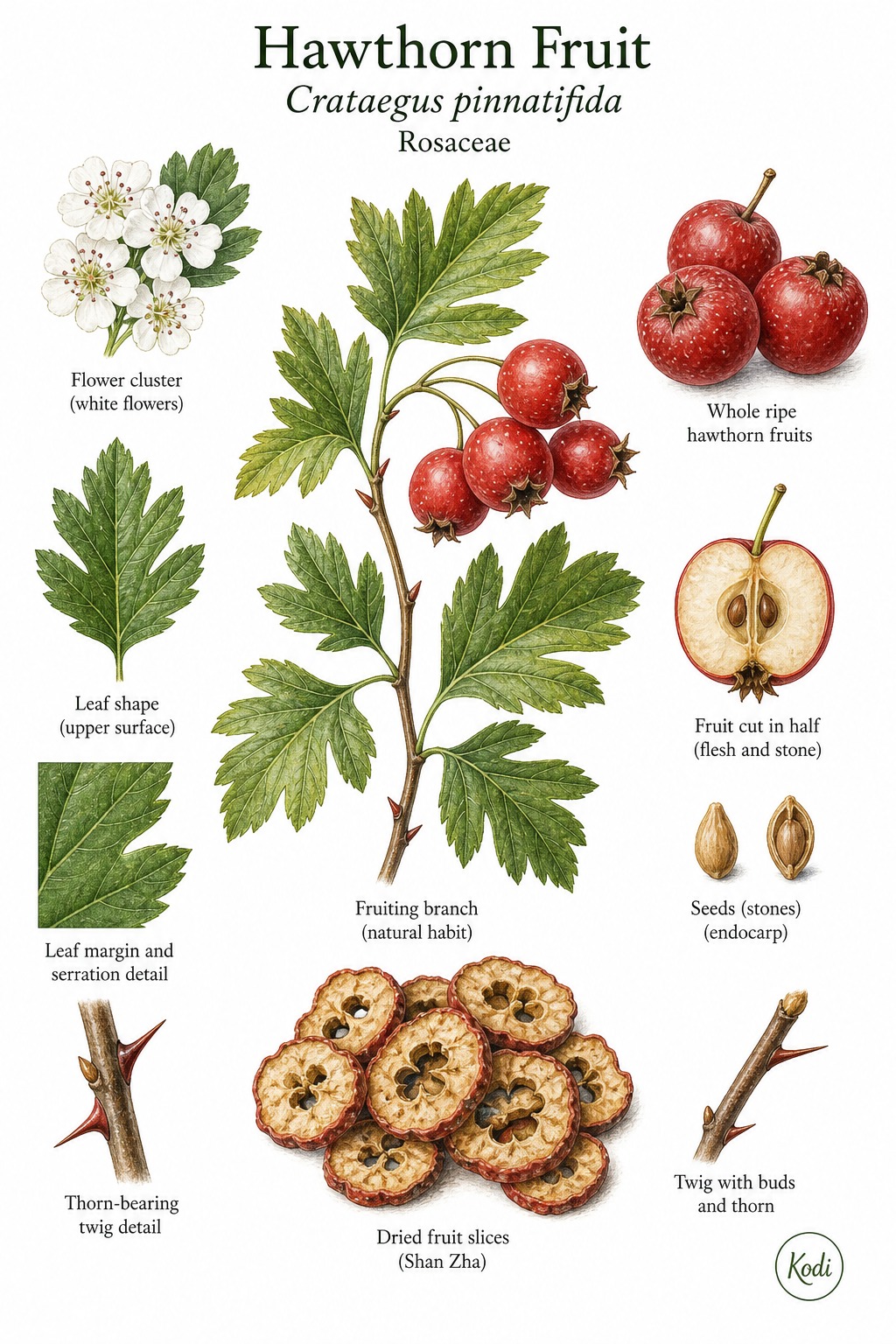
Known in TCM as Shan Zha (山楂), this sour and sweet, slightly warm herb enters the Spleen, Stomach, and Liver. Traditionally, it reduces food stagnation - Shan Zha is a classic digestive fruit for fullness, belching, sour accumulation, and poor appetite, especially when greasy or meat-heavy food has become stuck, most often applied for indigestion, abdominal distension, and hyperlipidemia. Modern research has identified Flavonoids among its active constituents.
Part used: Fruit
Also Known As
Latin: Fructus Crataegi | Pinyin: Shan Zha | Chinese: 山楂
TCM Properties
- Taste
- sour, sweet
- Temperature
- slightly warm
- Channels
- Spleen, Stomach, Liver
Traditional Use
Primary Actions
- Reduces food stagnation - Shan Zha is a classic digestive fruit for fullness, belching, sour accumulation, and poor appetite, especially when greasy or meat-heavy food has become stuck.
- Moves blood and disperses stasis - traditional use extends to postpartum abdominal pain, retained lochia, and fixed pain where food stagnation and blood stasis overlap.
- Transforms turbidity and eases distention - it is often chosen when accumulative digestive patterns lead to bloating, focal fullness, or a heavy postprandial sensation.
- Processed forms shift the emphasis - raw Shan Zha leans toward moving food and blood, while charred forms are more often used when diarrhea follows food stagnation.
Secondary Actions
- Shan Zha is one of the clearest examples of a food-like medicinal fruit that still has strong enough movement to matter in formula design.
- Modern supplement literature often discusses hawthorn leaves, flowers, and extracts together, but this monograph remains anchored in the traditional fruit medicine.
Classic Formulas
- Bao He Wan - the classic food-stagnation formula in which Shan Zha is the lead herb for undigested food, epigastric fullness, and sour belching.
- Jiao San Xian combinations - charred Shan Zha with charred Shen Qu and charred Mai Ya for stubborn food accumulation and post-overeating distress.
- Postpartum stasis formulas with Dang Gui, Hong Hua, or Xiang Fu - traditional pairing strategy when digestive stagnation and blood stasis coexist.
Classical References
- Standard TCM teaching describes Shan Zha as sour, sweet, and slightly warm, entering the Spleen, Stomach, and Liver to reduce food accumulation and invigorate blood.
- Materia medica tradition repeatedly notes its particular strength in dispersing meat and greasy-food stagnation, which is one reason it remains so common in digestive formulas.
Modern Research
Active Compounds
- Flavonoids such as vitexin, hyperoside, and rutin - major antioxidant and cardiometabolic candidate constituents
- Oligomeric procyanidins - polyphenolic compounds frequently discussed in vascular and lipid literature
- Triterpenic acids such as ursolic and oleanolic acid - supportive constituents in anti-inflammatory and metabolic research
- Organic acids including citric, chlorogenic, and related fruit acids - constituents relevant to digestive and food-chemistry interpretation
Studied Effects
- A 2014 review of Crataegus pinnatifida summarized a broad pharmacology literature spanning digestive, cardiovascular, antimicrobial, and endocrine effects, making it one of the more modern-research-supported fruits in this section of the queue (PMID 24487567).
- A 2017 rat study found that a phenol-rich fraction of Crataegus pinnatifida fruit improved lipid and oxidative-stress parameters in hyperlipidemia models, supporting the ongoing metabolic interest around Shan Zha while remaining preclinical (PMID 29200740).
- A 2020 fruit-extract study reported reduced inflammation and oxidative stress in a doxorubicin-induced chronic-heart-failure rat model, which is suggestive but still far from proving routine clinical cardiology use for crude Shan Zha decoction pieces (PMID 33232307).
PubMed References
- Crataegus pinnatifida: chemical constituents, pharmacology, and potential applications. (2014)
- Evaluation of Hypolipidemic and Antioxidant Effects in Phenolrich Fraction of Crataegus pinnatifida Fruit in Hyperlipidemia Rats and Identification of Chemical Composition by Ultra-performance Liquid Chromatography Coupled with Quadropole Time-of-flight Mass Spectrometry. (2017)
- Ethanol Extract of Chinese Hawthorn (Crataegus pinnatifida) Fruit Reduces Inflammation and Oxidative Stress in Rats with Doxorubicin-Induced Chronic Heart Failure. (2020)
Safety & Interactions
Contraindications
- Marked Spleen-Stomach deficiency without accumulation
- Pregnancy without qualified supervision when strong blood-moving use is intended
Cautions
- Hawthorn supplement products are often more concentrated and less fruit-specific than traditional Shan Zha decoction pieces.
- Memorial Sloan Kettering notes potential interaction concerns around anticoagulants, antiplatelet drugs, digoxin, and cardiovascular therapy monitoring.
- Frequent or concentrated use may aggravate acid sensitivity in some patients despite the herb's digestive reputation.
Drug Interactions
- Anticoagulants or antiplatelet drugs - possible additive bleeding-risk concern based on hawthorn interaction literature.
- Digoxin or prescription heart-failure therapy - use should be monitored rather than self-prescribed alongside cardiac medication.
Conditions
- Indigestion Traditional ★★★★☆ JSON
- Abdominal Distension Traditional ★★★★☆ JSON
- Hyperlipidemia Research ★★★☆☆ JSON
- Hypertension Research ★★☆☆☆ JSON
- Blood Stasis Traditional ★★☆☆☆ JSON
Frequently Asked Questions
What is Hawthorn Fruit used for?
Hawthorn Fruit is traditionally used to Reduces food stagnation - Shan Zha is a classic digestive fruit for fullness, belching, sour accumulation, and poor appetite, especially when greasy or meat-heavy food has become stuck., Moves blood and disperses stasis - traditional use extends to postpartum abdominal pain, retained lochia, and fixed pain where food stagnation and blood stasis overlap., Transforms turbidity and eases distention - it is often chosen when accumulative digestive patterns lead to bloating, focal fullness, or a heavy postprandial sensation., Processed forms shift the emphasis - raw Shan Zha leans toward moving food and blood, while charred forms are more often used when diarrhea follows food stagnation.. Research has investigated its effects on: A 2014 review of Crataegus pinnatifida summarized a broad pharmacology literature spanning digestive, cardiovascular, antimicrobial, and endocrine effects, making it one of the more modern-research-supported fruits in this section of the queue (PMID 24487567).; A 2017 rat study found that a phenol-rich fraction of Crataegus pinnatifida fruit improved lipid and oxidative-stress parameters in hyperlipidemia models, supporting the ongoing metabolic interest around Shan Zha while remaining preclinical (PMID 29200740)..
What are other names for Hawthorn Fruit?
Hawthorn Fruit is also known as Crataegi, Chinese Hawthorn Fruit. In TCM: 山楂 (Shan Zha); Fructus Crataegi.
Is Hawthorn Fruit safe during pregnancy?
The safety of Hawthorn Fruit during pregnancy has not been established. Consult a qualified healthcare provider before use.
What are the contraindications for Hawthorn Fruit?
Hawthorn Fruit should not be used in: Marked Spleen-Stomach deficiency without accumulation; Pregnancy without qualified supervision when strong blood-moving use is intended. Consult a qualified practitioner before use.
Does Hawthorn Fruit interact with any medications?
Hawthorn Fruit may interact with: Anticoagulants or antiplatelet drugs - possible additive bleeding-risk concern based on hawthorn interaction literature.; Digoxin or prescription heart-failure therapy - use should be monitored rather than self-prescribed alongside cardiac medication.. Always inform your healthcare provider of any herbal supplements you are taking.