Hedge Prinsepia Nut
- Chinese
- 蕤仁
- Pinyin
- Rui Ren
- Latin
- Nux Prinsepiae
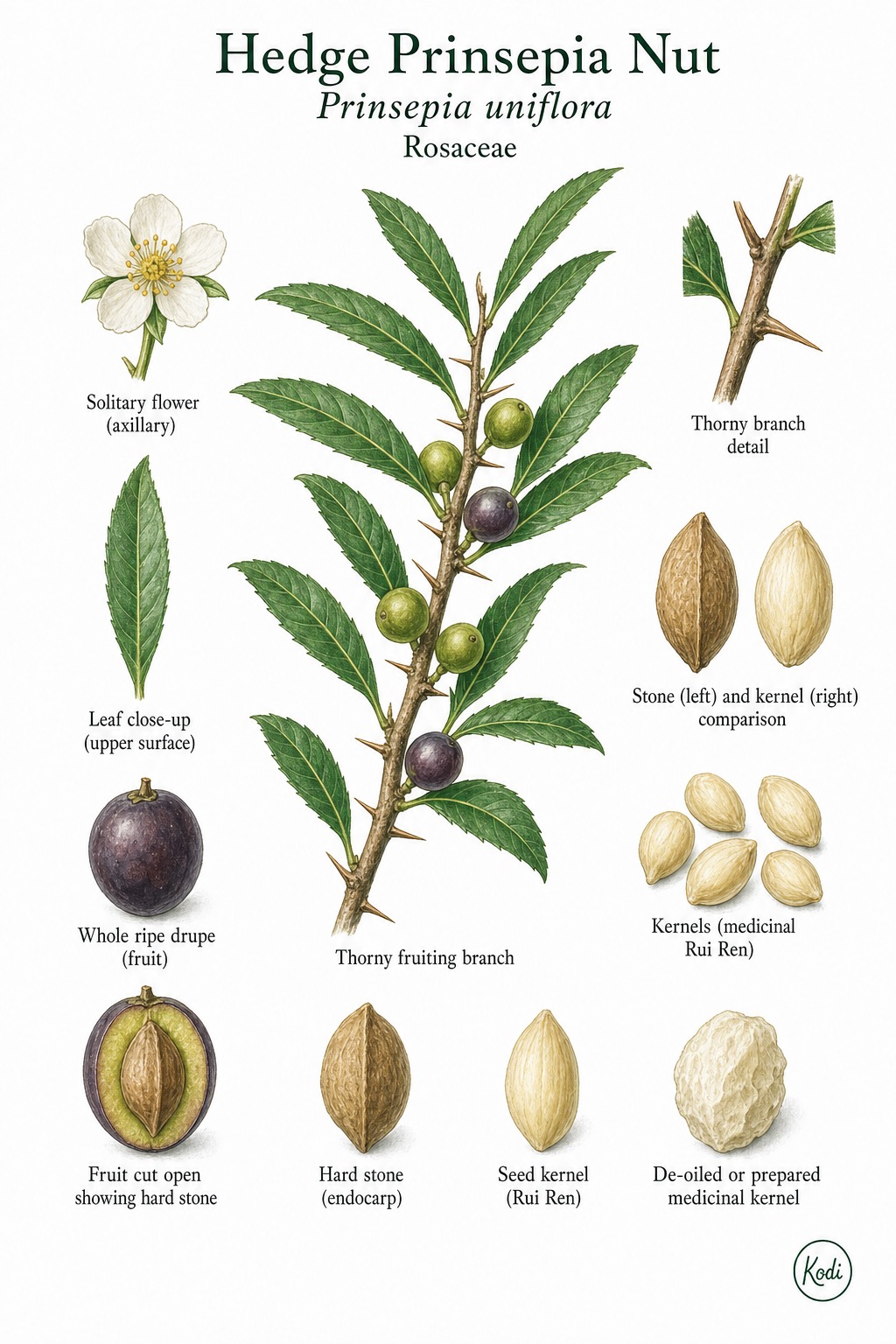
Known in TCM as Rui Ren (蕤仁), this sweet, slightly cold herb enters the Heart and Liver. Traditionally, it nourishes the Liver and brightens the eyes - Rui Ren is a classical eye herb for red, painful, blurred, tearful, or photosensitive eyes when dryness, heat, or insufficient nourishment are involved, most often applied for blurred vision and insomnia. Modern research has identified Fixed among its active constituents.
Also Known As
Latin: Nux Prinsepiae | Pinyin: Rui Ren | Chinese: 蕤仁
TCM Properties
- Taste
- sweet
- Temperature
- slightly cold
- Channels
- Heart, Liver
Traditional Use
Primary Actions
- Nourishes the Liver and brightens the eyes - Rui Ren is a classical eye herb for red, painful, blurred, tearful, or photosensitive eyes when dryness, heat, or insufficient nourishment are involved.
- Dispels wind-heat from the eyes - traditional external and internal use includes acute red-eye and irritated-lid patterns rather than only deep deficiency states.
- Calms the spirit - older sources also remember Rui Ren as a mild settling medicine for poor sleep or restlessness.
- Often processed for ophthalmic use - the seed is classically de-oiled, powdered, or made into ointment-like preparations for topical eye applications.
Secondary Actions
- This imported record should be read as the classical eye-medicine Rui Ren rather than as a generic edible seed-oil entry.
- Traditional caution notes specifically say it is not suitable when eye pain comes purely from Liver-Kidney deficiency without the relevant wind-heat or irritation context.
Classic Formulas
- Chun Xue Gao - classical Rui Ren eye preparation for dim vision, wind irritation, and chronic tearing.
- Rui Ren ointment and wash traditions - seed-based topical preparations for red eyes, canthus irritation, and lid inflammation.
- Rui Ren with cooling eye herbs such as Hu Huang Lian or bamboo leaf - older strategy for hot, painful, or inflamed eyes.
Classical References
- The official modern Chinese reference platform describes Rui Ren as sweet and slightly cold, entering the Heart and Liver, with actions of dispelling wind-heat, nourishing the Liver, brightening the eyes, and calming the spirit.
- Classical citations focus overwhelmingly on ophthalmic use, which helps distinguish this record from other oily or moistening seeds in the materia medica.
Modern Research
Active Compounds
- Fixed oils rich in unsaturated fatty acids - the major bulk constituent of the kernel
- Triterpenoid components such as ursolic-acid-related markers - modern quality-control clues noted in contemporary reference material
- Protein and minor phenolic fractions - supportive constituents discussed in seed-composition work
Studied Effects
- Direct indexed research on Rui Ren itself is sparse, and modern literature is much thinner than the long classical ophthalmic tradition would suggest.
- Current seed-oil research in the broader Prinsepia group tends to focus on antioxidant, skin-protective, or compositional questions rather than on the traditional eye indications, so modern extrapolation should remain conservative.
Safety & Interactions
Contraindications
- Eye pain arising from pure Liver-Kidney deficiency without the relevant heat or irritation context
Cautions
- Modern evidence for the classical eye indications remains limited despite the herb's long traditional use.
- Because seed preparations are oily and often specially processed for eye use, crude self-preparation for ophthalmic application is not appropriate.
Conditions
- Blurred Vision Traditional ★★★★☆ JSON
- Insomnia Traditional ★★☆☆☆ JSON
Frequently Asked Questions
What is Hedge Prinsepia Nut used for?
Hedge Prinsepia Nut is traditionally used to Nourishes the Liver and brightens the eyes - Rui Ren is a classical eye herb for red, painful, blurred, tearful, or photosensitive eyes when dryness, heat, or insufficient nourishment are involved., Dispels wind-heat from the eyes - traditional external and internal use includes acute red-eye and irritated-lid patterns rather than only deep deficiency states., Calms the spirit - older sources also remember Rui Ren as a mild settling medicine for poor sleep or restlessness., Often processed for ophthalmic use - the seed is classically de-oiled, powdered, or made into ointment-like preparations for topical eye applications.. Research has investigated its effects on: Direct indexed research on Rui Ren itself is sparse, and modern literature is much thinner than the long classical ophthalmic tradition would suggest.; Current seed-oil research in the broader Prinsepia group tends to focus on antioxidant, skin-protective, or compositional questions rather than on the traditional eye indications, so modern extrapolation should remain conservative..
What are other names for Hedge Prinsepia Nut?
Hedge Prinsepia Nut is also known as Prinsepiae Nux, Prinsepia Seed Kernel. In TCM: 蕤仁 (Rui Ren); Nux Prinsepiae.
Is Hedge Prinsepia Nut safe during pregnancy?
The safety of Hedge Prinsepia Nut during pregnancy has not been established. Consult a qualified healthcare provider before use.
What are the contraindications for Hedge Prinsepia Nut?
Hedge Prinsepia Nut should not be used in: Eye pain arising from pure Liver-Kidney deficiency without the relevant heat or irritation context. Consult a qualified practitioner before use.