Hematite
- Chinese
- 赭石
- Pinyin
- Zhe Shi
- Latin
- Haematitum
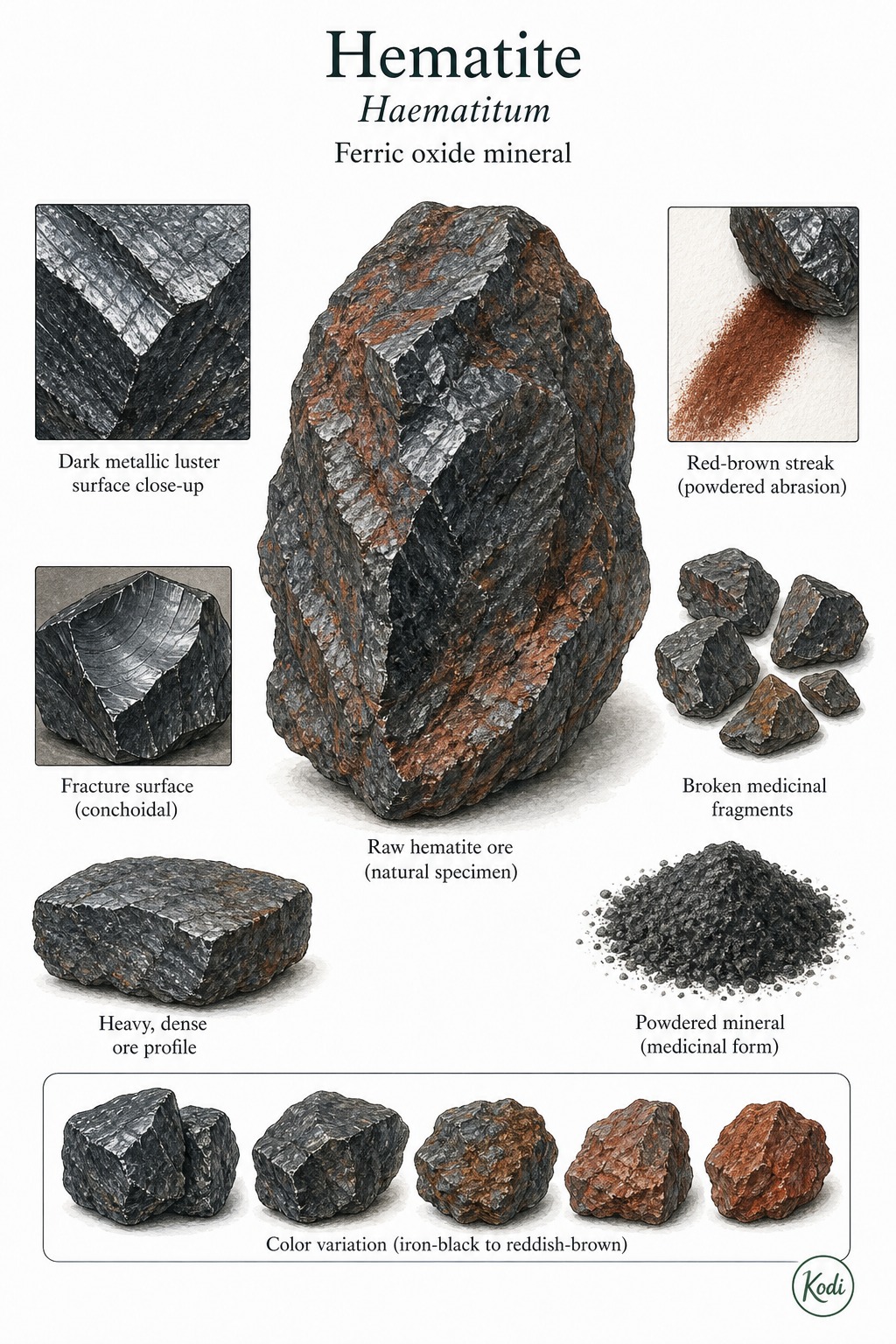
Known in TCM as Zhe Shi (赭石), this bitter, cold herb enters the Liver and Heart. Traditionally, it anchors rising Liver Yang - Zhe Shi is used for dizziness, headache, facial flushing, and agitation when upward flaring or counterflow is prominent, most often applied for nausea, wheezing, and hypertension. Modern research has identified Ferric among its active constituents.
Part used: Haematite
Also Known As
Latin: Haematitum | Pinyin: Zhe Shi | Chinese: 赭石
TCM Properties
- Taste
- bitter
- Temperature
- cold
- Channels
- Liver, Heart
Traditional Use
Primary Actions
- Anchors rising Liver Yang - Zhe Shi is used for dizziness, headache, facial flushing, and agitation when upward flaring or counterflow is prominent.
- Directs rebellious qi downward - traditional indications include nausea, vomiting, belching, hiccup, and wheezing from upward-stirring Lung or Stomach qi.
- Cools the blood and helps stop bleeding - older use includes vomiting of blood, nosebleed-type patterns, and heat-agitated bleeding presentations.
Secondary Actions
- This common-name entry documents the general hematite medicine, while the next record under Dai Zhe Shi carries the more fully specified classical name most often used in formula teaching.
- Because it is heavy and mineral in nature, Zhe Shi is typically broken and decocted first rather than treated like an ordinary light herb.
Classic Formulas
- Xuan Fu Dai Zhe Tang - classic pairing with Xuan Fu Hua and Sheng Jiang for stubborn counterflow nausea, belching, and focal fullness.
- Zhen Gan Xi Feng Tang - heavy-settling use for Liver-Yang rising and internal wind patterns.
- Cooling-and-descending combinations with Shi Gao or Bai Shao - traditional strategy for heat with upward rebellion and bleeding.
Classical References
- Traditional teaching treats Zhe Shi and Dai Zhe Shi as the same medicinal hematite family, with the shorter Zhe Shi name functioning as a common alias.
- The central classical identity is a bitter cold, heavy mineral that both settles upward excess and redirects rebellious qi downward.
Modern Research
Active Compounds
- Ferric oxide - the dominant mineral basis of medicinal hematite
- Trace mineral admixtures - minor components that vary by source and affect quality rather than defining pharmacology
- Potential heavy-metal impurities - a core modern safety issue for crude mineral medicines
Studied Effects
- Direct indexed research on Zhe Shi as a crude TCM hematite is sparse, and most modern discussion centers on mineral composition, heavy-metal control, and traditional processing rather than on robust herb-specific clinical trials.
- Modern pharmacologic summaries still attribute sedative, hematinic, and downward-directing physiologic effects to hematite preparations, but the evidence base is much thinner than for better-studied botanical herbs.
Safety & Interactions
Contraindications
- Pregnancy without qualified supervision
- Marked deficiency-cold without upward excess or counterflow
- Poorly sourced mineral material with unknown impurity profile
Cautions
- As a mineral medicine, hematite requires source quality control because arsenic, lead, and other contaminants are a practical concern.
- Its heavy downward action is useful precisely because it is not gentle, which is why casual self-use is a poor fit.
- Traditional and modern reference sources both caution that prolonged or excessive use can irritate the digestive tract.
Drug Interactions
- Tetracycline-class antibiotics - mineral binding may reduce absorption.
- Isoniazid or rifampin - reference sources warn of reduced absorption when combined with hematite.
Conditions
Frequently Asked Questions
What is Hematite used for?
Hematite is traditionally used to Anchors rising Liver Yang - Zhe Shi is used for dizziness, headache, facial flushing, and agitation when upward flaring or counterflow is prominent., Directs rebellious qi downward - traditional indications include nausea, vomiting, belching, hiccup, and wheezing from upward-stirring Lung or Stomach qi., Cools the blood and helps stop bleeding - older use includes vomiting of blood, nosebleed-type patterns, and heat-agitated bleeding presentations.. Research has investigated its effects on: Direct indexed research on Zhe Shi as a crude TCM hematite is sparse, and most modern discussion centers on mineral composition, heavy-metal control, and traditional processing rather than on robust herb-specific clinical trials.; Modern pharmacologic summaries still attribute sedative, hematinic, and downward-directing physiologic effects to hematite preparations, but the evidence base is much thinner than for better-studied botanical herbs..
What are other names for Hematite?
Hematite is also known as Red Ochre, Ferric Oxide Mineral. In TCM: 赭石 (Zhe Shi); Haematitum.
Is Hematite safe during pregnancy?
The safety of Hematite during pregnancy has not been established. Consult a qualified healthcare provider before use.
What are the contraindications for Hematite?
Hematite should not be used in: Pregnancy without qualified supervision; Marked deficiency-cold without upward excess or counterflow; Poorly sourced mineral material with unknown impurity profile. Consult a qualified practitioner before use.
Does Hematite interact with any medications?
Hematite may interact with: Tetracycline-class antibiotics - mineral binding may reduce absorption.; Isoniazid or rifampin - reference sources warn of reduced absorption when combined with hematite.. Always inform your healthcare provider of any herbal supplements you are taking.