Hemsley Rockvine Root
- Chinese
- 三叶青
- Pinyin
- San Ye Qing
- Latin
- Radix Tetrastigmatis Hemsleyani
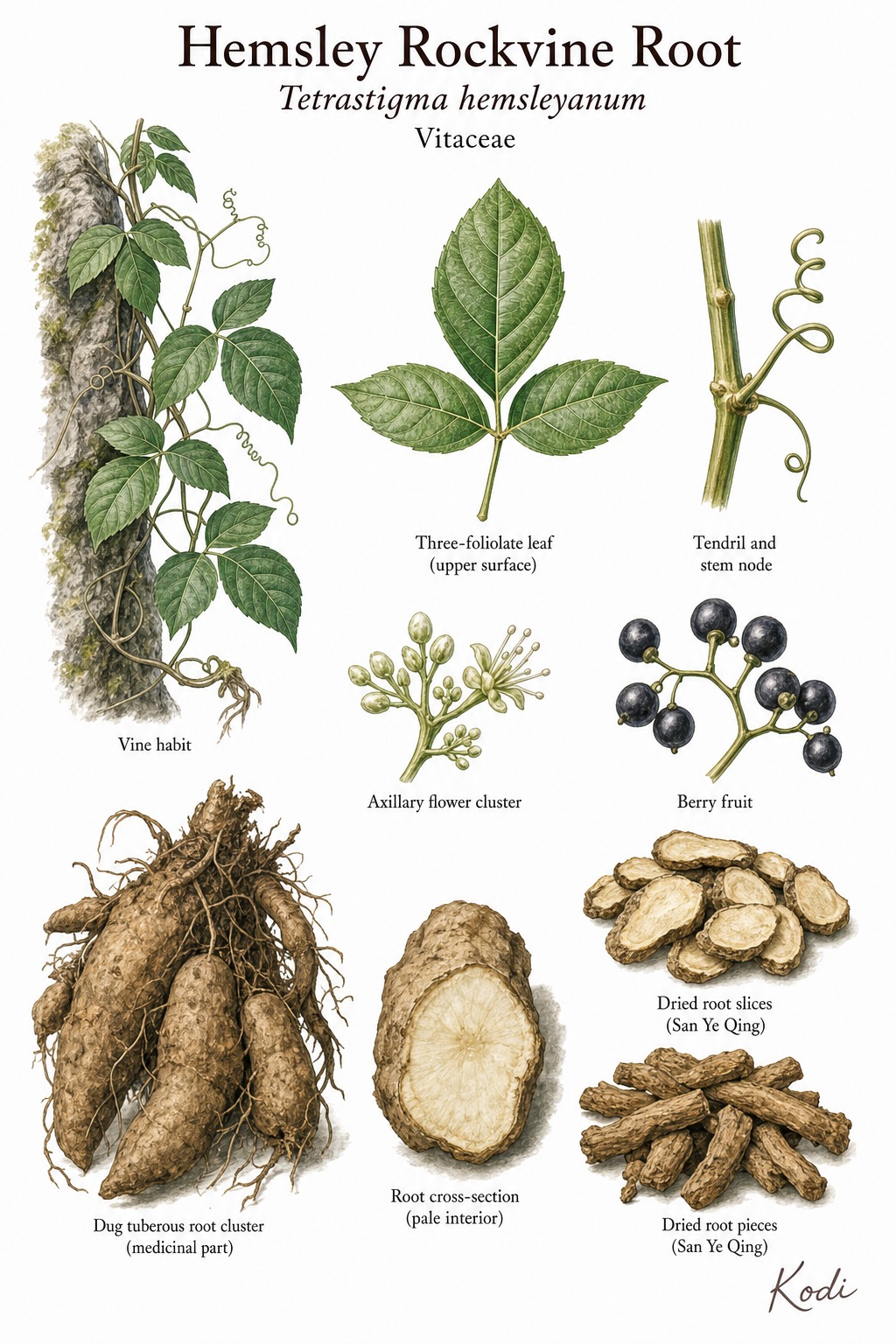
Known in TCM as San Ye Qing (三叶青), this bitter and acrid, cool herb enters the Heart, Lung, Liver, and Kidney. Traditionally, it clears heat and resolves toxicity - San Ye Qing is used for sore throat, inflammatory swellings, pediatric febrile disorders, and other toxic-heat presentations, most often applied for pharyngitis, bronchitis, and upper respiratory infection. Modern research has identified Flavonoids among its active constituents.
Part used: Root
Also Known As
Latin: Radix Tetrastigmatis Hemsleyani | Pinyin: San Ye Qing | Chinese: 三叶青
TCM Properties
- Taste
- bitter, acrid
- Temperature
- cool
- Channels
- Heart, Lung, Liver, Kidney
Traditional Use
Primary Actions
- Clears heat and resolves toxicity - San Ye Qing is used for sore throat, inflammatory swellings, pediatric febrile disorders, and other toxic-heat presentations.
- Dispels wind and transforms phlegm - traditional use includes bronchitic cough, pneumonia-style heat-phlegm patterns, and certain convulsive or febrile pediatric complaints.
- Invigorates blood and relieves pain - it is also used externally or internally for trauma, snakebite, fissures, and painful swellings.
Secondary Actions
- Modern popular writing often elevates San Ye Qing for anticancer discussion, but the classical core is broader heat-toxin, phlegm, and swelling management rather than a standalone oncology identity.
- This record stays anchored to the root medicine rather than to every aerial-part extract study now appearing in the literature.
Classic Formulas
- Heat-toxin decoctions for throat swelling and pediatric fever - common folk and regional pattern of use.
- Respiratory combinations with heat-clearing and phlegm-transforming herbs - traditional approach for bronchitic or pneumonic patterns.
- External powders or poultices for trauma, bites, and toxic swellings - long-standing local-use direction.
Classical References
- Recent officially reviewed Chinese medical explanations describe San Ye Qing as bitter, slightly acrid, and cool, clearing heat and toxins, transforming phlegm, and relieving pain, with application to dysenteric, respiratory, pediatric febrile, and traumatic conditions.
- Regional practice also preserves the synonym Jin Si Diao Hu Lu, which should be understood as the same medicinal identity here rather than as a separate herb.
Modern Research
Active Compounds
- Flavonoids - major quality and anti-inflammatory candidate constituents
- Alkaloids - a less famous but experimentally active fraction in macrophage studies
- Polysaccharides - increasingly discussed in immunomodulatory and lung-injury research
- Phenolic compounds - supportive antioxidant and signaling-related constituents
Studied Effects
- A 2018 study isolated alkaloids from Tetrastigma hemsleyanum and reported anti-inflammatory effects in LPS-stimulated RAW264.7 macrophages, supporting the herb's long-standing anti-inflammatory reputation at a preclinical level (PMID 29899226).
- A 2022 study identified CDK6 and MET as candidate targets in the antitumor activity of Tetrastigma hemsleyanum, illustrating why the herb attracts so much modern oncology interest even though the data remain mechanistic and preclinical (PMID 35480115).
- A recent lung-injury study found that Tetrastigma hemsleyanum polysaccharide attenuated Poly(I:C)-induced acute lung injury through barrier-preserving and inflammatory-pathway effects, aligning with the herb's respiratory heat-phlegm tradition without yet proving routine clinical efficacy (PMID 41520962).
PubMed References
- Alkaloids from Tetrastigma hemsleyanum and Their Anti-Inflammatory Effects on LPS-Induced RAW264.7 Cells. (2018)
- Cyclin-Dependent Kinase 6 Identified as the Target Protein in the Antitumor Activity of Tetrastigma hemsleyanum. (2022)
- Polysaccharide from Tetrastigma hemsleyanum Diels et Gilg attenuates Poly(I:C)-induced acute lung injury by preserving epithelial barrier integrity and modulating STING/TBK1-NF-kB and IRF1-STAT1 signaling. (2025)
Safety & Interactions
Cautions
- Much of the modern literature is preclinical and should not be mistaken for established clinical evidence in cancer or severe infection.
- Because the herb is also used in folk practice for serious conditions such as high fever, pneumonia, and toxic swelling, it should not replace urgent medical evaluation when those are present.
Conditions
- Pharyngitis Traditional ★★★☆☆ JSON
- Bronchitis Traditional ★★★☆☆ JSON
- Upper Respiratory Infection Traditional ★★★☆☆ JSON
- Traumatic Injury Traditional ★★☆☆☆ JSON
- Cancer Preclinical ★★☆☆☆ JSON
Frequently Asked Questions
What is Hemsley Rockvine Root used for?
Hemsley Rockvine Root is traditionally used to Clears heat and resolves toxicity - San Ye Qing is used for sore throat, inflammatory swellings, pediatric febrile disorders, and other toxic-heat presentations., Dispels wind and transforms phlegm - traditional use includes bronchitic cough, pneumonia-style heat-phlegm patterns, and certain convulsive or febrile pediatric complaints., Invigorates blood and relieves pain - it is also used externally or internally for trauma, snakebite, fissures, and painful swellings.. Research has investigated its effects on: A 2018 study isolated alkaloids from Tetrastigma hemsleyanum and reported anti-inflammatory effects in LPS-stimulated RAW264.7 macrophages, supporting the herb's long-standing anti-inflammatory reputation at a preclinical level (PMID 29899226).; A 2022 study identified CDK6 and MET as candidate targets in the antitumor activity of Tetrastigma hemsleyanum, illustrating why the herb attracts so much modern oncology interest even though the data remain mechanistic and preclinical (PMID 35480115)..
What are other names for Hemsley Rockvine Root?
Hemsley Rockvine Root is also known as Tetrastigma Root, Jin Si Diao Hu Lu. In TCM: 三叶青 (San Ye Qing); Radix Tetrastigmatis Hemsleyani.
Is Hemsley Rockvine Root safe during pregnancy?
The safety of Hemsley Rockvine Root during pregnancy has not been established. Consult a qualified healthcare provider before use.