Hen
- Chinese
- 母鸡
- Pinyin
- Mu Ji
- Latin
- Gallus domesticus
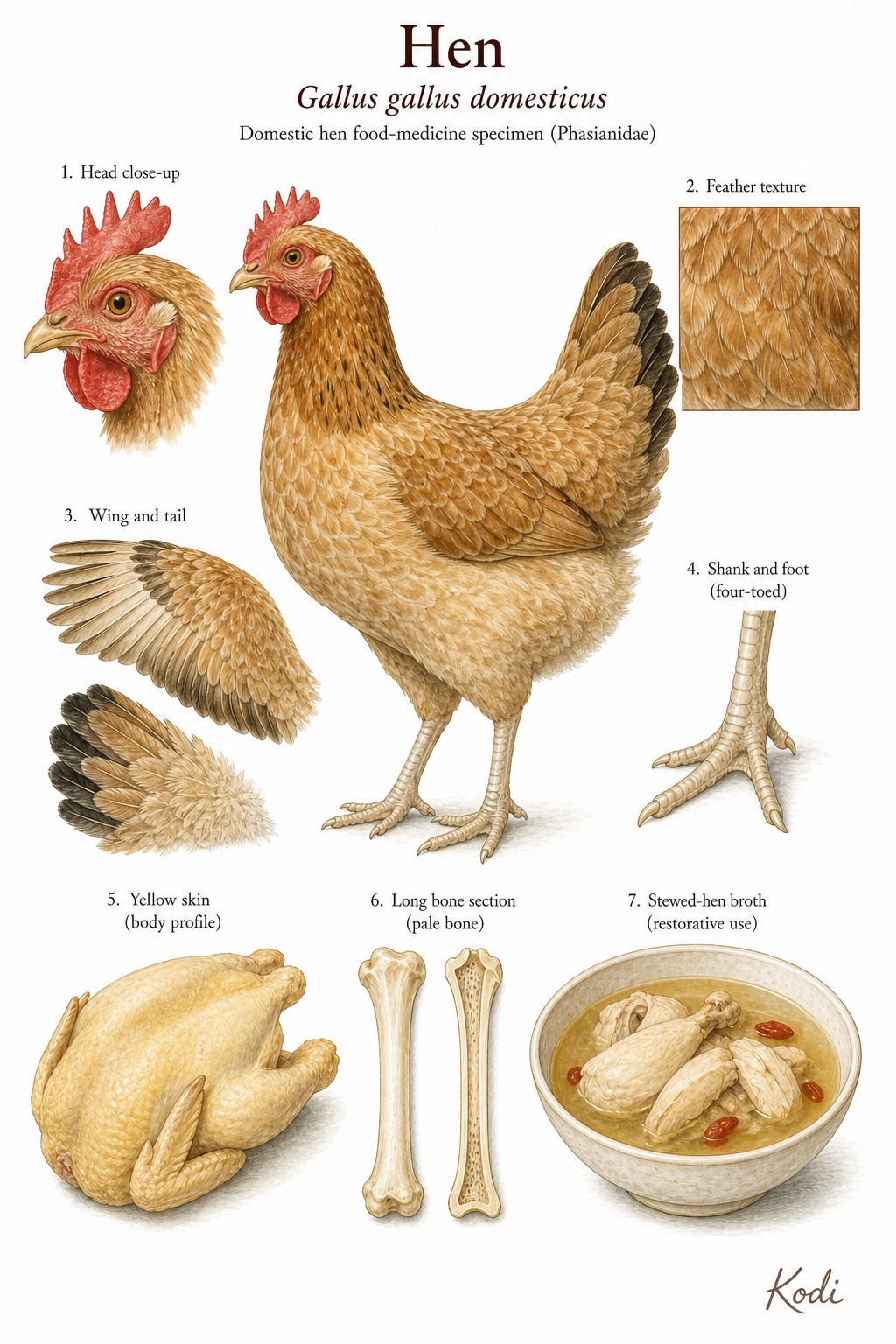
Known in TCM as Mu Ji (母鸡), this sweet, warm herb enters the Spleen and Stomach. Traditionally, it warms the middle and supplements qi - Mu Ji is used in medicinal-diet practice for weakness after illness, poor appetite, loose stool, and fatigue when the patient needs nourishing food rather than a harsh medicinal stimulant, most often applied for fatigue, poor appetite, and diarrhea. Modern research has identified Protein among its active constituents.
Also Known As
Latin: Gallus domesticus | Pinyin: Mu Ji | Chinese: 母鸡
TCM Properties
- Taste
- sweet
- Temperature
- warm
- Channels
- Spleen, Stomach
Traditional Use
Primary Actions
- Warms the middle and supplements qi - Mu Ji is used in medicinal-diet practice for weakness after illness, poor appetite, loose stool, and fatigue when the patient needs nourishing food rather than a harsh medicinal stimulant.
- Nourishes blood and supports convalescence - stewed hen is a classic restorative food for postpartum weakness, chronic deficiency, pale complexion, and gradual recovery from depletion.
- Supplements essence and marrow through food therapy - traditional use includes frailty, emaciation, and long-course weakness in people who tolerate soups and broths better than concentrated decoctions.
Secondary Actions
- This generic hen record is broader and milder than the already-live black-bone silky fowl record, which carries a stronger specialized gynecologic and Yin-Blood tonic reputation.
- Mu Ji is primarily a food-medicine material used in stews, soups, and convalescent diet therapy rather than as a stand-alone dry-herb decoction item.
Classic Formulas
- Huang Qi stewed hen broths - common medicinal-diet strategy for qi deficiency, poor appetite, and recovery after childbirth or illness.
- Dang Gui hen soup traditions - restorative pairing for blood deficiency, menstrual depletion, and postpartum weakness.
- Ren Shen or Tai Zi Shen chicken soup - convalescent food-medicine approach when appetite, strength, and fluids all need rebuilding.
Classical References
- Traditional food-medicine references describe chicken meat as sweet and warm, entering the Spleen and Stomach to warm the center and tonify essence and marrow.
- Older dietetic teaching often treats mature hens as especially useful for deficiency, postpartum recovery, and people who need gentle long-course nourishment rather than a strong medicinal push.
Modern Research
Active Compounds
- Protein and essential amino acids - the core nutritional basis of the food-medicine tonic reputation
- Carnosine and anserine - histidine-containing dipeptides often highlighted in chicken-extract and fatigue research
- Collagen and gelatin-derived peptides - supportive constituents concentrated in slow-cooked broth preparations
- Iron, zinc, and B vitamins - nutrients relevant to convalescent and blood-building dietary use
Studied Effects
- A 2012 review of chicken essence summarized anti-fatigue, anti-stress, immune, metabolic, and postpartum-lactation findings, helping explain why hen and chicken broths retain a tonic-food reputation in East Asian practice (PMID 22432477).
- A 2013 placebo-controlled study found daily essence of chicken improved recovery from mental fatigue in healthy males, offering limited but relevant human support for convalescent fatigue use (PMID 23831862).
- A 2018 in vitro and in vivo study characterized essence of chicken as an ergogenic aid with antifatigue potential, supporting the food-medicine tonic tradition more than any narrow disease claim (PMID 30544515).
PubMed References
Safety & Interactions
Contraindications
- Marked food stagnation or greasy damp-heat with thick coating and poor digestive transformation
- Acute exterior illness where heavy tonic nourishment would trap the pathogen
Cautions
- Rich hen broths can be too cloying for weak digestion or for patients with active dampness despite the bird's traditional restorative reputation.
- Food safety, sourcing, and hygienic preparation matter more here than in a typical dry-herb record because the material is an animal food as well as a medicine.
- Commercial chicken-essence extracts are more concentrated and not equivalent to ordinary stewed hen.
Conditions
- Fatigue Traditional ★★★☆☆ JSON
- Poor Appetite Traditional ★★☆☆☆ JSON
- Diarrhea Traditional ★★☆☆☆ JSON
- Leukorrhea Traditional ★☆☆☆☆ JSON
Frequently Asked Questions
What is Hen used for?
Hen is traditionally used to Warms the middle and supplements qi - Mu Ji is used in medicinal-diet practice for weakness after illness, poor appetite, loose stool, and fatigue when the patient needs nourishing food rather than a harsh medicinal stimulant., Nourishes blood and supports convalescence - stewed hen is a classic restorative food for postpartum weakness, chronic deficiency, pale complexion, and gradual recovery from depletion., Supplements essence and marrow through food therapy - traditional use includes frailty, emaciation, and long-course weakness in people who tolerate soups and broths better than concentrated decoctions.. Research has investigated its effects on: A 2012 review of chicken essence summarized anti-fatigue, anti-stress, immune, metabolic, and postpartum-lactation findings, helping explain why hen and chicken broths retain a tonic-food reputation in East Asian practice (PMID 22432477).; A 2013 placebo-controlled study found daily essence of chicken improved recovery from mental fatigue in healthy males, offering limited but relevant human support for convalescent fatigue use (PMID 23831862)..
What are other names for Hen?
Hen is also known as Gallus, Chicken. In TCM: 母鸡 (Mu Ji); Gallus domesticus.
Is Hen safe during pregnancy?
The safety of Hen during pregnancy has not been established. Consult a qualified healthcare provider before use.
What are the contraindications for Hen?
Hen should not be used in: Marked food stagnation or greasy damp-heat with thick coating and poor digestive transformation; Acute exterior illness where heavy tonic nourishment would trap the pathogen. Consult a qualified practitioner before use.