Henbane Seed
- Chinese
- 天仙子
- Pinyin
- Tian Xian Zi
- Latin
- Hyoscyamii Semen
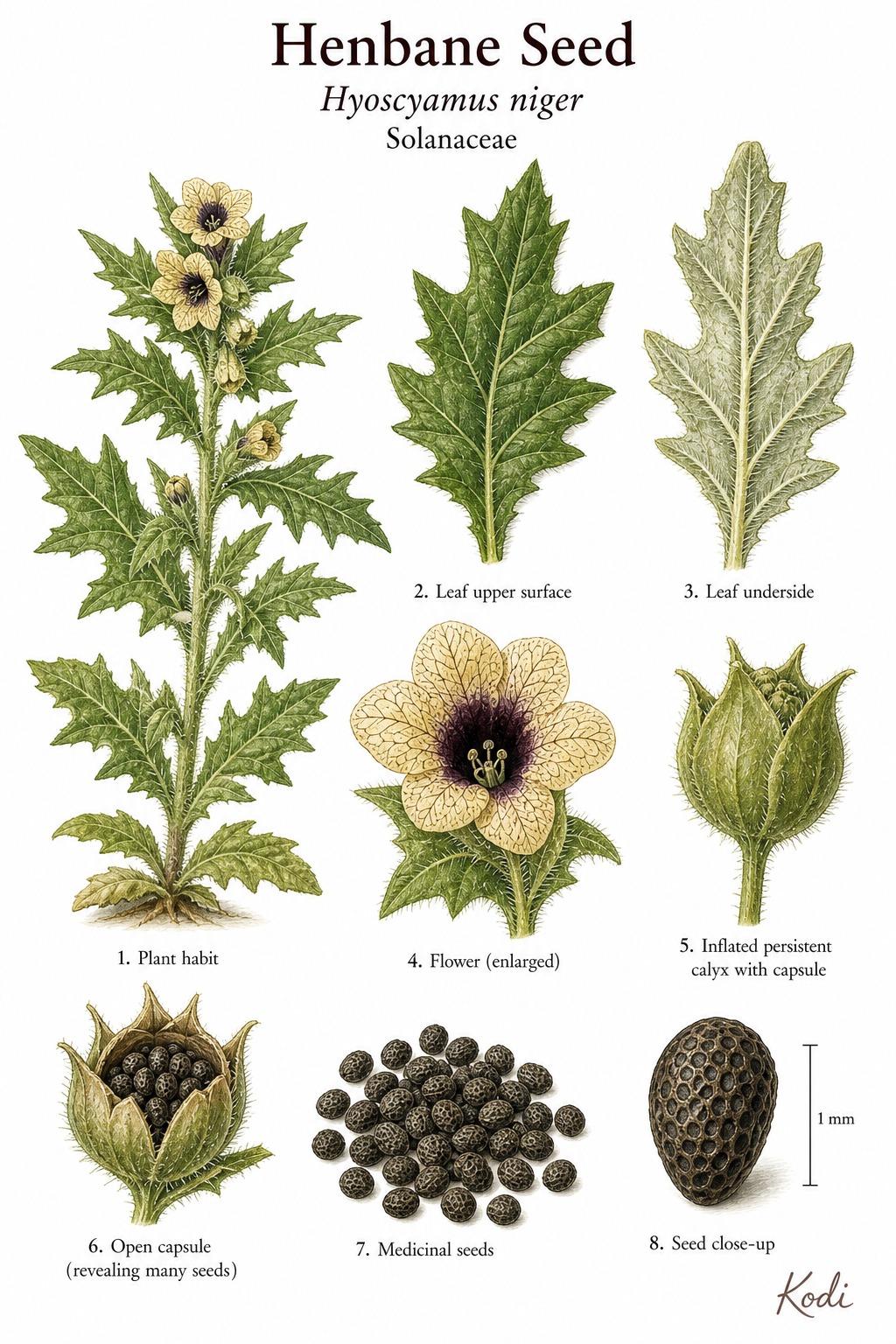
Known in TCM as Tian Xian Zi (天仙子), this bitter and acrid, warm herb enters the Heart, Liver, and Stomach. Traditionally, it relieves spasm and severe pain - Tian Xian Zi is used for sharp abdominal pain, stomach or intestinal cramping, toothache, wind-damp pain, and traumatic pain where spasm and obstruction are pronounced, most often applied for abdominal pain, toothache, and wheezing. Modern research has identified Hyoscyamine among its active constituents.
Part used: Seed
Also Known As
Latin: Hyoscyamii Semen | Pinyin: Tian Xian Zi | Chinese: 天仙子
TCM Properties
- Taste
- bitter, acrid
- Temperature
- warm
- Channels
- Heart, Liver, Stomach
Traditional Use
Primary Actions
- Relieves spasm and severe pain - Tian Xian Zi is used for sharp abdominal pain, stomach or intestinal cramping, toothache, wind-damp pain, and traumatic pain where spasm and obstruction are pronounced.
- Calms coughing and wheezing by relieving spasm - older practice includes minute-dose internal use or smoke use for stubborn asthma-like cough with tightness.
- Calms the spirit and settles convulsive disorders - traditional use extends to mania, fright epilepsy, and severe agitation patterns.
Secondary Actions
- This is a seed-specific toxic tropane-alkaloid record and should not be flattened into the already-live Yang Jin Hua flower page, even though both belong to the same broader belladonna-type pharmacology family.
- Tian Xian Zi is remembered less as a general tonic herb than as a dangerous specialist analgesic-antispasmodic used in very small doses or external applications.
Classic Formulas
- Tian Xian Zi Wan from the Saint Ji tradition - warming stop-diarrhea use for chronic cold diarrhea and prolapse patterns.
- Miao Gong San - pairing with Da Huang for dysenteric pain and tenesmus when obstruction and lingering pathogen coexist.
- Lang Dang Zi San - older sedating strategy for mania, convulsions, or seizure-like presentations.
- Toothache powders, smoke applications, or point use - classic external direction for severe dental pain.
Classical References
- Official Chinese herb references describe Tian Xian Zi as bitter, acrid, warm, and highly toxic, entering the Heart, Liver, and Stomach to stop spasm and pain and calm convulsive disorders.
- Classical literature repeatedly highlights toothache, spasmodic abdominal pain, wheezing, chronic diarrhea, prolapse, and mania-like states as its main indication clusters.
- The decisive traditional fact is not only efficacy but danger: internal doses are tiny and continuous use is specifically discouraged.
Modern Research
Active Compounds
- Hyoscyamine - one of the principal belladonna-type tropane alkaloids
- Scopolamine - major anticholinergic alkaloid relevant to antispasmodic and toxic effects
- Atropine - alkaloid contributing to the herb's strong anticholinergic risk profile
- Withanolides and minor seed constituents - additional compounds that broaden chemistry without softening toxicity concerns
Studied Effects
- A 2014 descriptive review summarized black henbane's bronchodilating, spasmolytic, sedative, and antidiarrheal pharmacology while placing poisoning management at the center of modern discussion (PMID 25386392).
- A 2004 hairy-root study increased scopolamine biosynthesis in Hyoscyamus niger, underscoring why contemporary research focuses on tropane-alkaloid production rather than casual crude-herb use (PMID 15084741).
- A 1999 phytochemical paper isolated withanolides from Hyoscyamus niger seeds, confirming that Tian Xian Zi is chemically complex beyond its belladonna alkaloids, though that complexity does not reduce toxicity concern (PMID 10543915).
PubMed References
Safety & Interactions
Contraindications
- Pregnancy
- Children or unsupervised home use
- Heart disease, tachyarrhythmia, glaucoma, or urinary retention-prone states
- Any repeated or prolonged internal dosing without expert supervision
Cautions
- Tian Xian Zi is highly toxic and can cause anticholinergic poisoning with delirium, dry mouth, dilated pupils, hyperthermia, rapid pulse, urinary retention, seizures, and coma.
- Official Chinese references explicitly warn against overdose and against continuous use even when the herb is being used medicinally.
- Its dramatic historical analgesic and antispasmodic reputation does not make it an acceptable everyday cough, pain, or diarrhea remedy.
Drug Interactions
- Other anticholinergic drugs - possible additive toxicity with atropine-like effects.
- Sedative or centrally acting drugs - may unpredictably intensify neurologic adverse effects.
Conditions
Frequently Asked Questions
What is Henbane Seed used for?
Henbane Seed is traditionally used to Relieves spasm and severe pain - Tian Xian Zi is used for sharp abdominal pain, stomach or intestinal cramping, toothache, wind-damp pain, and traumatic pain where spasm and obstruction are pronounced., Calms coughing and wheezing by relieving spasm - older practice includes minute-dose internal use or smoke use for stubborn asthma-like cough with tightness., Calms the spirit and settles convulsive disorders - traditional use extends to mania, fright epilepsy, and severe agitation patterns.. Research has investigated its effects on: A 2014 descriptive review summarized black henbane's bronchodilating, spasmolytic, sedative, and antidiarrheal pharmacology while placing poisoning management at the center of modern discussion (PMID 25386392).; A 2004 hairy-root study increased scopolamine biosynthesis in Hyoscyamus niger, underscoring why contemporary research focuses on tropane-alkaloid production rather than casual crude-herb use (PMID 15084741)..
What are other names for Henbane Seed?
Henbane Seed is also known as Hyoscyami, Black Henbane Seed. In TCM: 天仙子 (Tian Xian Zi); Hyoscyamii Semen.
Is Henbane Seed safe during pregnancy?
Henbane Seed is not recommended during pregnancy.
What are the contraindications for Henbane Seed?
Henbane Seed should not be used in: Pregnancy; Children or unsupervised home use; Heart disease, tachyarrhythmia, glaucoma, or urinary retention-prone states; Any repeated or prolonged internal dosing without expert supervision. Consult a qualified practitioner before use.
Does Henbane Seed interact with any medications?
Henbane Seed may interact with: Other anticholinergic drugs - possible additive toxicity with atropine-like effects.; Sedative or centrally acting drugs - may unpredictably intensify neurologic adverse effects.. Always inform your healthcare provider of any herbal supplements you are taking.