Heterophylly Falsestarwort Root
- Chinese
- 太子参
- Pinyin
- Tai Zi Shen
- Latin
- Radix Pseudostellariae
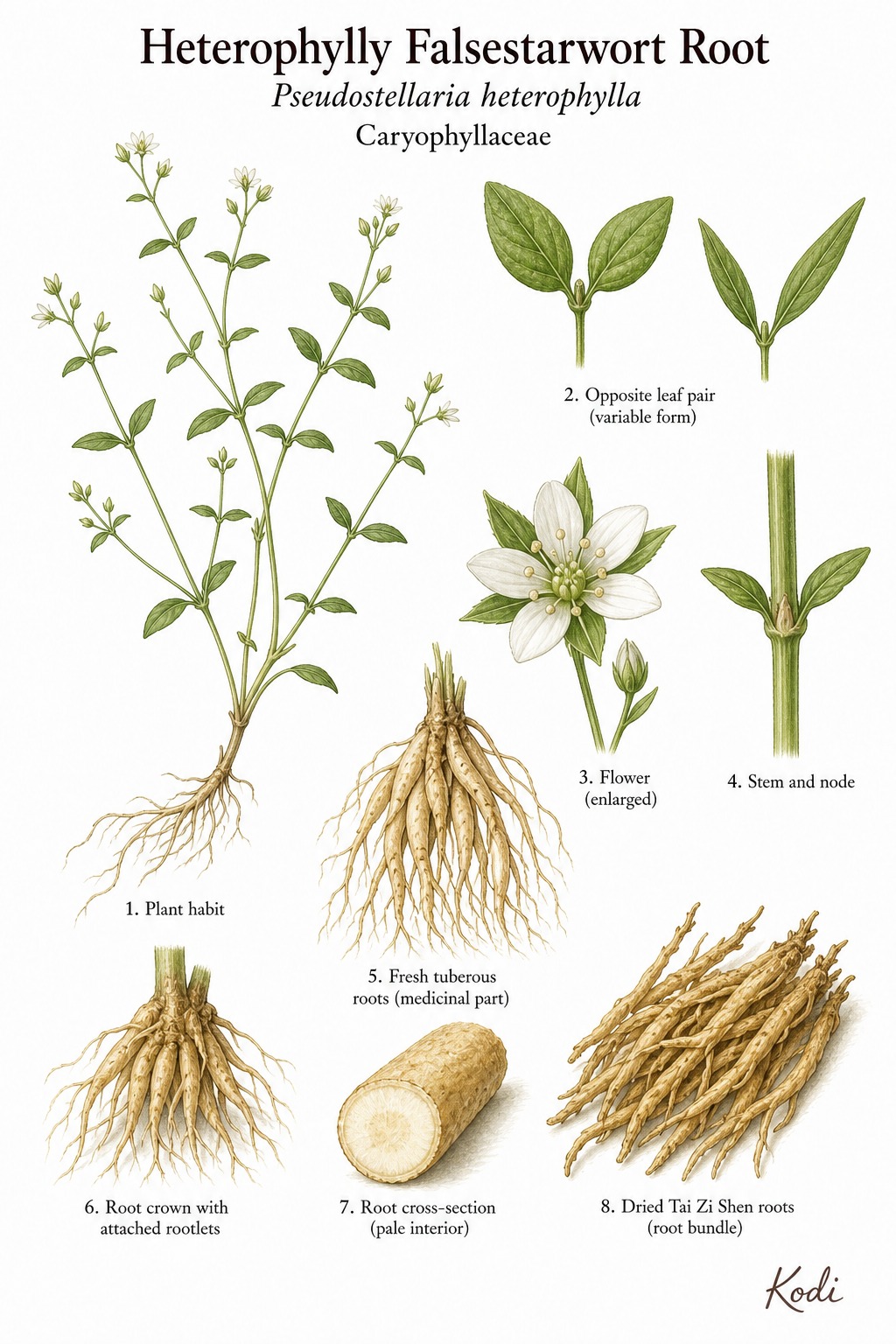
Known in TCM as Tai Zi Shen (太子参), this sweet and slightly bitter, neutral herb enters the Spleen and Lung. Traditionally, it tonifies qi and generates fluids - Tai Zi Shen is used for post-illness weakness, thirst, low energy, and deficiency patterns where both qi and fluids have been depleted, most often applied for fatigue, poor appetite, and dry cough. Modern research has identified Polysaccharides among its active constituents.
Part used: Root
Also Known As
Latin: Radix Pseudostellariae | Pinyin: Tai Zi Shen | Chinese: 太子参
TCM Properties
- Taste
- sweet, slightly bitter
- Temperature
- neutral
- Channels
- Spleen, Lung
Traditional Use
Primary Actions
- Tonifies qi and generates fluids - Tai Zi Shen is used for post-illness weakness, thirst, low energy, and deficiency patterns where both qi and fluids have been depleted.
- Strengthens the Spleen and supports appetite - traditional use includes poor appetite, mild loose stool, and weak digestion in people who do not tolerate stronger tonics well.
- Benefits the Lung and moistens dry cough - it is chosen for dry cough with scant phlegm, weak respiration, or recovery-stage Lung depletion rather than for excess phlegm patterns.
Secondary Actions
- Tai Zi Shen is milder than Ren Shen and better suited to children, delicate constitutions, and patients who need tonification without the force or warming density of stronger ginseng use.
- Its practical value lies in being a bridge herb between qi tonics and fluid-generating herbs, which is why it appears so often in recovery-stage, pediatric, and dietetic-style prescriptions.
Classic Formulas
- Gentle Spleen-Qi support formulas modified from Shen Ling Bai Zhu San or Yi Gong San - used when appetite, fluids, and mild deficiency all need support without heavy stimulation.
- Post-febrile qi-yin recovery combinations with Mai Men Dong, Shi Hu, or Sha Shen - strategy for thirst, fatigue, and dry cough after heat illness.
- Pediatric spontaneous-sweating or dry-cough pairings with Huang Qi, Fu Xiao Mai, or Bai He - traditional pattern-based use for delicate constitutions.
Classical References
- Official Chinese references describe Tai Zi Shen as sweet, slightly bitter, and neutral, with the ability to tonify qi, generate fluids, strengthen the Spleen, and benefit the Lung.
- Modern traditional teaching repeatedly notes that it resembles ginseng in function but is gentler and better tolerated by patients who cannot handle stronger supplementation.
- Its especially valued traditional niche is deficiency with poor appetite, dry cough, post-illness qi-fluid loss, or pediatric spontaneous sweating.
Modern Research
Active Compounds
- Polysaccharides - major immunologic and gut-modulating constituents in modern research
- Cyclopeptides such as heterophyllin-related compounds - characteristic Pseudostellaria bioactives
- Peptides from protein hydrolysates - important fractions in immune-function studies
- Beta-carbolines, flavonoids, and sterol-triterpene fractions - supportive constituents in broader pharmacology work
Studied Effects
- A 2019 study found that a Pseudostellaria heterophylla peptide promoted spleen-lymphocyte activity and cytokine signaling, supporting the herb's modern immunomodulatory reputation (PMID 31140514).
- A 2022 study reported that Pseudostellaria polysaccharide improved immune function and gut-flora balance in immunosuppressed mice, providing a plausible modern bridge to the herb's recovery-tonic use (PMID 36348804).
- A 2021 phytochemical study identified pseudosterins A-C from Pseudostellaria heterophylla and reported cardioprotective effects, illustrating the species' expanding modern pharmacology profile (PMID 34443633).
PubMed References
- Immunomodulatory effects of Pseudostellaria heterophylla peptide on spleen lymphocytes via a Ca2+/CaN/NFATc1/IFN-gamma pathway (2019)
- The regulatory effects of Pseudostellaria heterophylla polysaccharide on immune function and gut flora in immunosuppressed mice (2022)
- Pseudosterins A-C, Three 1-Ethyl-3-formyl-beta-carbolines from Pseudostellaria heterophylla and Their Cardioprotective Effects (2021)
Safety & Interactions
Contraindications
- Spleen-cold with chronic slippery diarrhea
- Use only with supervision when there is marked bloating or weak digestion that worsens under tonic therapy
Cautions
- Official Chinese references note that large or excessive internal doses may cause chest oppression, abdominal distension, dry mouth, poor appetite, irritability, or blood-pressure reduction.
- Tai Zi Shen is gentler than Ren Shen but it is not interchangeable with stronger ginseng when formula intensity matters.
- Most modern evidence remains preclinical or mechanistic rather than based on large direct clinical trials of the crude drug.
Drug Interactions
- Vitamin C, niacin, glutamic acid, or pepsin mixtures - official Chinese references warn of reduced effect when combined.
- Codeine, morphine, pethidine, or phenobarbital - official references caution possible intensification of respiratory or sedative suppression.
- Cardiac glycosides - official Chinese references warn of additive toxicity.
Conditions
Frequently Asked Questions
What is Heterophylly Falsestarwort Root used for?
Heterophylly Falsestarwort Root is traditionally used to Tonifies qi and generates fluids - Tai Zi Shen is used for post-illness weakness, thirst, low energy, and deficiency patterns where both qi and fluids have been depleted., Strengthens the Spleen and supports appetite - traditional use includes poor appetite, mild loose stool, and weak digestion in people who do not tolerate stronger tonics well., Benefits the Lung and moistens dry cough - it is chosen for dry cough with scant phlegm, weak respiration, or recovery-stage Lung depletion rather than for excess phlegm patterns.. Research has investigated its effects on: A 2019 study found that a Pseudostellaria heterophylla peptide promoted spleen-lymphocyte activity and cytokine signaling, supporting the herb's modern immunomodulatory reputation (PMID 31140514).; A 2022 study reported that Pseudostellaria polysaccharide improved immune function and gut-flora balance in immunosuppressed mice, providing a plausible modern bridge to the herb's recovery-tonic use (PMID 36348804)..
What are other names for Heterophylly Falsestarwort Root?
Heterophylly Falsestarwort Root is also known as Pseudostellaria, Pseudostellaria Root. In TCM: 太子参 (Tai Zi Shen); Radix Pseudostellariae.
Is Heterophylly Falsestarwort Root safe during pregnancy?
The safety of Heterophylly Falsestarwort Root during pregnancy has not been established. Consult a qualified healthcare provider before use.
What are the contraindications for Heterophylly Falsestarwort Root?
Heterophylly Falsestarwort Root should not be used in: Spleen-cold with chronic slippery diarrhea; Use only with supervision when there is marked bloating or weak digestion that worsens under tonic therapy. Consult a qualified practitioner before use.
Does Heterophylly Falsestarwort Root interact with any medications?
Heterophylly Falsestarwort Root may interact with: Vitamin C, niacin, glutamic acid, or pepsin mixtures - official Chinese references warn of reduced effect when combined.; Codeine, morphine, pethidine, or phenobarbital - official references caution possible intensification of respiratory or sedative suppression.; Cardiac glycosides - official Chinese references warn of additive toxicity.. Always inform your healthcare provider of any herbal supplements you are taking.