Himalayan Teasel Root
- Chinese
- 川续断
- Pinyin
- Chuan Xu Duan
- Latin
- Radix Dipsaci
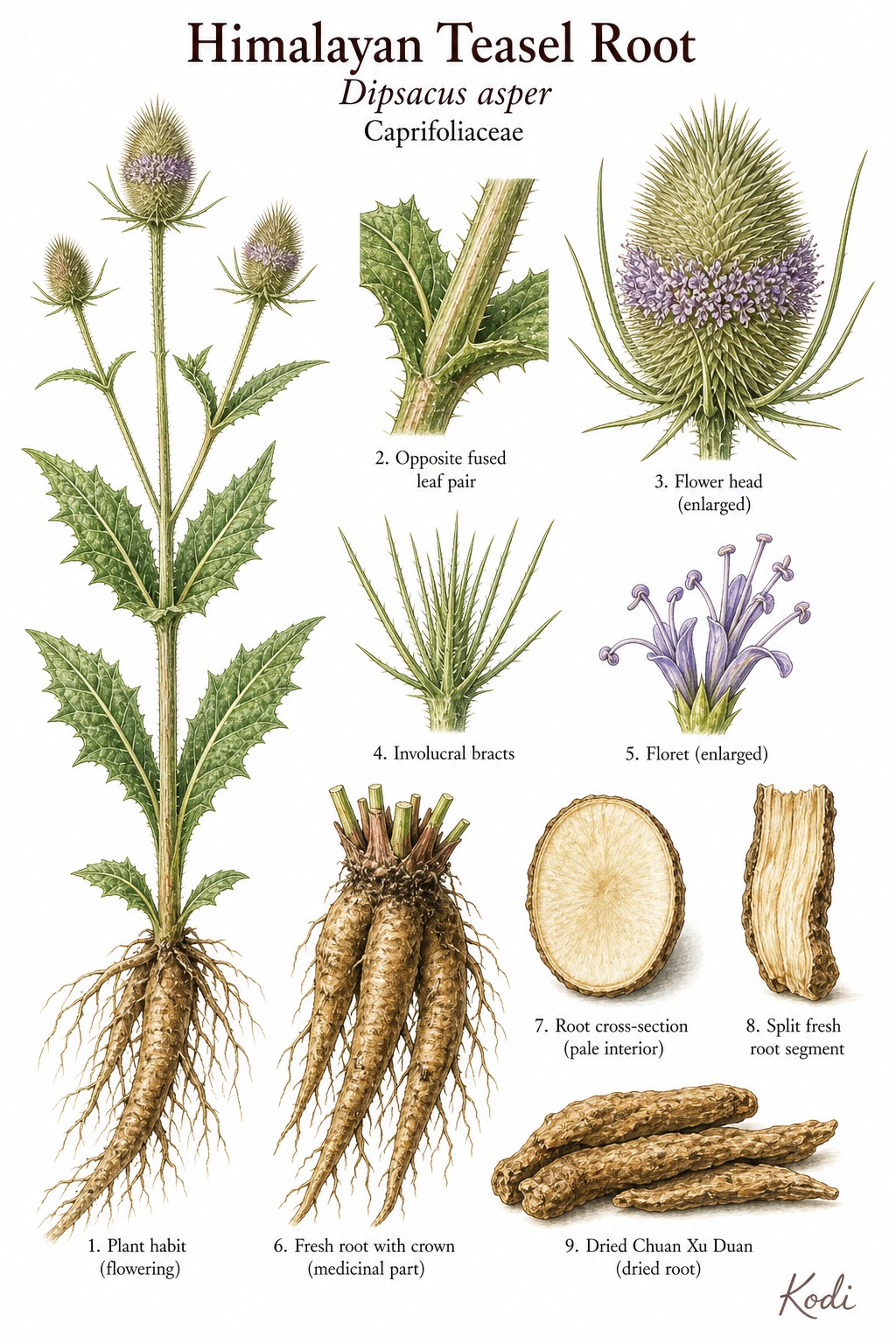
Known in TCM as Chuan Xu Duan (川续断), this bitter and sweet and acrid, slightly warm herb enters the Liver and Kidney. Traditionally, it tonifies the Liver and Kidney and strengthens sinews and bones - Chuan Xu Duan is classically used for low back pain, weak knees, frail tendons, and structural weakness rooted in deficiency, most often applied for low back pain, threatened miscarriage, and traumatic injury. Modern research has identified Asperosaponin among its active constituents.
Part used: Root
Also Known As
Latin: Radix Dipsaci | Pinyin: Chuan Xu Duan | Chinese: 川续断
TCM Properties
- Taste
- bitter, sweet, acrid
- Temperature
- slightly warm
- Channels
- Liver, Kidney
Traditional Use
Primary Actions
- Tonifies the Liver and Kidney and strengthens sinews and bones - Chuan Xu Duan is classically used for low back pain, weak knees, frail tendons, and structural weakness rooted in deficiency.
- Reconnects injury and supports repair - the herb is valued in traumatic injury, tendon damage, and fracture-recovery patterns where both movement and rebuilding are needed.
- Secures the Chong and Ren while stopping bleeding - traditional use includes threatened miscarriage, uterine bleeding, and restless fetus when deficiency and instability underlie the presentation.
Secondary Actions
- Chuan Xu Duan is best understood as the regional or daodi-facing name of standard Xu Duan rather than as a different medicinal species with different core actions.
- This sibling record keeps a slightly more source-root and orthopedic emphasis, leaving the next standard Xu Duan page to carry the broader everyday clinical naming layer.
Classic Formulas
- Shou Tai Wan - classic fetus-calming formula that pairs Xu Duan with Sang Ji Sheng, Tu Si Zi, and E Jiao for threatened miscarriage from deficiency.
- Xu Duan Tang or Xu Duan San lineages - classical trauma and bleeding-oriented formulas that preserve the herb's reconnecting reputation.
- Low-back and sinew-bone combinations with Du Zhong and Niu Xi - common traditional strategy for chronic lumbar weakness and structural instability.
Classical References
- Official Chinese references describe Xu Duan as bitter, sweet, acrid, and slightly warm, entering the Liver and Kidney to tonify, reconnect, and move the blood channels.
- The name itself carries the idea of reconnecting what is broken, which is why the herb sits naturally at the intersection of orthopedics, gynecology, and pregnancy support.
- Modern quick-reference material explicitly notes that Chuan Xu Duan is the same Dipsacus asper root as standard Xu Duan, just with regional naming emphasis.
Modern Research
Active Compounds
- Asperosaponin VI - the best-known marker compound in modern Dipsacus research
- Triterpenoid saponins such as akebia saponin D and related Dipsacus saponins - core bone- and repair-oriented constituents
- Iridoids and alkaloids - supportive phytochemical classes in pharmacognostic profiling
- Polysaccharides and sterol-related fractions - additional constituents relevant to broader tissue-support research
Studied Effects
- A 2024 study found that asperosaponin VI alleviated osteoblast ferroptosis and diabetic osteoporosis, reinforcing why Dipsacus asper remains a major modern bone-health research herb (PMID 39647633).
- A 2021 study reported that asperosaponin VI promoted osteogenic mineralization and suppressed osteoclastogenesis in combination work with BMP-2, matching the herb's classic bone-strengthening reputation (PMID 34901550).
- A 2018 rat and endothelial-cell study found that asperosaponin VI promoted angiogenesis and accelerated wound healing through HIF-1alpha/VEGF signaling, offering a modern correlate for the herb's repair-oriented trauma use (PMID 29219948).
PubMed References
- Asperosaponin VI inhibition of DNMT alleviates GPX4 suppression-mediated osteoblast ferroptosis and diabetic osteoporosis (2024)
- Synergy effects of Asperosaponin VI and bioactive factor BMP-2 on osteogenesis and anti-osteoclastogenesis (2021)
- Asperosaponin VI promotes angiogenesis and accelerates wound healing in rats via up-regulating HIF-1alpha/VEGF signaling (2018)
Safety & Interactions
Contraindications
- Wind-heat or damp-heat painful obstruction without an underlying deficiency pattern
Cautions
- Traditional use in threatened miscarriage does not make pregnancy bleeding or pain a self-treatment scenario; urgent obstetric causes still require evaluation.
- Most bone-healing and osteoporosis literature remains preclinical rather than decisive human trial evidence.
- Regional naming such as Chuan Xu Duan should not be confused with counterfeit or unrelated teasel-like roots in trade.
Conditions
- Low Back Pain Traditional ★★★★☆ JSON
- Threatened Miscarriage Traditional ★★★★☆ JSON
- Traumatic Injury Traditional ★★★☆☆ JSON
- Abnormal Uterine Bleeding Traditional ★★☆☆☆ JSON
- Osteoporosis Preclinical ★★☆☆☆ JSON
Frequently Asked Questions
What is Himalayan Teasel Root used for?
Himalayan Teasel Root is traditionally used to Tonifies the Liver and Kidney and strengthens sinews and bones - Chuan Xu Duan is classically used for low back pain, weak knees, frail tendons, and structural weakness rooted in deficiency., Reconnects injury and supports repair - the herb is valued in traumatic injury, tendon damage, and fracture-recovery patterns where both movement and rebuilding are needed., Secures the Chong and Ren while stopping bleeding - traditional use includes threatened miscarriage, uterine bleeding, and restless fetus when deficiency and instability underlie the presentation.. Research has investigated its effects on: A 2024 study found that asperosaponin VI alleviated osteoblast ferroptosis and diabetic osteoporosis, reinforcing why Dipsacus asper remains a major modern bone-health research herb (PMID 39647633).; A 2021 study reported that asperosaponin VI promoted osteogenic mineralization and suppressed osteoclastogenesis in combination work with BMP-2, matching the herb's classic bone-strengthening reputation (PMID 34901550)..
What are other names for Himalayan Teasel Root?
Himalayan Teasel Root is also known as Dipsaci, Sichuan Teasel Root. In TCM: 川续断 (Chuan Xu Duan); Radix Dipsaci.
Is Himalayan Teasel Root safe during pregnancy?
The safety of Himalayan Teasel Root during pregnancy has not been established. Consult a qualified healthcare provider before use.
What are the contraindications for Himalayan Teasel Root?
Himalayan Teasel Root should not be used in: Wind-heat or damp-heat painful obstruction without an underlying deficiency pattern. Consult a qualified practitioner before use.