Himalayan Teasel Root
- Chinese
- 续断
- Pinyin
- Xu Duan
- Latin
- Radix Dipsaci
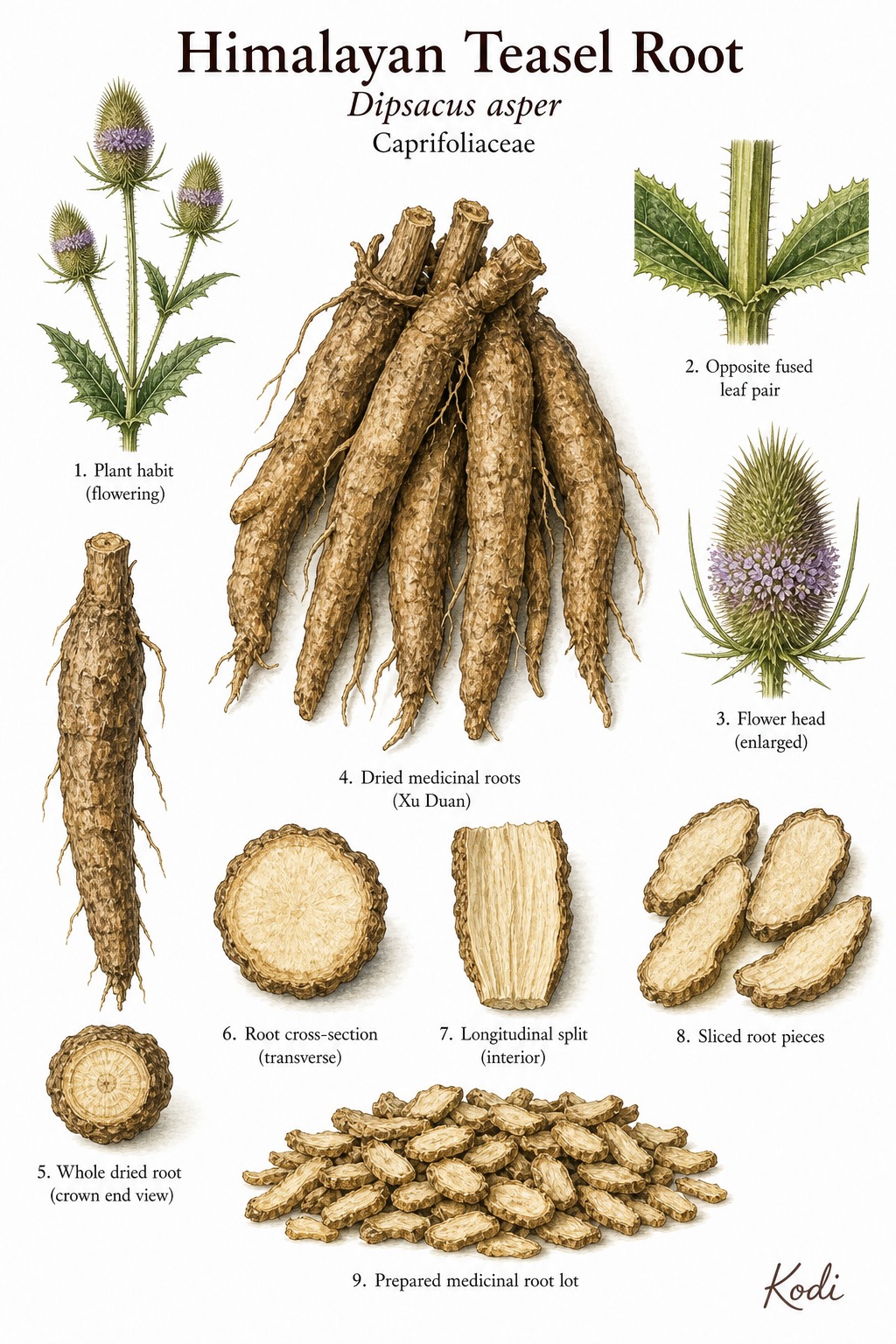
Known in TCM as Xu Duan (续断), this bitter and sweet and acrid, slightly warm herb enters the Liver and Kidney. Traditionally, it tonifies the Liver and Kidney and strengthens tendons and bones - Xu Duan is a foundational herb for lumbar soreness, weak knees, frail structure, and chronic deficiency affecting musculoskeletal stability, most often applied for low back pain, threatened miscarriage, and abnormal uterine bleeding. Modern research has identified Asperosaponin among its active constituents.
Part used: Root
Also Known As
Latin: Radix Dipsaci | Pinyin: Xu Duan | Chinese: 续断
TCM Properties
- Taste
- bitter, sweet, acrid
- Temperature
- slightly warm
- Channels
- Liver, Kidney
Traditional Use
Primary Actions
- Tonifies the Liver and Kidney and strengthens tendons and bones - Xu Duan is a foundational herb for lumbar soreness, weak knees, frail structure, and chronic deficiency affecting musculoskeletal stability.
- Calms the fetus and secures pregnancy - it is one of the better-known herbs for threatened miscarriage with sore back, weak lower burner support, or deficiency-related uterine instability.
- Activates the blood while helping repair what is damaged - traditional use includes traumatic injury, fracture, tendon damage, and pain after falls or overstrain.
Secondary Actions
- Xu Duan is the broad standard clinical name for this Dipsacus asper medicine, while the Chuan Xu Duan sibling preserves a more regional and source-forward naming layer.
- Its combination of tonifying, stabilizing, and gently moving actions is why it appears in both fertility-pregnancy formulas and orthopedic trauma formulas without feeling contradictory.
Classic Formulas
- Shou Tai Wan - classic use of Xu Duan with Sang Ji Sheng, Tu Si Zi, and E Jiao for threatened miscarriage from deficiency.
- Tai Shan Pan Shi San and related pregnancy-support formulas - examples of Xu Duan in formulas that stabilize and nourish while protecting the fetus.
- San Bi Tang and other sinew-bone formulas - broader use when chronic weakness, painful obstruction, and deficient structure overlap.
Classical References
- Official Chinese herb references describe Xu Duan as bitter, sweet, acrid, and slightly warm, entering the Liver and Kidney to tonify, reconnect sinews and bones, and move the blood network.
- Classical texts consistently emphasize back and knee weakness, miscarriage risk, uterine bleeding, traumatic injury, and fractures as its signature terrain.
- Compared with some stronger hot Kidney tonics, Xu Duan is valued because it supplements without being excessively harsh and also keeps a repair-oriented blood-moving dimension.
Modern Research
Active Compounds
- Asperosaponin VI - the principal quality-marker and the most studied pharmacologic constituent
- Dipsacus triterpenoid saponins - a broader saponin family relevant to osteogenesis and tissue repair
- Iridoids and alkaloids - supportive constituents in modern phytochemical work
- Polysaccharide and sterol-related fractions - additional components explored in complex extract studies
Studied Effects
- A 2022 study on recurrent spontaneous abortion pathways found that asperosaponin VI influenced decidual-cell signaling, offering a mechanistic bridge to Xu Duan's classic fetus-calming indication (PMID 35783512).
- A 2024 study showed asperosaponin VI alleviated osteoblast ferroptosis and diabetic osteoporosis, supporting continued modern bone-metabolism interest in Xu Duan (PMID 39647633).
- A 2023 experimental study of the Achyranthes bidentata-Dipsacus asper herb pair supported anti-osteoporotic mechanisms, reinforcing why Xu Duan remains central in bone-strengthening formula logic (PMID 37849727).
PubMed References
- Research on the Mechanism of Asperosaponin VI for Treating Recurrent Spontaneous Abortion by Bioinformatics Analysis and Experimental Validation (2022)
- Asperosaponin VI inhibition of DNMT alleviates GPX4 suppression-mediated osteoblast ferroptosis and diabetic osteoporosis (2024)
- Unraveling the potential mechanisms of the anti-osteoporotic effects of the Achyranthes bidentata-Dipsacus asper herb pair: a network pharmacology and experimental study (2023)
Safety & Interactions
Contraindications
- Wind-heat or damp-heat painful obstruction without deficiency
- Use only with professional guidance when pregnancy pain or vaginal bleeding could reflect an emergency condition
Cautions
- Xu Duan's traditional calming-fetus use should never delay obstetric assessment when miscarriage, bleeding, or severe pain is actively suspected.
- Most modern evidence for osteoporosis, fracture repair, and miscarriage mechanisms remains preclinical or early translational rather than based on large human outcome trials.
- The herb is commonly well tolerated in practice, but correct pattern use still matters because it is warming and repair-oriented rather than cooling or draining.
Conditions
- Low Back Pain Traditional ★★★★☆ JSON
- Threatened Miscarriage Traditional ★★★★☆ JSON
- Abnormal Uterine Bleeding Traditional ★★☆☆☆ JSON
- Joint Pain Traditional ★★☆☆☆ JSON
- Osteoporosis Preclinical ★★☆☆☆ JSON
Frequently Asked Questions
What is Himalayan Teasel Root used for?
Himalayan Teasel Root is traditionally used to Tonifies the Liver and Kidney and strengthens tendons and bones - Xu Duan is a foundational herb for lumbar soreness, weak knees, frail structure, and chronic deficiency affecting musculoskeletal stability., Calms the fetus and secures pregnancy - it is one of the better-known herbs for threatened miscarriage with sore back, weak lower burner support, or deficiency-related uterine instability., Activates the blood while helping repair what is damaged - traditional use includes traumatic injury, fracture, tendon damage, and pain after falls or overstrain.. Research has investigated its effects on: A 2022 study on recurrent spontaneous abortion pathways found that asperosaponin VI influenced decidual-cell signaling, offering a mechanistic bridge to Xu Duan's classic fetus-calming indication (PMID 35783512).; A 2024 study showed asperosaponin VI alleviated osteoblast ferroptosis and diabetic osteoporosis, supporting continued modern bone-metabolism interest in Xu Duan (PMID 39647633)..
What are other names for Himalayan Teasel Root?
Himalayan Teasel Root is also known as Dipsaci, Teasel Root. In TCM: 续断 (Xu Duan); Radix Dipsaci.
Is Himalayan Teasel Root safe during pregnancy?
The safety of Himalayan Teasel Root during pregnancy has not been established. Consult a qualified healthcare provider before use.
What are the contraindications for Himalayan Teasel Root?
Himalayan Teasel Root should not be used in: Wind-heat or damp-heat painful obstruction without deficiency; Use only with professional guidance when pregnancy pain or vaginal bleeding could reflect an emergency condition. Consult a qualified practitioner before use.