Honeycomb
- Chinese
- 露蜂房
- Pinyin
- Feng Fang
- Latin
- Nidus Vespae
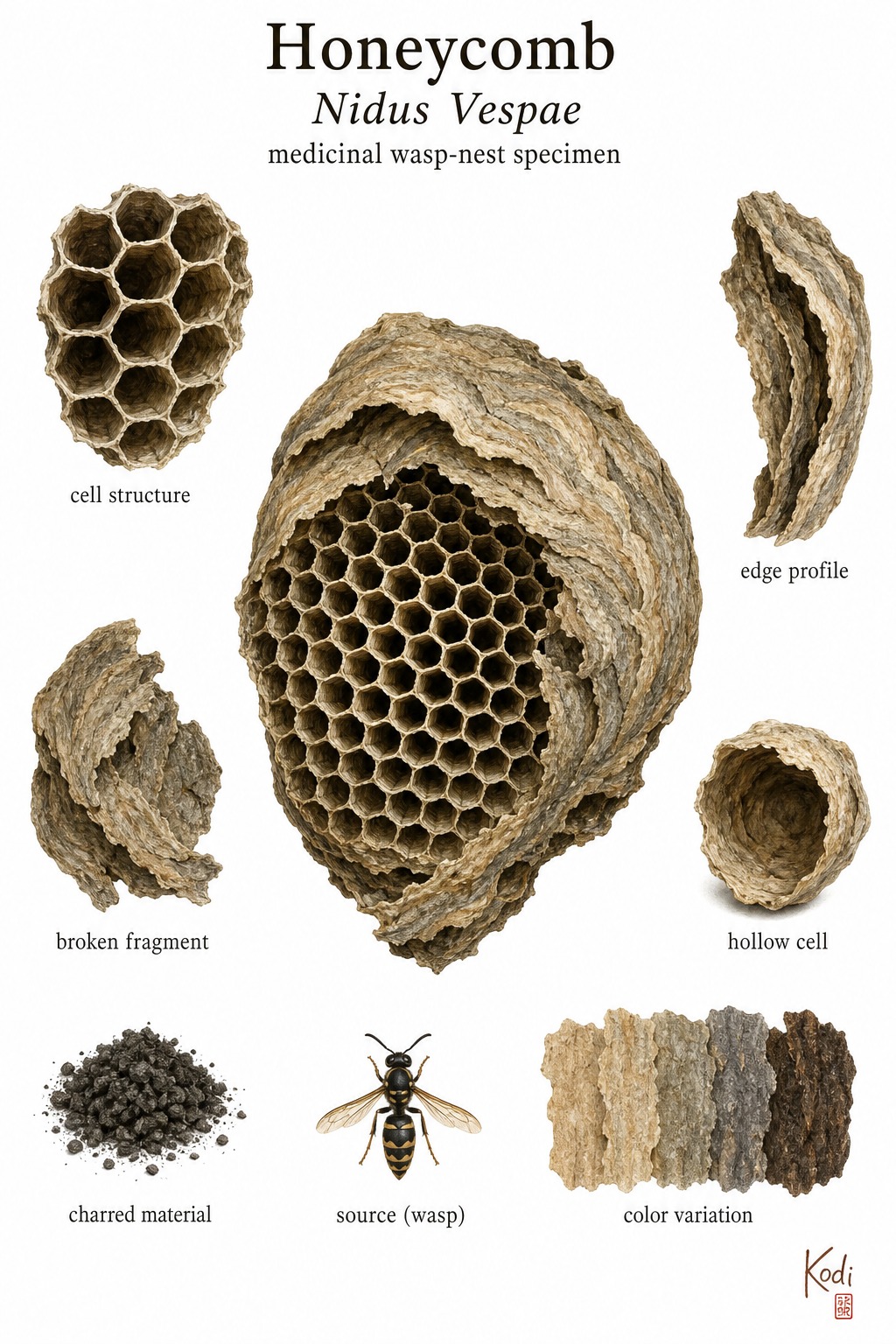
Known in TCM as Feng Fang (露蜂房), this sweet, neutral herb enters the Stomach. Traditionally, it attacks toxin and reduces swelling - Lu Feng Fang is used for sores, abscesses, breast swellings, lymphatic masses, and painful toxic nodules, most often applied for toothache, abscess, and breast abscess. Modern research has identified Diterpenoids among its active constituents.
Part used: Nest
Also Known As
Latin: Nidus Vespae | Pinyin: Feng Fang | Chinese: 露蜂房
TCM Properties
- Taste
- sweet
- Temperature
- neutral
- Channels
- Stomach
Traditional Use
Primary Actions
- Attacks toxin and reduces swelling - Lu Feng Fang is used for sores, abscesses, breast swellings, lymphatic masses, and painful toxic nodules.
- Dispels wind and relieves pain - traditional use extends to toothache, wind-damp joint pain, skin itching, and stubborn painful obstruction.
- Kills parasites and relieves itching - older applications include scabies-like itching, ringworm-type lesions, and ulcerative skin conditions.
Secondary Actions
- Despite the English label honeycomb, this TCM record refers to the medicinal wasp nest material rather than to edible comb or a bee-product food.
- The raw nest is commonly used externally or in carefully supervised internal doses, and later prepared forms such as Zhi Feng Fang should not be treated as identical in emphasis.
Classic Formulas
- Lu Feng Fang powders or ashes for toothache - classic local-use direction for severe dental pain and gum swelling.
- Breast-abscess and toxic-swelling formulas - traditional use when heat-toxin and hard painful swelling dominate.
- External washes or powders for eczema, scabies, or parasitic itching - a classic toxin-killing and itch-relieving route.
Classical References
- Traditional references describe Lu Feng Fang as a slightly toxic nest medicine that attacks toxin, kills parasites, dispels wind, and stops pain.
- Modern secondary references often standardize its medicinal profile as sweet and neutral entering the Stomach, though older literature also preserves some variation in flavor description.
- The core stable indications across sources are toothache, sores, itching, breast swelling, and painful toxic lesions.
Modern Research
Active Compounds
- Diterpenoids - newly characterized anti-inflammatory constituents from wasp-nest extracts
- Flavonoid-rich fractions - components investigated in antitumor and anti-inflammatory studies
- Wax, resin, and volatile admixtures - complex nest constituents relevant to traditional external use
- Proteinaceous fractions - part of the bioactive complexity but also a possible allergen burden
Studied Effects
- A 2026 phytochemical paper isolated anti-inflammatory diterpenoids from Nidus vespae and found activity against experimental macrophage inflammation, supporting continued preclinical interest in the nest's toxin-resolving profile (PMID 41791110).
- A 2013 screening study reported that total flavonoids from Nidus vespae inhibited osteosarcoma U2OS cells, illustrating one modern antitumor research direction that remains far from clinical proof (PMID 24311870).
- A 2022 Biology study found nest material from Vespa velutina inhibited adipose-tissue expansion in obese mice, highlighting how modern work is mechanistically interesting but still quite distant from classical routine use (PMID 36101393).
PubMed References
- Anti-inflammatory diterpenoids from the wasp nest (Nidus vespae) of Vespula vulgaris against MSU-induced inflammation in Raw264.7 cells (2026)
- A study on screening of osteosarcoma U2OS cell inhibiting active components from nidus vespae (2013)
- Nidus vespae Built by an Invasive Alien Hornet, Vespa velutina nigrithorax, Inhibits Adipose Tissue Expansion in High-Fat Diet-Induced Obese Mice (2022)
Safety & Interactions
Contraindications
- Known allergy or strong hypersensitivity to wasp, hornet, or related insect products
- Pregnancy without professional supervision
- Unsupervised internal use
Cautions
- Lu Feng Fang is not a benign edible comb product and should not be confused with food honeycomb or beeswax.
- Allergic reactions, contamination, and variable sourcing are practical concerns with raw nest materials.
- Most modern evidence remains preclinical and should not be mistaken for proof of cancer or obesity treatment.
Conditions
Frequently Asked Questions
What is Honeycomb used for?
Honeycomb is traditionally used to Attacks toxin and reduces swelling - Lu Feng Fang is used for sores, abscesses, breast swellings, lymphatic masses, and painful toxic nodules., Dispels wind and relieves pain - traditional use extends to toothache, wind-damp joint pain, skin itching, and stubborn painful obstruction., Kills parasites and relieves itching - older applications include scabies-like itching, ringworm-type lesions, and ulcerative skin conditions.. Research has investigated its effects on: A 2026 phytochemical paper isolated anti-inflammatory diterpenoids from Nidus vespae and found activity against experimental macrophage inflammation, supporting continued preclinical interest in the nest's toxin-resolving profile (PMID 41791110).; A 2013 screening study reported that total flavonoids from Nidus vespae inhibited osteosarcoma U2OS cells, illustrating one modern antitumor research direction that remains far from clinical proof (PMID 24311870)..
What are other names for Honeycomb?
Honeycomb is also known as Vespa, Lu Feng Fang, Wasp Nest. In TCM: 露蜂房 (Feng Fang); Nidus Vespae.
Is Honeycomb safe during pregnancy?
The safety of Honeycomb during pregnancy has not been established. Consult a qualified healthcare provider before use.
What are the contraindications for Honeycomb?
Honeycomb should not be used in: Known allergy or strong hypersensitivity to wasp, hornet, or related insect products; Pregnancy without professional supervision; Unsupervised internal use. Consult a qualified practitioner before use.