Honeysuckle Flower
- Chinese
- 金银花
- Pinyin
- Jin Yin Hua
- Latin
- Flos Lonicerae
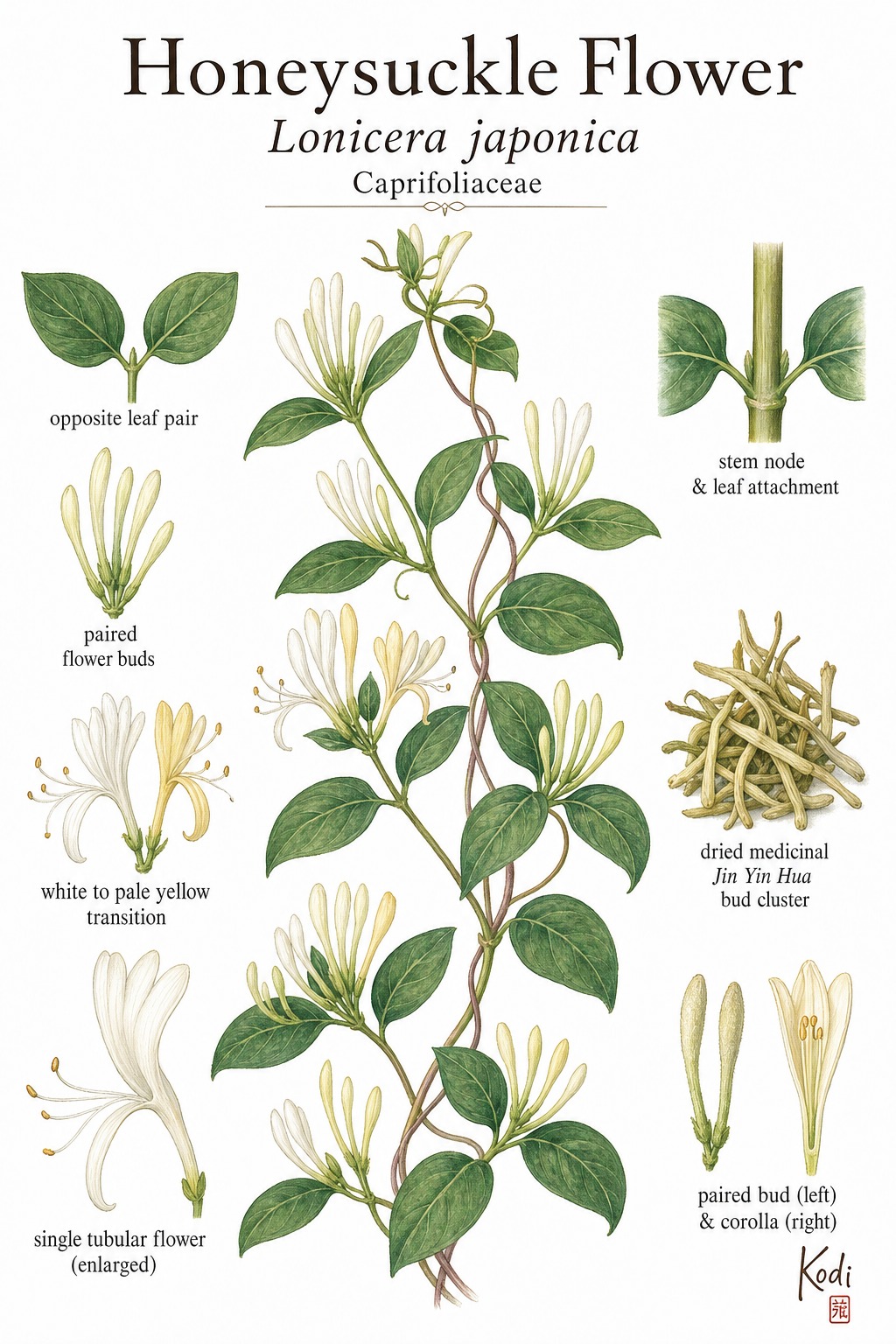
Known in TCM as Jin Yin Hua (金银花), this sweet, cold herb enters the Lung, Heart, and Stomach. Traditionally, it clears heat and resolves toxicity - Jin Yin Hua is one of the flagship herbs for carbuncles, furuncles, sore throat, febrile toxin, and inflamed suppurative lesions, most often applied for pharyngitis, upper respiratory infection, and furunculosis. Modern research has identified Chlorogenic among its active constituents.
Part used: Flower
Also Known As
Latin: Flos Lonicerae | Pinyin: Jin Yin Hua | Chinese: 金银花
TCM Properties
- Taste
- sweet
- Temperature
- cold
- Channels
- Lung, Heart, Stomach
Traditional Use
Primary Actions
- Clears heat and resolves toxicity - Jin Yin Hua is one of the flagship herbs for carbuncles, furuncles, sore throat, febrile toxin, and inflamed suppurative lesions.
- Disperses wind-heat - it is widely used for fever, sore throat, headache, and early warm-pathogen presentations when the exterior is still involved.
- Cools blood and relieves hot dysenteric patterns - traditional use extends to heat entering the blood level, toxic rashes, and hot intestinal disorders.
Secondary Actions
- Jin Yin Hua is the canonical standard name for the medicinal flower bud, while the next Shuang Hua sibling preserves a very common synonym and trade-label naming layer.
- Its combination of exterior-releasing and toxin-clearing actions explains why it sits comfortably in both early wind-heat formulas and deeper heat-toxin or abscess formulas.
Classic Formulas
- Yin Qiao San - the iconic wind-heat formula pairing Jin Yin Hua with Lian Qiao for sore throat, fever, and early febrile disease.
- Wu Wei Xiao Du Yin - classic toxin-clearing formula for boils, carbuncles, and suppurative lesions.
- Qing Ying Tang - classical use when heat enters the nutritive level and Jin Yin Hua helps vent and clear lingering toxic heat.
Classical References
- Official Chinese references describe Jin Yin Hua as sweet and cold, entering the Lung, Heart, and Stomach to clear heat, resolve toxin, and disperse wind-heat.
- Traditional herbology repeatedly highlights the flower's role in sore throat, toxic sores, warm disease, and fire-toxin skin lesions.
Modern Research
Active Compounds
- Chlorogenic acids - major phenolic markers strongly associated with anti-inflammatory and antioxidant research
- Flavonoids such as luteoloside and lonicerin - characteristic anti-inflammatory constituents
- Iridoids and secoiridoids - important classes in quality and pharmacology studies
- Polysaccharides - increasingly studied immune and functional-food fractions
Studied Effects
- A 2023 review summarized extraction, structural characteristics, and health-related activity of Lonicera japonica polysaccharides, reflecting the breadth of current modern research on Jin Yin Hua beyond simple folk use (PMID 37375383).
- A 2023 experimental study found Lonicera japonica showed antibacterial activity against Bacillus cereus through network pharmacology, metabolomics, and in vitro work, aligning with the herb's long-standing anti-infective reputation at a preclinical level (PMID 37223411).
- A 2012 wound model study reported anti-inflammatory and wound-repair effects of Lonicera japonica extract, offering another modern bridge to the toxin-clearing and sore-resolving tradition (PMID 23173654).
PubMed References
- Extraction, Purification, Structural Characteristics, Health Benefits, and Application of the Polysaccharides from Lonicera japonica Thunb.: A Review (2023)
- Lonicera japonica Thunb. as a promising antibacterial agent for Bacillus cereus ATCC14579 based on network pharmacology, metabolomics, and in vitro experiments (2023)
- Wound repair and anti-inflammatory potential of Lonicera japonica in excision wound-induced rats (2012)
Safety & Interactions
Contraindications
- Spleen-Stomach deficiency-cold with chronic loose stools
Cautions
- Jin Yin Hua is generally mild, but its cold nature can burden weak digestion if used heavily or long term without a clear heat pattern.
- Most modern evidence remains preclinical or review-level rather than direct proof for every infectious or inflammatory condition.
Conditions
- Pharyngitis Traditional ★★★★☆ JSON
- Upper Respiratory Infection Traditional ★★★★☆ JSON
- Furunculosis Traditional ★★★☆☆ JSON
- Breast Abscess Traditional ★★☆☆☆ JSON
Frequently Asked Questions
What is Honeysuckle Flower used for?
Honeysuckle Flower is traditionally used to Clears heat and resolves toxicity - Jin Yin Hua is one of the flagship herbs for carbuncles, furuncles, sore throat, febrile toxin, and inflamed suppurative lesions., Disperses wind-heat - it is widely used for fever, sore throat, headache, and early warm-pathogen presentations when the exterior is still involved., Cools blood and relieves hot dysenteric patterns - traditional use extends to heat entering the blood level, toxic rashes, and hot intestinal disorders.. Research has investigated its effects on: A 2023 review summarized extraction, structural characteristics, and health-related activity of Lonicera japonica polysaccharides, reflecting the breadth of current modern research on Jin Yin Hua beyond simple folk use (PMID 37375383).; A 2023 experimental study found Lonicera japonica showed antibacterial activity against Bacillus cereus through network pharmacology, metabolomics, and in vitro work, aligning with the herb's long-standing anti-infective reputation at a preclinical level (PMID 37223411)..
What are other names for Honeysuckle Flower?
Honeysuckle Flower is also known as Lonicera, Japanese Honeysuckle Flower. In TCM: 金银花 (Jin Yin Hua); Flos Lonicerae.
Is Honeysuckle Flower safe during pregnancy?
The safety of Honeysuckle Flower during pregnancy has not been established. Consult a qualified healthcare provider before use.
What are the contraindications for Honeysuckle Flower?
Honeysuckle Flower should not be used in: Spleen-Stomach deficiency-cold with chronic loose stools. Consult a qualified practitioner before use.